

Beam Splitters
A beam splitter is the elementary two-port mixer of quantum optics. At a fixed optical frequency and for declared spatial, temporal, and polarization modes, an ideal lossless beam splitter applies a unitary transformation to two annihilation operators. The same transformation redistributes classical field amplitudes, one-photon probability amplitudes, multiphoton creation operators, and Gaussian-state moments.
That common algebra does not make all interference effects identical. Single-photon interference combines alternatives for one excitation. Hong–Ou–Mandel interference combines two-photon alternatives. For independent inputs its contrast vanishes when the internal states are fully orthogonal; correlated inputs require the joint-state treatment below. A beam splitter can also reveal nonclassical input statistics, but it does not by itself create photons or provide a universal test of quantumness.
Three conventions must be stated before using a beam-splitter formula:
- which normalized input and output modes define the ports;
- whether the equation transforms operators or states;
- which phases have been assigned to reflection, transmission, and external propagation.
Different phase conventions are physically equivalent when used consistently. Mixing them is not.
Required background. Quantized Electromagnetic Modes defines the port operators, Photon Number States supplies normalized Fock states, and Tensor Products explains the two-mode state space. Interferometers combines the splitter with propagation phases and phase readout.
Ports Are Modes
Section titled “Ports Are Modes”Input and output operators
Section titled “Input and output operators”Let and annihilate photons in two orthogonal input modes, and let and describe two orthogonal output modes. Each mode must include all degrees of freedom needed to specify the field:
For discrete normalized modes,
and the same relations must hold for and . An optical bench label alone is not a complete mode definition. A detector may collect many spectral or spatial modes behind one geometric output port.
Write the linear input–output relation as
For a passive device, annihilation operators mix only with annihilation operators. A transformation that mixes with is an active Bogoliubov transformation and requires an energy source such as a pump.
The validity envelope
Section titled “The validity envelope”The two-mode description assumes that the device does not appreciably couple the selected ports to unmodeled radiation, absorption, polarization, or frequency channels. It is often an excellent approximation within a declared bandwidth. Outside that envelope, the coefficients can depend on frequency and polarization:
where labels polarization or another internal mode. A single pair of numbers and should not be used across a broadband pulse unless their variation is negligible over the occupied spectrum.
Bulk dielectric plates, cube beam splitters, fiber couplers, and integrated directional couplers can all realize two-mode mixing. Their electromagnetic boundary conditions differ, but their ideal quantum description reduces to the same unitary mode transformation after the relevant ports and phases have been fixed.
Lossless Two-Mode Scattering
Section titled “Lossless Two-Mode Scattering”Unitarity from the commutators
Section titled “Unitarity from the commutators”If
then
Canonical output commutators therefore require
For equal numbers of finite input and output modes, is unitary. This is the quantum version of power conservation for a lossless passive network.
A convenient SU(2) convention
Section titled “A convenient SU(2) convention”Throughout this page, use
with
Define the intensity transmittance and reflectance by
This matrix has unit determinant. A general matrix differs only by an overall phase, which can be assigned to the output modes and does not change isolated counting probabilities.
After choosing port phases so that is real and nonnegative, a useful two-parameter form is
The balanced case has
The inverse operator relation is
That inverse matters when an input state is rewritten in the output Fock basis.
Number conservation
Section titled “Number conservation”The total photon number is
Using gives
An ideal passive beam splitter changes how occupation is distributed between ports but preserves total occupation exactly. Energy is conserved as well when the mixed modes have the same carrier frequency. Frequency-converting devices can still conserve the signal-mode photon number while exchanging energy with a classical pump. Such driven frequency conversion need not mix annihilation and creation operators.
The Quantum Unitary
Section titled “The Quantum Unitary”Generator
Section titled “Generator”The mode transformation can be generated by
The exponent is anti-Hermitian, so is unitary. Its Heisenberg action is
An effective interaction Hamiltonian producing this unitary for a duration is
This Hamiltonian is Hermitian. In a directional coupler, the propagation coordinate can play the role that time plays in the effective evolution.
Heisenberg operators versus Schrödinger states
Section titled “Heisenberg operators versus Schrödinger states”The equation
is a Heisenberg transformation. Schrödinger states transform as . Creation operators used to build the output state therefore transform with the inverse map:
In vector notation the creation operators above transform with , not . Consequently one-photon state coefficients transform with , just like coherent amplitudes: the coefficient of output is . Distinguish these coefficients from the column of creation operators to avoid inserting an unnecessary inverse or conjugation.
SU(2) structure
Section titled “SU(2) structure”Introduce the Schwinger operators
They obey angular-momentum commutators and commute with . The beam splitter is an SU(2) rotation generated by a direction in the – plane. In the fixed- sector,
Thus every -photon two-mode manifold carries the spin- representation of SU(2). This observation organizes multiphoton amplitudes and makes passive two-mode optics mathematically parallel to spin rotations.
Phase Conventions
Section titled “Phase Conventions”Port phases are coordinates
Section titled “Port phases are coordinates”The phase of each mode operator is conventional. If input and output modes are redefined by diagonal unitary matrices,
then the scattering matrix becomes
This transformation changes displayed signs and factors of but not a prediction expressed in the rephased states, operators, and propagation phases. An isolated port phase is not observable. Relative phase accumulated around a closed interferometric comparison is.
Two common balanced matrices
Section titled “Two common balanced matrices”A reciprocal symmetric convention is
It assigns a relative phase between reflected and transmitted amplitudes. A real Hadamard convention is
They describe the same ideal splitting operation up to input and output phase shifts. Neither is more quantum or more physical. The surrounding optical paths determine which convention is convenient.
For a symmetric reciprocal matrix
unitarity requires
When both amplitudes are nonzero, their relative phase is therefore . The familiar factor of is a consequence of losslessness, reciprocity, symmetry, and a particular choice of reference planes. It is not a universal rule for every displayed beam-splitter matrix.
State Transformations
Section titled “State Transformations”Vacuum
Section titled “Vacuum”The two-mode vacuum is invariant:
A passive unitary cannot create excitations from vacuum. This separates beam splitters from squeezers and parametric amplifiers.
Coherent inputs
Section titled “Coherent inputs”For coherent input amplitudes and , the output remains a product of coherent states:
The amplitudes obey the same matrix equation as classical complex fields. Ideal passive linear optics therefore does not entangle product coherent states. The detailed derivation, dark-port interference, and attenuation limit are developed in Coherent Light.
Number in one input
Section titled “Number in one input”For photons in port and vacuum in port ,
The output is
Consequently,
The port counts have a binomial distribution, but this does not mean that each photon carried a pre-existing independent path label. The state is a coherent superposition of occupation alternatives. Measurements diagonal in the output number basis reproduce the same binomial probabilities that an independent-trial story would predict for this particular input.
The moments are
with perfect number anticorrelation
Gaussian moments
Section titled “Gaussian moments”Passive linear optics also transforms Gaussian first and second moments. With the quadratures ordered as
a mode unitary induces the real matrix
It is both orthogonal and symplectic:
First moments and covariance matrices transform as
This is the phase-space form of passive mode mixing. Gaussian States and Wigner Functions develops the covariance formalism; Squeezed Light explains how a beam splitter can redistribute squeezing and generate mode entanglement from suitable nonclassical inputs.
Single-Photon Interference
Section titled “Single-Photon Interference”One occupied input
Section titled “One occupied input”For one photon in port ,
The click probabilities at ideal output detectors are
For the symmetric balanced convention and ,
This is a coherent path superposition. A single beam splitter followed immediately by separate number measurements does not produce a phase-dependent fringe: the output alternatives are orthogonal and are counted separately. A fringe appears when alternatives are recombined or when the input already contains coherent amplitudes in both ports.
Two input amplitudes
Section titled “Two input amplitudes”Consider a general state in the one-photon sector,
The output amplitudes obey
Therefore
The last term is the one-photon interference term. It exists because two indistinguishable alternatives reach the same final detector: enter through and transmit, or enter through and reflect. Changing a relative input phase can route all probability to one output of a balanced splitter.
Does the output contain entanglement?
Section titled “Does the output contain entanglement?”Relative to the output-mode tensor product, the state
is mode entangled. This statement is meaningful only after the subsystems have been declared as modes and . It is not entanglement between two photons, because the state contains one photon. Questions about locality, accessible operations, vacuum reference phases, and particle-versus-mode language are developed in Entanglement in Quantum Optics.
Hong–Ou–Mandel Interference
Section titled “Hong–Ou–Mandel Interference”Ideal two-photon input
Section titled “Ideal two-photon input”Place one photon in each input:
Using the Schrödinger creation-operator map gives
At a balanced splitter, , so the coincidence amplitude vanishes. In the symmetric convention,
The overall factor has no effect on any probability. Both photons leave the same output, with equal probabilities for the two ports.
Which amplitudes cancel?
Section titled “Which amplitudes cancel?”A coincidence can arise by two indistinguishable histories:
- both photons transmit;
- both photons reflect.
For a balanced lossless splitter, their amplitudes have equal magnitude and opposite phase. The labels “photon 1” and “photon 2” do not survive as physical particle identities. The detector sees one photon in each output, and the two assignments of identical bosons to that outcome must be added at the amplitude level.
The cancellation is a two-photon, fourth-order interference effect. It does not mean that photons attract, collide inside the optic, or choose the same port in advance.
Wave-packet overlap
Section titled “Wave-packet overlap”Let
and define similarly. Their internal-mode overlap is
Assume is constant across the occupied internal modes, both inputs contain exactly one photon, and detection integrates the complete packets without resolving the internal mode. The probability of one photon in each output is
At balance,
Thus
The ideal balanced-dip visibility, normalized to the distinguishable coincidence level, is
This equality assumes independent pure single photons, a balanced splitter, stable rates, and negligible background. With background, predict the raw coincidences using the detector response before inferring an overlap.
Delay scan
Section titled “Delay scan”Using temporal amplitudes , a delay corresponds to
and
A coincidence scan measures under the ideal assumptions above. Its width is set by the mutual temporal coherence of the photon wave packets, not directly by detector timing resolution when the coincidence window is broad enough to collect each pair.
Mixed and correlated photons
Section titled “Mixed and correlated photons”For independent single-photon internal states and , the balanced result generalizes to
The overlap combines mismatch and mixedness. If the photons are entangled with unobserved partners or other degrees of freedom, their reduced states may be mixed even when average spectra look identical. A Hong–Ou–Mandel dip is therefore a powerful overlap diagnostic, but its visibility is not by itself a complete state tomography.
The product-state assumption is essential. For a joint internal state with one photon in each input, the balanced, internal-mode-blind coincidence probability is
Here swaps internal states while the input ports label the tensor factors. For independent inputs, . Correlated inputs need not obey that formula: an antisymmetric internal state has swap eigenvalue and gives . This is consistent with bosonic exchange symmetry because the complete spatial-plus-internal state remains symmetric. Wang’s two-photon wavepacket analysis gives the continuous-spectrum version.
Indistinguishability explains the general identical-particle principle. Photon Number States explains why low multiphoton contamination, high purity, and high indistinguishability are separate source properties.
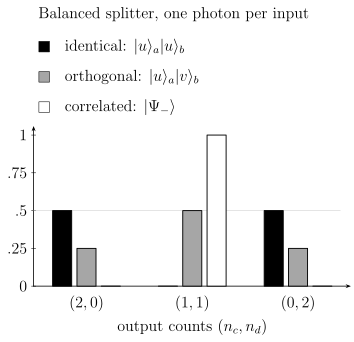
Each input port contains exactly one photon and the splitter treats both orthogonal internal modes equally. Identical product inputs bunch; orthogonal product inputs have ; the antisymmetric correlated internal state always leaves one photon in each port. The bars are ideal total-occupation probabilities, with all internal modes accepted. Exchange symmetry of the joint state determines the result.
Nonideal Beam Splitters
Section titled “Nonideal Beam Splitters”Imbalance
Section titled “Imbalance”Even with perfectly identical photons,
An unbalanced device cannot produce a zero coincidence probability. For fully distinguishable photons,
The correct reference level must therefore use the measured and rather than assume one half.
Loss requires environmental modes
Section titled “Loss requires environmental modes”A two-by-two matrix for the accessible ports of a lossy component is subunitary. If one wrote only
with a strict deficit in at least one direction, then at least one output commutator would be too small. Quantum mechanics restores them by adding environmental operators:
with
The full transformation on system plus environment is unitary. Tracing over the inaccessible outputs produces a quantum channel. Loss before the splitter changes the input state; loss after it changes detection probabilities; unequal loss in the two arms can also reveal path information. These cases should not be folded into one unexplained efficiency number.
Spectral and polarization dependence
Section titled “Spectral and polarization dependence”For wave packets, use
Frequency-dependent splitting ratios and phases reshape the packets and can reduce interference even when the incident modes were identical. The same warning applies to polarization-dependent coatings and birefringent couplers. A scalar overlap measured before the device is insufficient if the device transforms the two inputs differently.
Detector and source effects
Section titled “Detector and source effects”Raw coincidence contrast can be reduced by:
- multiphoton emission or more than one pair in a gate;
- uncorrelated background and detector dark counts;
- detector dead time, afterpulsing, saturation, or cross-talk;
- a coincidence window that excludes part of the wave packet or admits excess accidentals;
- timing drift and unstable input flux;
- collection efficiencies that depend on internal mode or scan delay;
- unresolved spectral, temporal, spatial, or polarization mismatch.
Constant output efficiencies , independent of internal mode and delay, merely multiply the two-detector coincidence probability by in this exact-two-photon, background-free model. Even unequal efficiencies then cancel from the normalized visibility. Filtering which changes the accepted internal states is a different effect.
Threshold detectors are sufficient to observe a low-brightness Hong–Ou–Mandel dip, but the inference from clicks to an input overlap still requires a source and detector model. Reporting only a fitted visibility without its reference level, uncertainty, and background policy is incomplete.
What Beam Splitters Enable
Section titled “What Beam Splitters Enable”Attenuation and channels
Section titled “Attenuation and channels”Mixing a signal with vacuum and discarding one output realizes the dilation of a pure-loss channel:
This model underlies propagation loss and detector inefficiency. The environmental output carries the information lost from the accessible signal.
Homodyne and displacement operations
Section titled “Homodyne and displacement operations”A balanced beam splitter combines a signal with a strong local oscillator. Subtracting the two output photocurrents isolates a phase-selected field quadrature. Homodyne Detection develops conditional photocurrent records; the optical receiver is treated in Homodyne and Heterodyne Detection.
Mixing with a strong coherent auxiliary on a highly transmissive splitter approximates a displacement. Phase-Space Distributions explains how displacement followed by parity or counting samples optical quasidistributions.
Interferometers and networks
Section titled “Interferometers and networks”Beam splitters and phase shifters form arbitrary finite passive unitary networks. An -mode unitary can be decomposed into a sequence of two-mode rotations and port phases. This is the foundation of multiport interferometers, linear-optical state preparation, boson sampling, and many photonic quantum-information protocols.
The existence of a unitary network does not imply deterministic interaction between photons. Passive linear optics acts linearly on modes; effective nonlinear gates generally need ancillary states, measurement, feedforward, postselection, or matter-mediated interactions.
Exercises
Section titled “Exercises”1. Commutators force unitarity
Section titled “1. Commutators force unitarity”Let
Derive the conditions on required for and to be canonical independent bosonic modes. Show that the coefficient matrix is unitary.
Solution
The diagonal commutators give
Independence requires
The remaining annihilation–annihilation commutators vanish automatically. If
these three equations state that its two rows are orthonormal:
Because is square, it follows that as well. Thus is unitary. Choosing and gives the SU(2) convention used on this page.
2. Derive the mode rotation
Section titled “2. Derive the mode rotation”Starting from
derive and by differential equations in .
Solution
Define
Let the anti-Hermitian generator be
Differentiating gives
and
Therefore . With and ,
Similarly,
The rotation preserves both canonical commutators and total photon number.
3. Rephase a balanced convention
Section titled “3. Rephase a balanced convention”Show explicitly that the symmetric matrix
can be converted into the Hadamard matrix
using only diagonal input and output phase matrices.
Solution
Choose
Then
Direct multiplication gives
The two displayed matrices therefore differ only by port-coordinate phases. Any surrounding propagation and state phases must be rephased at the same time.
4. Binomial splitting of a number state
Section titled “4. Binomial splitting of a number state”For input , derive the output number distribution and compute the mean, variance, and covariance of the two output counts.
Solution
The transformed state is
The binomial theorem and normalized Fock states give
Hence
The moments of a binomial variable are
Because in every outcome,
and
The negative covariance expresses exact conservation of the total input number.
5. Deterministic single-photon routing
Section titled “5. Deterministic single-photon routing”Use the symmetric balanced convention
Find the relative phase in
that sends the photon entirely to output , and the phase that sends it entirely to output .
Solution
The output amplitudes are
To make output dark, require
so and
Then . To make output dark, require
so and
Then , whose phase is irrelevant to the unit detection probability. The routing is interference between the two input alternatives, not a change in the splitter’s or .
6. Hong–Ou–Mandel interference away from balance
Section titled “6. Hong–Ou–Mandel interference away from balance”For one identical photon in each input, derive the coincidence probability for arbitrary and . Compare it with the distinguishable value and find the visibility
Solution
The coefficient of in the identical-photon output state is . Therefore
For distinguishable photons, the alternatives “both transmit” and “both reflect” add as probabilities:
Their difference is
Thus
It reaches one only at . A nonzero minimum at zero delay can be caused by splitter imbalance even for perfectly overlapping photons.
7. Gaussian Hong–Ou–Mandel dip
Section titled “7. Gaussian Hong–Ou–Mandel dip”Two photons have identical Gaussian spectral intensity
The Gaussian is a narrow-band approximation with , so detunings may be integrated over the real line. One photon is delayed by . Find the ideal balanced coincidence probability.
Solution
The overlap is the Fourier transform of the spectral intensity:
The Gaussian transform gives
Therefore
For a balanced splitter,
The carrier phase cancels from the probability. The dip reaches zero at and approaches for delays much longer than .
8. Why a lossy map needs noise
Section titled “8. Why a lossy map needs noise”Suppose an attenuator is written incorrectly as
Show what goes wrong. Add the minimum vacuum environment needed to repair the commutator, and derive the reduced output of an input one-photon state.
Solution
The incomplete map gives
Introduce an independent environment mode :
Then
With the environment initially in vacuum, a unitary dilation maps
where depends on convention. Tracing over the environment removes the coherence between orthogonal environment states:
Loss is therefore not a noncanonical rescaling of an isolated operator. It is unitary mode mixing followed by loss of access to an environmental output.
9. A coincidence peak from correlated internal states
Section titled “9. A coincidence peak from correlated internal states”Let be orthogonal polarizations. Compare the balanced-splitter coincidence probabilities of , , and . Does the last result follow from multiplying its reduced density matrices?
Solution
The swap expectations are , respectively, giving coincidences . For , both reduced states equal ; incorrectly replacing the joint state by their product would give and predict . Identical single-photon marginals do not determine two-photon interference when the inputs are correlated. A number-resolving measurement gives the full distributions plotted above; ordinary two-channel threshold detection can still measure the coincidence component.
References
Section titled “References”- S. M. Barnett and P. M. Radmore, Methods in Theoretical Quantum Optics (Oxford University Press, 2002), Chapter 2, doi:10.1093/acprof:oso/9780198563617.001.0001.
- F. Bouchard, A. Sit, Y. Zhang, R. Fickler, F. M. Miatto, Y. Yao, F. Sciarrino, and E. Karimi, “Two-Photon Interference: The Hong–Ou–Mandel Effect,” Reports on Progress in Physics 84, 012402 (2021), doi:10.1088/1361-6633/abcd7a; arXiv:2006.09335.
- R. A. Campos, B. E. A. Saleh, and M. C. Teich, “Quantum-Mechanical Lossless Beam Splitter: SU(2) Symmetry and Photon Statistics,” Physical Review A 40, 1371–1384 (1989), doi:10.1103/PhysRevA.40.1371.
- C. C. Gerry and P. L. Knight, Introductory Quantum Optics (Cambridge University Press, 2005), Chapters 4 and 6, doi:10.1017/CBO9780511791239.
- C. K. Hong, Z. Y. Ou, and L. Mandel, “Measurement of Subpicosecond Time Intervals between Two Photons by Interference,” Physical Review Letters 59, 2044–2046 (1987), doi:10.1103/PhysRevLett.59.2044.
- P. Kok, W. J. Munro, K. Nemoto, T. C. Ralph, J. P. Dowling, and G. J. Milburn, “Linear Optical Quantum Computing with Photonic Qubits,” Reviews of Modern Physics 79, 135–174 (2007), doi:10.1103/RevModPhys.79.135.
- U. Leonhardt, “Quantum Physics of Simple Optical Instruments,” Reports on Progress in Physics 66, 1207–1249 (2003), doi:10.1088/0034-4885/66/7/203; arXiv:quant-ph/0305007.
- R. Loudon, The Quantum Theory of Light, 3rd ed. (Oxford University Press, 2000), Chapters 6 and 9.
- L. Mandel and E. Wolf, Optical Coherence and Quantum Optics (Cambridge University Press, 1995), Chapters 12 and 22, doi:10.1017/CBO9781139644105.
- M. Reck, A. Zeilinger, H. J. Bernstein, and P. Bertani, “Experimental Realization of Any Discrete Unitary Operator,” Physical Review Letters 73, 58–61 (1994), doi:10.1103/PhysRevLett.73.58.
- D. F. Walls and G. J. Milburn, Quantum Optics, 2nd ed. (Springer, 2008), Chapters 2 and 5, doi:10.1007/978-3-540-28574-8.
- K. Wang, “Quantum Theory of Two-Photon Wavepacket Interference in a Beam Splitter,” arXiv:quant-ph/0311011 (2003).
- A. Zeilinger, “General Properties of Lossless Beam Splitters in Interferometry,” American Journal of Physics 49, 882–883 (1981), doi:10.1119/1.12387.