

Gaussian States and Wigner Functions
Gaussian states are the tractable core of phase-space quantum mechanics. Their Wigner functions are Gaussian functions on phase space, so the state is controlled by its first moments and covariance matrix. This makes Gaussian states the natural bridge between wave packets, harmonic-oscillator ground states, coherent states, squeezed states, semiclassical dynamics, and continuous-variable quantum information.
The Wigner Function page defines the transform. This page specializes to the Gaussian sector and explains why it is closed under quadratic Hamiltonian evolution.
Continuous-Variable Quantum Computation applies these moments to Gaussian gates and non-Gaussian resources. Continuous-Variable Platforms describes optical and microwave implementations.
Phase-Space Variables and Moments
Section titled “Phase-Space Variables and Moments”For one degree of freedom, collect canonical variables into the phase-space vector
The first moment is
The covariance matrix is
Explicitly,
where
The covariance matrix records widths and phase-space tilt. For a Gaussian Wigner function, no higher moments are independent data.
Gaussian Wigner Functions
Section titled “Gaussian Wigner Functions”With the Wigner normalization used in this volume,
a one-mode Gaussian Wigner function is
For a diagonal covariance matrix this becomes
where and .
This formula looks like an ordinary classical Gaussian probability density. It is still a Wigner function: it represents a quantum density operator only when its covariance matrix satisfies the uncertainty constraint.
Uncertainty Constraint
Section titled “Uncertainty Constraint”Let
be the symplectic matrix. A physical one-mode Gaussian covariance matrix satisfies
For a real symmetric positive-definite covariance matrix , this is equivalent in one degree of freedom to
In components,
Pure one-mode Gaussian states saturate this inequality:
The purity is , obtained from . Mixed Gaussian states therefore have larger covariance determinant. Thus a broad positive Gaussian on phase space is not automatically a pure minimum-uncertainty state.
A Positive Gaussian That Is Not a Quantum State
Section titled “A Positive Gaussian That Is Not a Quantum State”The constraint can be tested through a measurement probability, not just a determinant. Choose an oscillator scale and define dimensionless coordinates and , so and . The normalized density in these coordinates is .
Consider the candidate
It is positive, integrates to one, and has positive Gaussian position and momentum marginals for every . Its covariance is , so quantum uncertainty requires .
To see what fails below this bound, pair it with the Wigner function of the oscillator’s first excited state, , where . The Weyl overlap identity gives the candidate probability of finding one excitation:
For , this gives . The inverse Weyl transform is therefore not a positive density operator: a projector cannot have negative expectation in a physical state. Normalization, reality, and positive marginals alone miss this failure. By contrast, describes a thermal oscillator with mean occupation ; the boundary is the vacuum (Weedbrook et al., 2012, §§II.A–B, with quadratures rescaled to ).
The determinant test is sufficient for a Gaussian candidate. For a general non-Gaussian function it is only necessary: second moments do not test positivity of the full inverse transform. The Gaussian states preview develops the corresponding multimode covariance and entanglement tests.
Gaussian Wave Packets
Section titled “Gaussian Wave Packets”A minimum-uncertainty wave packet with no correlation has
Its Wigner function is
This is the phase-space version of the Gaussian wave packets developed in Gaussian Wave Packets. The center gives the classical-looking location of the packet, while the covariance matrix gives its quantum spread.
If , the Gaussian ellipse is tilted in phase space. Such correlations appear naturally during free evolution: a wave packet spreads because position becomes correlated with momentum.
Harmonic-Oscillator Ground State
Section titled “Harmonic-Oscillator Ground State”For the harmonic oscillator
the ground state has covariance matrix
The Wigner function is
Its covariance determinant is
so it is a pure minimum-uncertainty Gaussian. Its phase-space ellipse is aligned with the oscillator energy contours after the natural scaling of and .
Coherent States
Section titled “Coherent States”A coherent state is a displaced oscillator ground state. In Wigner phase space, displacement changes the first moment but not the covariance:
Therefore
Under harmonic-oscillator evolution, the center follows the classical orbit and the covariance returns to itself. This is the phase-space reason coherent states are classical-like oscillator states. The Hilbert-space construction is given in Coherent States; this page records the Wigner-function viewpoint.
Squeezed States Preview
Section titled “Squeezed States Preview”A pure squeezed state changes the covariance while preserving its determinant. The product of the separate position and momentum widths need not stay minimal when their covariance is nonzero. In a simple oscillator-aligned convention,
with . The determinant remains
For , the Wigner ellipse is stretched in and squeezed in . For , the roles reverse. More general squeezed states also rotate the ellipse, producing nonzero .
Squeezing does not violate the uncertainty principle. It redistributes uncertainty between conjugate quadratures while keeping the symplectic area bounded below by .
Evolution Under Quadratic Hamiltonians
Section titled “Evolution Under Quadratic Hamiltonians”Gaussian states remain Gaussian under Hamiltonians that are at most quadratic in and . The reason is that Wigner evolution is exactly classical for quadratic Hamiltonians: higher Moyal corrections vanish.
With no linear driving term, let the classical phase-space flow be linear,
where is symplectic:
Then a Gaussian evolves by
A linear force adds an affine displacement to the flow: , while the covariance formula is unchanged.
For a free particle,
The covariance evolves as
This is wave-packet spreading in covariance-matrix language. The Wigner function shears in phase space rather than diffusing like a classical noisy distribution.
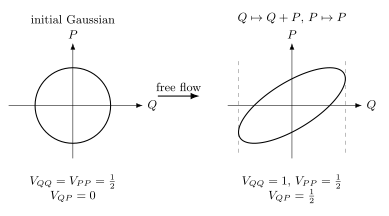
Free propagation in dimensionless canonical coordinates sends to over the illustrated interval. The contour tilts and extends farther along . Its covariance determinant remains , so a pure Gaussian stays pure even as its position distribution spreads.
Why Gaussian States Are Special
Section titled “Why Gaussian States Are Special”Gaussian Wigner functions are special for three reasons:
- They are determined entirely by first and second moments.
- They remain Gaussian under quadratic Hamiltonians and linear canonical transformations.
- Their Wigner functions are nonnegative, so many calculations resemble classical Gaussian probability theory while still obeying quantum uncertainty.
The last point must be handled carefully. Positivity of a Wigner function is not the same as classicality in every operational sense, and mixed non-Gaussian states can also have nonnegative Wigner functions. Gaussian states are tractable because the phase-space calculus closes, not because quantum mechanics has disappeared.
Common Mistakes
Section titled “Common Mistakes”- Treating a positive Gaussian Wigner function as proof that the state is classical in all respects.
- Forgetting the covariance constraint .
- Confusing displacement, which changes first moments, with squeezing, which changes covariance.
- Assuming all positive Wigner functions are Gaussian.
- Applying quadratic-flow covariance formulas to anharmonic Hamiltonians without including Moyal corrections.
- Forgetting that mixed Gaussian states need not saturate the uncertainty bound.
References
Section titled “References”- M. Hillery, R. F. O’Connell, M. O. Scully, and E. P. Wigner, “Distribution functions in physics: Fundamentals,” Physics Reports 106, 121-167, 1984.
- W. P. Schleich, Quantum Optics in Phase Space, Wiley-VCH, 2001.
- A. Serafini, Quantum Continuous Variables: A Primer of Theoretical Methods, CRC Press, 2017.
- C. Weedbrook, S. Pirandola, R. García-Patrón, N. J. Cerf, T. C. Ralph, J. H. Shapiro, and S. Lloyd, “Gaussian quantum information,” Reviews of Modern Physics 84, 621–669 (2012), doi:10.1103/RevModPhys.84.621, arXiv:1110.3234.
- E. Wigner, “On the Quantum Correction For Thermodynamic Equilibrium,” Physical Review 40, 749-759, 1932.
- C. K. Zachos, D. B. Fairlie, and T. L. Curtright, eds., Quantum Mechanics in Phase Space, World Scientific, 2005.
Exercises
Section titled “Exercises”- Normalize the one-mode Gaussian Wigner function. For the candidate above, also evaluate and its overlap with the vacuum . What goes wrong at ?
Solution
For positive definite ,
Therefore
Radial Gaussian integration also gives
At these are and . Neither can be interpreted as the purity or vacuum probability of a density operator, because both would exceed one. The integrals are well defined; the invalid step is treating their inverse Weyl transform as a positive quantum state.
- Check the uncertainty determinant for the harmonic-oscillator ground state.
Solution
For the ground state,
Thus
The pure Gaussian saturates the one-mode uncertainty bound.
- Show that squeezing preserves the covariance determinant in the aligned convention.
Solution
With
and , the determinant is
Squeezing changes the ellipse shape while preserving its symplectic area for a pure Gaussian.
- Derive the free-particle covariance shear.
Solution
For a free particle,
Then
and
Finally, because is constant.