

Tight-Binding Chain
The tight-binding chain is a quadratic one-dimensional lattice model in which coherent nearest-neighbor hopping turns one localized orbital per site into an exactly calculable cosine band.
Open chains have standing waves, while periodic rings have a discrete set of traveling waves. The same one-particle energies also solve the noninteracting many-particle problem, but the allowed occupations depend on statistics and particle number.
Helpful background. Tight-Binding Model derives the localized-orbital approximation; Occupation-Number Representation explains how bosons and fermions occupy its modes.
Nearest-Neighbor Hopping and the Localized Basis
Section titled “Nearest-Neighbor Hopping and the Localized Basis”The reference chain has these physical choices.
| Field | Baseline choice |
|---|---|
| sites | sites at , with |
| retained basis | one orthonormal localized orbital per site |
| one-particle space | |
| Fock-space lift | one spinless bosonic or fermionic mode per site, stated explicitly |
| onsite energy | uniform real |
| hopping | real nearest-neighbor amplitude in the convention |
| interactions | none |
| internal flavor | none |
| boundaries | open, periodic, or twisted, always stated |
| energy scale | |
| lattice spacing | |
| thermodynamic reference | periodic rings followed by at fixed |
The one-particle problem does not require particle statistics. Statistics enter only when the same one-body matrix is lifted to a many-particle Fock space. Likewise, a band dispersion alone does not specify a many-body ground state: particle number or chemical potential, statistics, temperature, and any omitted internal degeneracy must also be supplied.
The baseline assumes an orthonormal retained basis. A nonorthogonal orbital set instead leads to a generalized eigenvalue problem and is not silently identified with this model.
Degrees of Freedom and Hilbert Spaces
Section titled “Degrees of Freedom and Hilbert Spaces”One-particle formulation
Section titled “One-particle formulation”The localized basis obeys
A one-particle state is
The site amplitudes are basis coefficients, not classical probabilities moving by random jumps. Their coherent phases determine interference, current, and band formation.
Fock-space formulation
Section titled “Fock-space formulation”Introduce annihilation and creation operators and . For fermions,
whereas bosons obey
In either case,
For spinless fermions, and the fixed- sector has dimension
For one bosonic species, and
The Fock-space Hamiltonian is many-particle in its domain but remains noninteracting because it is quadratic and number conserving.
Hamiltonian and Conventions
Section titled “Hamiltonian and Conventions”Open chain
Section titled “Open chain”For open boundaries, the one-particle operator is
There are undirected bonds. The corresponding Fock-space operator is
Periodic chain
Section titled “Periodic chain”For a ring, site labels are understood modulo :
The Hamiltonian is
An ordinary simple ring has distinct bonds for . At , the modular shorthand visits the same undirected pair twice. The two-site limit here therefore means one explicitly listed bond, as in the Tight-Binding Dimer.
Bond-list form
Section titled “Bond-list form”For either boundary condition, let be the set of distinct undirected bonds. Then
This form makes bond counting explicit and is the preferred starting point for finite numerics. If a directed sum already contains both orientations, adding a separate Hermitian-conjugate term would double the hopping.
Energy zero and hopping sign
Section titled “Energy zero and hopping sign”In a fixed- sector, the onsite term contributes the constant
It shifts every energy in that sector without changing eigenvectors or gaps. Across sectors, however, it changes particle-addition energies and cannot be dropped without also stating how the chemical potential is transformed.
On an open bipartite chain, the basis rephasing
maps . The same transformation works on an even ring. It fails to flip every bond on an odd ring because the loop phase is invariant under local basis rephasings. Thus the baseline is harmless for an open chain or even ring, but hopping signs around general loops carry physical information.
Symmetries and Conserved Quantities
Section titled “Symmetries and Conserved Quantities”Number conservation
Section titled “Number conservation”The quadratic lift has a global symmetry,
and
Fixed-particle-number sectors are therefore exact invariant subspaces.
Translation
Section titled “Translation”On a uniform periodic ring, one-site translation acts as
and satisfies
With the Fourier convention below, a one-particle mode with amplitudes has translation eigenvalue . The distinct phases label the crystal-momentum sectors. Open boundaries remove this exact symmetry even though the bulk couplings remain uniform.
Inversion and spinless time reversal
Section titled “Inversion and spinless time reversal”For a reflection-symmetric chain, inversion sends to its reflected site and commutes with . With real onsite energies and hoppings, complex conjugation in the site basis gives the spinless time-reversal relation
For a ring carrying a generic twist, time reversal and reflection both reverse the loop phase:
They are symmetries at twists equivalent to or modulo , possibly combined with a gauge transformation depending on where the bond phases are placed. Spectra at and are related even at generic twist.
Sublattice spectral symmetry
Section titled “Sublattice spectral symmetry”An open chain and an even ring are bipartite. Define the one-particle sublattice operator
After subtracting the uniform onsite energy,
nearest-neighbor hopping obeys
Consequently, every one-particle eigenvalue is paired with . This is a one-particle chiral or sublattice spectral symmetry. It should not be promoted automatically to a many-body particle–hole statement without specifying statistics, filling, constants, and the transformation of the Fock operators.
Normal Modes and Free Many-Particle Energies
Section titled “Normal Modes and Free Many-Particle Energies”Finite one-particle problem
Section titled “Finite one-particle problem”For any declared finite graph, the tight-binding problem is exactly the spectral problem of an Hermitian matrix:
A unitary eigenvector matrix gives
“Exact” here means reduction to finite Hermitian diagonalization. Closed-form radicals are neither expected nor required for a generic large graph.
Quadratic many-particle lift
Section titled “Quadratic many-particle lift”Define normal modes
The same unitary transformation preserves either the canonical anticommutation or commutation relations and yields
Every occupation configuration is an eigenstate with energy
For spinless fermions, or ; for bosons, is any nonnegative integer. This solves the number-conserving free many-body problem once the one-particle modes are known. Adding density interactions, pairing, a local constraint, or a dynamical gauge field changes the solution class.
Scope of the claim
Section titled “Scope of the claim”The following statements are exact for the baseline:
- all finite one-particle eigenvalues and eigenvectors;
- all free Fock-space energies and occupation eigenstates;
- the periodic dispersion and open-chain standing waves;
- equilibrium occupation observables reducible to the one-body spectrum;
- unitary one-particle dynamics and evolution of Gaussian states.
Quadratic dynamics preserve Gaussianity when the initial state is Gaussian; they do not make an arbitrary state Gaussian. In particular, a finite canonical thermal state with fixed particle number is generally not a Gaussian state, even without interactions.
The baseline does not establish an interacting phase diagram, quasiparticle lifetime, thermalization mechanism, Mott transition, superconductivity, or material-specific band accuracy.
Periodic Dispersion and the Infinite-Chain Band
Section titled “Periodic Dispersion and the Infinite-Chain Band”Use the unitary Fourier transform
where any inequivalent integer values of may be chosen. The Hamiltonian becomes
with
The finite ring samples a periodic function:
There are exactly inequivalent one-particle modes, not an infinite number of distinct copies of the band.
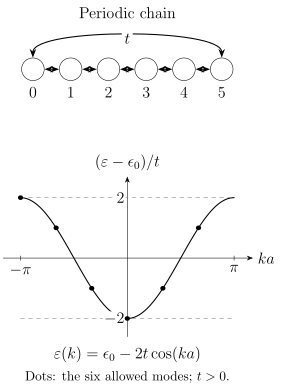
The periodic baseline is diagonal in crystal momentum. For , the one-particle band runs from at to at the Brillouin-zone edge; a finite ring retains only its allowed momenta.
Band edges and velocity
Section titled “Band edges and velocity”For the continuous bulk band and real nonzero ,
For ,
The wave-packet group velocity is
so
An extended eigenstate at a band edge has zero group velocity; zero velocity is not localization.
A finite untwisted ring samples only allowed momenta. For odd , it contains but not , so its actual spectral width for is
For example, a three-site ring has energies and width . Even rings sample both bulk band edges. A twist can move both sampled extrema.
Effective mass
Section titled “Effective mass”Near the band minimum,
Matching to gives
The curvature at the band top has the opposite sign. Effective Mass gives the tensor definition.
Infinite-chain density of states
Section titled “Infinite-chain density of states”Per site and per retained flavor, the normalized one-particle density of states is
The expression applies inside the band and is zero outside; its endpoint divergences are understood through integration. It satisfies
The inverse-square-root divergences at the two band edges are one-dimensional van Hove singularities, not delta-function bound states. Density of States explains normalization across dimensions and internal degeneracies.
Open-Chain Standing Waves
Section titled “Open-Chain Standing Waves”For , the normalized eigenvectors are
with
Their energies are
These are standing waves satisfying the discrete endpoint conditions
The dimensionless angle is sometimes denoted . It is not the eigenvalue of an exact finite-chain translation operator because open boundaries break that symmetry.
Open and periodic chains share the same bulk band as , but their finite spectra, degeneracies, bond counts, eigenvectors, and trace moments differ.
A Boundary Twist Shifts the Allowed Momenta
Section titled “A Boundary Twist Shifts the Allowed Momenta”A boundary twist is defined here by
The allowed wave numbers and energies are
Increasing by relabels the finite modes:
Therefore
as an unordered multiset. A site-dependent rephasing can place the entire twist on one boundary bond or distribute it uniformly, but it cannot remove the total loop phase. Peierls Phase Preview explains the gauge and flux interpretation.
Filling and Free Many-Body Ground States
Section titled “Filling and Free Many-Body Ground States”For spinless fermions at zero temperature, the ground state fills the lowest one-particle energies, with degeneracy handled explicitly at the Fermi level. In the infinite translation-invariant chain, define the filling
For and , symmetric filling about gives
and
At half filling,
For noninteracting bosons at fixed finite , the zero-temperature ground state puts every particle into the lowest one-particle mode. Degeneracy of that mode must be resolved before claiming a unique condensate. In one-dimensional thermodynamic systems, condensate and finite-temperature statements require the infrared and ensemble analysis developed in the Ideal Bose Gas.
Calling the baseline a metal or insulator before specifying statistics and filling is incomplete. A completely filled isolated spinless band has no available state within that retained band, but whether a physical material is insulating also depends on omitted bands, gaps, interactions, and charge response.
Observables
Section titled “Observables”Site density and one-body density matrix
Section titled “Site density and one-body density matrix”The local occupation is
The equal-time one-body density matrix is
For a translation-invariant state it depends only on . In the zero-temperature infinite spinless Fermi sea,
and
The algebraic decay is a free one-dimensional Fermi-sea fingerprint. Interactions generally change its exponent and belong to Spinless Fermion Chains.
Momentum occupation
Section titled “Momentum occupation”For a periodic chain,
At zero temperature, a spinless free Fermi sea has unit occupation below the Fermi energy and zero occupation above it, apart from finite-size degeneracy choices. A free Bose ground state instead has macroscopic occupation of the lowest mode at fixed large particle number.
Bond current
Section titled “Bond current”For the real-hopping convention, define the particle current from site to by
It appears in the lattice continuity equation
where denotes time. A charge current requires multiplication by the carrier charge with a declared sign convention.
Spectral and dynamical quantities
Section titled “Spectral and dynamical quantities”Useful diagnostics include:
- the finite spectrum and level degeneracies;
- the local density of states;
- the return probability and spreading of a localized wave packet;
- the one-body propagator;
- density correlations obtained by Wick reduction when the state is Gaussian;
- ground-state energy versus boundary twist;
- band velocity and curvature.
On an infinite chain, the exact one-particle amplitude from site to site is
where on the right is a Bessel function. This ballistic quantum spreading is coherent and differs from diffusion generated by stochastic hopping.
What the Model Omits
Section titled “What the Model Omits”The cosine band describes coherent motion within one retained orbital per site. It contains no particle collisions, dephasing, bath, or interaction-driven insulating phase. Material applications also require checking that omitted bands and orbital-overlap corrections are small over the energies of interest.
Important Limits and Variants
Section titled “Important Limits and Variants”| Limit or variant | Model change | Consequence |
|---|---|---|
| atomic limit | all one-particle site states have energy | |
| dimer | two sites and one bond | energies |
| open bulk limit | through open chains | standing-wave spectrum becomes dense in the same cosine band |
| periodic bulk limit | through rings | momentum grid becomes continuous in the Brillouin zone |
| continuum near band bottom | with | recovers a quadratic kinetic energy after subtracting the band offset |
| boundary twist | total phase around a ring | shifts the finite momentum grid |
| site disorder | varies | translation is lost; one-dimensional localization physics can emerge |
| longer-range hopping | add | dispersion becomes for real inversion-symmetric hopping |
| staggered or dimerized chain | alternating onsite energies or bonds | produces a two-site unit cell and two bands |
| several orbitals or flavors | matrix-valued onsite and hopping terms | Bloch Hamiltonian has multiple bands |
| Hubbard interaction | add | compare the Hubbard Dimer and Hubbard Chain |
| spinless density interaction | add | route to the – chain and XXZ mapping |
| pairing terms | add and | number conservation is lost; Bogoliubov rather than unitary diagonalization is required |
The continuum scaling requires both
and subtraction or absorption of the diverging band-bottom offset . Taking at fixed instead sends the effective mass to infinity.
Minimal Worked Example: One Bond
Section titled “Minimal Worked Example: One Bond”For two sites joined by one bond,
The normalized eigenstates are
with
and
For , constructive relative phase lowers the energy. A particle prepared on site evolves with transfer probability
The onsite energy contributes only a common dynamical phase to this fixed one-particle process. The Tight-Binding Dimer develops this two-level dynamics in full.
Small Spectra to Calculate Directly
Section titled “Small Spectra to Calculate Directly”These examples distinguish open and periodic boundaries and show how a one-particle spectrum determines a free-fermion spectrum.
TB-O4: Four-site open chain
Section titled “TB-O4: Four-site open chain”Use
and the ordered basis
The one-particle matrix is
Define the golden ratio
The exact ordered spectrum is
Numerically,
The exact trace checks are
There must be four nondegenerate eigenvalues. A wrap bond added accidentally changes both the spectrum and the second moment.
TB-P6: Six-site periodic ring
Section titled “TB-P6: Six-site periodic ring”Use
with the six distinct bonds
The ordered one-particle spectrum is
Its trace checks are
The levels at and are each twofold degenerate because momenta and are distinct but have the same energy. Losing those degeneracies indicates broken translation, inversion, or real-hopping symmetry; creating a zero level usually indicates a wrong bond list or momentum grid.
Two-fermion lift
Section titled “Two-fermion lift”Lift TB-P6 to two spinless fermions. The sector dimension must be
The many-body ground energy is
with degeneracy two: the mode is occupied together with either member of the pair. Occupying the same one-particle mode twice is forbidden. A dimension larger than or a ground energy signals that fermionic occupation constraints were not enforced.
General Trace-Moment Check
Section titled “General Trace-Moment Check”For a simple unweighted chain graph with distinct bonds,
and
Thus the centered second moment per site is
This invariant checks the sum of squared hopping magnitudes without depending on eigenvector phases. Different graphs can share this value, so also inspect the intended bond list and selected matrix entries.
Numerical Accuracy
Section titled “Numerical Accuracy”For double-precision dense diagonalization of TB-O4 and TB-P6:
| Quantity | Useful small-matrix target |
|---|---|
| Hermiticity | |
| sorted eigenvalues | maximum absolute error |
| eigenvector residual | |
| orthonormality | |
| trace and centered second moment | absolute error |
| mode count | exactly one-particle eigenvalues including multiplicity |
Degenerate eigenvectors may rotate within their eigenspaces, so validation should compare projectors or residuals rather than component-by-component eigenvectors.
Choosing a Diagonalization Method
Section titled “Choosing a Diagonalization Method”For short-range open chains the one-particle matrix is tridiagonal; for rings it is cyclic tridiagonal. Dense diagonalization gives a small complete spectrum, sparse methods target selected eigenpairs, and Fourier modes solve uniform periodic systems. Construct the free Fock spectrum only after imposing the chosen statistics and particle-number sector.
Exercises
Section titled “Exercises”1. Derive the bond trace moment
Section titled “1. Derive the bond trace moment”Let for a simple graph with real hopping on each of distinct undirected bonds. Prove
Solution
The diagonal matrix element at site is
Every neighbor of contributes
Therefore
where is the degree of site . Taking the trace and using the graph handshaking identity gives
2. Recover the four-site golden-ratio spectrum
Section titled “2. Recover the four-site golden-ratio spectrum”Use the open-chain formula to derive the exact TB-O4 eigenvalues.
Solution
For , , and ,
The exact trigonometric values are
The remaining cosines have opposite signs, so
The pairing about zero is also required by the open chain’s sublattice spectral symmetry.
3. Calculate the six-site ring and its two-fermion ground state
Section titled “3. Calculate the six-site ring and its two-fermion ground state”List the six allowed momenta for TB-P6, recover the one-particle spectrum, and explain the twofold ground-state degeneracy.
Solution
Choose momenta
Using gives
Two spinless fermions must occupy distinct modes. One occupies the unique mode, while the other can occupy either momentum in the pair. Hence
and the ground eigenspace has dimension two.
4. Prove spectral pairing on a bipartite chain
Section titled “4. Prove spectral pairing on a bipartite chain”Suppose has hopping only between even and odd sites and obeys . If , find the partner eigenstate.
Solution
Multiply the eigenvalue equation by :
Using gives
Thus is an eigenstate at . Restoring the uniform onsite shift pairs energies and . A zero mode can be its own energy partner.
5. Track a boundary twist through one period
Section titled “5. Track a boundary twist through one period”Show that the twisted spectrum is -periodic as an unordered set, even though a fixed level label need not be periodic by itself.
Solution
The allowed momenta are
After increasing the twist by ,
Therefore level at equals level at . The labels cycle, but the multiset of energies is unchanged.
6. Compute half-filled Fermi fingerprints
Section titled “6. Compute half-filled Fermi fingerprints”For the infinite spinless chain at half filling and , find , , and for nonzero integer . Which separations have zero correlator?
Solution
At ,
Therefore
The one-body correlator is
It vanishes for every nonzero even . For odd , its sign alternates while its magnitude decays as .
References
Section titled “References”- A. Altland and B. Simons, Condensed Matter Field Theory, 2nd ed., Cambridge University Press (2010).
- N. W. Ashcroft and N. D. Mermin, Solid State Physics, Holt, Rinehart and Winston (1976).
- P. Coleman, Introduction to Many-Body Physics, Cambridge University Press (2015).
- E. N. Economou, Green’s Functions in Quantum Physics, 3rd ed., Springer (2006).
- P. Fazekas, Lecture Notes on Electron Correlation and Magnetism, World Scientific (1999).
- C. Kittel, Introduction to Solid State Physics, 8th ed., Wiley (2005).
- M. P. Marder, Condensed Matter Physics, 2nd ed., Wiley (2010).
- S. H. Simon, The Oxford Solid State Basics, Oxford University Press (2013).
- J. C. Slater and G. F. Koster, “Simplified LCAO Method for the Periodic Potential Problem,” Physical Review 94, 1498–1524 (1954), doi:10.1103/PhysRev.94.1498.
- G. H. Wannier, “The Structure of Electronic Excitation Levels in Insulating Crystals,” Physical Review 52, 191–197 (1937), doi:10.1103/PhysRev.52.191.