

Harmonic Chain
The harmonic chain is a periodic array of equal masses coupled by quadratic nearest-neighbor springs, exactly reducible to independent phonon modes plus a free center-of-mass coordinate whose zero frequency must not be quantized as an oscillator.
The four-site example below makes the oscillator count explicit. A uniform displacement has no restoring force; the three relative displacements oscillate.
Helpful background. Coupled oscillators explains normal coordinates; phonons connects their quantization to collective excitations.
A Periodic Chain of Masses and Springs
Section titled “A Periodic Chain of Masses and Springs”The calculation uses the following physical choices.
| Field | Baseline choice |
|---|---|
| sites | equal masses labeled |
| geometry | one-dimensional periodic chain of reference spacing |
| coordinate | one scalar displacement per site |
| momentum | canonical momentum |
| mass | |
| coupling | nearest-neighbor spring constant |
| boundary condition | and |
| onsite pinning | absent |
| anharmonicity | absent |
| equilibrium ensemble | fixed and temperature |
| thermodynamic limit | at fixed |
| zero-mode convention | center of mass retained unless explicitly fixed |
The site label is periodic, but the scalar displacement itself is not silently compactified. Uniformly shifting every costs no spring energy and produces a free center-of-mass degree of freedom. A pinned chain, an open chain, a diatomic chain, and an anharmonic chain are different physical models.
Degrees of Freedom and Hilbert Space
Section titled “Degrees of Freedom and Hilbert Space”The microscopic canonical algebra is
Before separating the uniform translation, the coordinate representation is
Define the center-of-mass displacement and total momentum by
They satisfy
After an orthogonal normal-coordinate transformation, the Hilbert space factors as
The first factor is a free coordinate. The remaining factors are harmonic oscillators. The relative-coordinate theory omits the first factor. This is a reduction of the degrees of freedom, not a normalizable state with both and : the commutator forbids simultaneous sharp values. With
the reduced variables obey
There are only independent canonical pairs. Below, “fixed center of mass” refers to this reduced theory; pinning instead adds a physical restoring force.
Hamiltonian and Stiffness Matrix
Section titled “Hamiltonian and Stiffness Matrix”The baseline Hamiltonian is
Writing and similarly for gives
with the periodic stiffness matrix
All indices in this expression are understood modulo . Every row sums to zero:
Consequently, the uniform vector
is an exact zero eigenvector. For , is positive semidefinite and this is its only zero direction. For , nonuniform directions are unstable, so the usual oscillator quantization does not define a lower-bounded Hamiltonian.
Fourier and Normal-Mode Conventions
Section titled “Fourier and Normal-Mode Conventions”Allowed wave numbers are
chosen once in a first Brillouin zone. Define
Hermiticity gives
and the transformed commutator is
The Hamiltonian becomes
where
Thus
For , introduce bosonic mode operators. One full-zone convention is
and
The mode algebra is
With the zero coordinate separated,
There are positive-frequency oscillator modes, not . Summing over the full discrete Brillouin zone gives one traveling-wave oscillator for each allowed nonzero . A real standing-wave convention instead combines each generic pair and into cosine and sine oscillators. Mixing the two conventions causes double counting.
Symmetries and Conserved Quantities
Section titled “Symmetries and Conserved Quantities”The baseline model has:
- continuous uniform-shift symmetry , generated by ;
- cyclic lattice translation , giving crystal momentum modulo ;
- reflection symmetry ;
- time-reversal symmetry with ;
- conservation of the energy in every nonzero normal mode;
- conservation of total momentum .
For the exactly harmonic Hamiltonian,
commutes with for every . The total phonon occupation also commutes with this quadratic Hamiltonian, but it is not a microscopic conserved charge protected by a fundamental symmetry. Anharmonic terms can create and destroy phonons while preserving the actual energy and crystal-momentum constraints.
The degeneracy follows from inversion and time-reversal symmetry. A perturbation that breaks those symmetries can alter that relation without changing the number of microscopic coordinates.
Natural Scales and Control Parameters
Section titled “Natural Scales and Control Parameters”The spring timescale and band-edge frequency are
At long wavelength,
with sound speed
The smallest nonzero frequency is
Useful dimensionless quantities are
together with a strain criterion that tests the harmonic approximation. For example, the model should not be extrapolated to a microscopic lattice unless
This inequality is a validity test, not a consequence of writing a quadratic Hamiltonian. The harmonic model itself has no parameter that describes the neglected cubic and quartic force constants.
What the Normal Modes Solve
Section titled “What the Normal Modes Solve”The harmonic chain is exactly solvable after its stiffness matrix is diagonalized, but the claim has boundaries.
| Quantity | Status | Caveat |
|---|---|---|
| finite-chain normal frequencies and eigenvectors | exact discrete Fourier solution | requires the stated periodic monatomic spring model |
| center-of-mass motion | exact free-particle solution | it is not a harmonic oscillator and has no normalizable ground state on |
| relative-coordinate spectrum | exact product of oscillator spectra | zero mode must be fixed, pinned, or retained separately |
| relative ground-state and thermal Gaussian correlations | exact within the harmonic Hamiltonian | a general non-Gaussian initial state does not become Gaussian under quadratic evolution |
| equilibrium oscillator occupations | exact Bose factors for positive-frequency modes | equilibrium phonon chemical potential is zero |
| real-time harmonic dynamics | exact coherent mode propagation | no damping, mode mixing, or thermalization occurs |
| low-wave-number continuum theory | controlled asymptotic limit | lattice dispersion and Brillouin-zone periodicity are discarded |
| material phonon spectrum | not predicted by the toy model alone | force constants, basis atoms, dimensions, and electronic effects are missing |
| transport coefficients | not generically finite in the ideal chain | integrability and absent scattering make ordinary relaxation assumptions fail |
For a fixed center of mass, an exact eigenstate is labeled by occupations :
The free dynamics is
Exact propagation does not imply irreversible equilibration. It instead preserves every indefinitely.
Thermodynamics of the Relative Modes
Section titled “Thermodynamics of the Relative Modes”With the center of mass fixed, the relative partition function is
The Bose occupation of a positive-frequency mode is
The relative internal energy and heat capacity are
and
In the thermodynamic limit, the vibrational density of states per chain length is
for . It approaches
at low frequency and has a one-dimensional van Hove divergence at the band edge.
The thermodynamic-limit zero-point energy per site is
In the acoustic quantum window
the thermal energy density and heat capacity are
and
At high temperature, every fixed-center oscillator approaches classical equipartition:
For a finite chain at temperatures below , the nonzero modes freeze out exponentially. The linear- law therefore requires a thermodynamic or sufficiently large-system window.
Infrared Fluctuations
Section titled “Infrared Fluctuations”For a fixed center of mass, the absolute displacement variance is
Because , this quantity grows as at and as at any fixed . The unpinned one-dimensional chain therefore does not support size-independent absolute localization around the chosen reference sites in the thermodynamic limit.
Relative displacements behave better. The variance of
contains an additional factor that removes the acoustic infrared divergence. Local bond strain can remain finite even when absolute displacements wander. In the classical thermal limit the finite-ring sums can be evaluated exactly:
The first grows with ; the second tends to a constant. The factor in the bond variance records the periodic constraint . These classical expressions require temperature above the phonon band; at lower temperature use the full quantum covariance before taking the large- limit.
Important Limits
Section titled “Important Limits”| Limit or modification | Result | Main caution |
|---|---|---|
| exact remains a free coordinate | ||
| continuous acoustic band | absolute displacement fluctuations diverge in one dimension | |
| all frequencies collapse | the system approaches free masses, not soft oscillators with fixed Fock normalization | |
| vibrational frequencies vanish | thermal and quantum limits must be reordered carefully | |
| weak onsite pinning | acoustic branch gains a gap | uniform-shift symmetry is explicitly broken |
| continuum limit | free elastic scalar field | lattice cutoff and Brillouin-zone structure are lost |
| high temperature | relative heat capacity | the free center of mass requires its own ensemble |
| weak anharmonicity | finite shifts, scattering, and lifetimes | mode occupations cease to be exact constants |
For the continuum limit, define mass density and elastic coefficient
Then , and the relative Hamiltonian approaches
Harmonic Oscillator to Fields explains the continuum-field correspondence.
The Free Translation Mode
Section titled “The Free Translation Mode”The sector is
On , it has continuous spectrum and no normalizable ground state. Its unconstrained canonical position integral is proportional to the available translation length and diverges if no finite translation range or reduction to relative variables is specified. The uniform translation is a physical symmetry, not automatically a gauge redundancy.
Three common choices define different finite systems:
- Retain the center of mass. Quantize as a free particle and specify the allowed range or wave-packet state of .
- Use relative coordinates only. Remove the free factor and retain independent oscillator pairs with the projected commutator above. This does not impose simultaneous eigenvalue constraints on the original and .
- Pin the chain. Add an onsite potential
which changes the dispersion to
The limits , , and need not commute for infrared-sensitive observables. An accidental small eigenvalue from rounding is a numerical error, not a physical pinning model. Classify the known translation vector as zero within a justified tolerance. If a positive regulator is deliberately added, state its operator: pinning only the center of mass differs from the onsite term above, which shifts every mode.
For even , the zone-boundary momentum is its own negative modulo a reciprocal vector. Generic and form degenerate pairs, but this self-conjugate point contributes only one oscillator. Correct mode counting always returns positive-frequency modes after the center of mass is fixed.
Typical Observables
Section titled “Typical Observables”Natural observables include:
- displacement and momentum covariances;
- bond strain ;
- normal-mode occupations ;
- vibrational energy and heat capacity;
- group velocity and wave-packet propagation;
- dynamical structure factors and spectral functions;
- local energy density and energy current.
Inside , the group velocity is
It approaches near the zone center and vanishes at the band edge. The existence of a normal mode does not guarantee that a particular probe sees it: scattering intensity also depends on polarization, form factors, and operator selection rules. Structure Factors explains those response conventions.
Minimal Worked Example
Section titled “Minimal Worked Example”Take . The allowed momenta may be represented by
The frequencies are
The eigenvector is uniform. The zone-boundary eigenvector is proportional to . The traveling waves are degenerate and can be replaced by real sine and cosine standing waves.
After fixing the center of mass, the ground energy is
The exact relative partition function is
The real normal vectors can be chosen proportional to , , , and . The middle two span the same degenerate space as the traveling waves at .
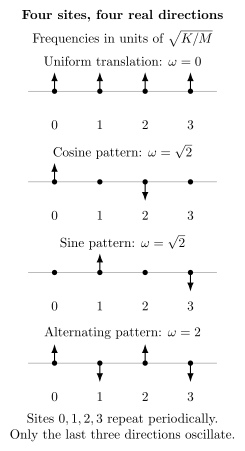
Each arrow gives a site’s scalar displacement; a dot without an arrow has zero displacement. Vector amplitudes are schematic, not a common normalization. The uniform pattern is a free coordinate. The other three are oscillator directions; the two middle patterns are independent despite sharing a frequency.
Numerical Benchmark
Section titled “Numerical Benchmark”For a compact matrix calculation, use
Diagonalize the mass-weighted stiffness matrix
The analytic eigenvalues and frequencies are
| Mode labels | Degeneracy | ||
|---|---|---|---|
Useful decimal frequencies are
Independent matrix invariants are
and
The fixed-center zero-point energy is
For the lowest nonzero mode in a sequence of chain lengths,
A valid implementation should:
- construct periodic neighbors without duplicating or omitting the wraparound spring;
- verify row sums and the exact null vector before diagonalization;
- compare eigenvalues, degeneracies, trace, and pseudodeterminant;
- form frequencies only after classifying negative, zero, and positive eigenvalues;
- compare eigenvector subspaces rather than individual vectors inside degenerate pairs;
- state whether the zero mode is retained, fixed, or pinned;
- test the acoustic convergence rather than only one chain length.
Boundaries, Pinning, and Anharmonicity
Section titled “Boundaries, Pinning, and Anharmonicity”Boundary conditions
Section titled “Boundary conditions”Open, free-end, and fixed-end chains have standing-wave spectra and different zero-mode structure. Reusing periodic wave numbers for them gives the wrong mode count and endpoint behavior.
Onsite pinning
Section titled “Onsite pinning”The onsite term proportional to gaps the acoustic branch and renders absolute displacement fluctuations infrared finite. It also explicitly breaks uniform-shift symmetry, so it is not a harmless numerical regulator unless the limit is demonstrated for the observable being calculated.
More atoms per cell
Section titled “More atoms per cell”A diatomic or multi-atom unit cell produces several branches. Acoustic and optical labels refer to long-wavelength displacement patterns, while exact frequencies require a matrix-valued dynamical problem. The general treatment belongs to Phonons as Many-Body Excitations.
Longer-range and disordered couplings
Section titled “Longer-range and disordered couplings”Translation-invariant longer-range springs change but preserve Fourier diagonalization. Random masses or spring constants destroy momentum as an exact label and can localize vibrational modes.
Anharmonicity
Section titled “Anharmonicity”Cubic and quartic displacement terms couple normal modes. They generate thermal expansion, frequency shifts, finite lifetimes, and scattering. The harmonic occupations then cease to be exact constants of motion.
Higher dimensions and fields
Section titled “Higher dimensions and fields”Several displacement polarizations and lattice directions produce a dynamical matrix at every crystal momentum. The long-wavelength continuum becomes an elastic field theory rather than a single scalar field.
Exercises
Section titled “Exercises”Exercise 1: Derive the dispersion
Section titled “Exercise 1: Derive the dispersion”Insert a plane wave into the classical equations of motion and derive the exact lattice dispersion.
Solution
Hamilton’s equations give
For the plane wave,
Using yields
The nonnegative frequency is therefore
Exercise 2: Isolate the center of mass
Section titled “Exercise 2: Isolate the center of mass”Show that the uniform Fourier coordinate gives and explain why its oscillator ground-state formula is invalid.
Solution
The normalized zero-mode variables are
and
The spring term vanishes for a uniform displacement. The kinetic contribution is
This is a free-particle Hamiltonian in . Its spectrum is continuous on , and it has no normalizable state with the oscillator energy . The factors in oscillator coordinates also diverge. One must retain, fix, or pin this coordinate explicitly.
Exercise 3: Count the four-site modes
Section titled “Exercise 3: Count the four-site modes”For , find the allowed momenta, frequencies, and fixed-center ground energy. Explain why the two modes at are not double counting.
Solution
The allowed momenta are , , , and . Substitution into the dispersion gives
After fixing the zero coordinate, there are three oscillators. Their zero-point energies sum to
The and traveling waves are independent directions of propagation. Equivalently, their two-dimensional degenerate subspace has independent cosine and sine standing waves. Either basis contains two oscillators, not four.
Exercise 4: Derive the low-temperature heat capacity
Section titled “Exercise 4: Derive the low-temperature heat capacity”Use the acoustic dispersion and thermodynamic-limit mode density to derive the leading thermal energy and heat capacity per length.
Solution
Both signs of contribute. With ,
Set . Then
Using
gives
Differentiating at fixed length yields
The derivation requires so that the momentum sum may be replaced by an integral.
Exercise 5: Compare absolute and relative fluctuations
Section titled “Exercise 5: Compare absolute and relative fluctuations”Use the low- form of the covariance to determine the infrared scaling of at zero and nonzero temperature. Explain why the bond variance does not have the same divergence.
Solution
At zero temperature, the long-wavelength contribution is proportional to
At fixed and sufficiently small ,
The integrand is then proportional to , so
For a bond displacement, Fourier transformation supplies
This factor cancels enough of the small- singularity to make the local bond variance infrared finite. Absolute positional order and local elastic strain therefore have different thermodynamic behavior.
References
Section titled “References”- N. W. Ashcroft and N. D. Mermin, Solid State Physics, Holt, Rinehart and Winston (1976).
- S. Baroni, S. de Gironcoli, A. Dal Corso, and P. Giannozzi, “Phonons and related crystal properties from density-functional perturbation theory”, Reviews of Modern Physics 73, 515–562 (2001).
- M. Born and K. Huang, Dynamical Theory of Crystal Lattices, Oxford University Press (1954).
- P. M. Chaikin and T. C. Lubensky, Principles of Condensed Matter Physics, Cambridge University Press (1995).
- P. Debye, “Zur Theorie der spezifischen Wärmen”, Annalen der Physik 344, 789–839 (1912).
- T. Giamarchi, Quantum Physics in One Dimension, Oxford University Press (2004).
- C. Kittel, Introduction to Solid State Physics, 8th ed., Wiley (2004).
- G. D. Mahan, Many-Particle Physics, 3rd ed., Springer (2000).
- A. A. Maradudin, E. W. Montroll, G. H. Weiss, and I. P. Ipatova, Theory of Lattice Dynamics in the Harmonic Approximation, 2nd ed., Academic Press (1971).
- Z. Rieder, J. L. Lebowitz, and E. Lieb, “Properties of a harmonic crystal in a stationary nonequilibrium state”, Journal of Mathematical Physics 8, 1073–1078 (1967).