

Many-Body Quantum Chaos Diagnostics
Many-body quantum chaos is the emergence of universal statistical structure in the spectra, eigenstates, and dynamics of interacting quantum systems after every relevant symmetry, scale, and averaging prescription has been specified. It is not exponential separation of state vectors under one unitary evolution, and it is not certified by one irregular-looking time trace.
For a finite Hamiltonian, the most reproducible starting point is a symmetry-resolved energy spectrum. In a generic nonintegrable regime, nearby levels often repel and longer-range correlations approach the appropriate random-matrix prediction below a system-dependent energy scale. In the same regime, local-observable matrix elements often satisfy the eigenstate thermalization hypothesis, while initially local operators spread through the system. These signatures are related, but none is logically identical to the others.
Helpful background. Conserved quantities explains symmetry sectors, and the microcanonical ensemble explains energy windows. Semiclassical quantum chaos develops the complementary classical-orbit viewpoint.
The term chaos has several uses: spectral repulsion, ETH, and scrambling are distinct tests. Random-matrix behavior is well established for specific ensembles and model classes; no theorem identifies all three tests for every local Hamiltonian.
Symmetry-resolved many-body spectra
Section titled “Symmetry-resolved many-body spectra”Let a finite many-body Hamiltonian act on a Hilbert space for system size :
For a short-range lattice model, has bounded support and the number of terms grows extensively with . After resolving the exact unitary symmetry algebra and superselection charges, write
The label can include particle number, total magnetization, momentum, point-group representation, parity, gauge charge, and boundary-sector data. For a non-Abelian symmetry, an irreducible representation can appear many times: acts as the identity on its symmetry multiplet and nontrivially on the multiplicity space. Analyze the latter spectrum, counting each symmetry-enforced multiplet once. Spectral statistics are defined within one such resolved block at a time.
After removing only justified symmetry-enforced repetitions, order the energies in a declared window. In the nondegenerate case,
Unexpected degeneracies require explanation; discarding them merely to obtain a strictly increasing sequence can manufacture repulsion. The analysis must also state:
- whether degeneracies required by antiunitary symmetry have been grouped;
- whether the window is fixed in energy or energy density ;
- whether the spectrum is unfolded;
- whether data are averaged over disorder, boundary twists, windows, or nearby times;
- how many statistically useful levels remain;
- how the answer changes with .
The thermodynamic density of states is typically exponential in , but exact diagonalization reaches only modest sizes. That mismatch makes convergence discipline central rather than optional.
Symmetry Resolution Is the First Diagnostic
Section titled “Symmetry Resolution Is the First Diagnostic”Commuting unitary symmetries
Section titled “Commuting unitary symmetries”If commutes with ,
then matrix elements between distinct eigenspaces of vanish. Levels in different sectors do not repel because no symmetry-preserving matrix element can hybridize them.
Combining two independent level sequences therefore weakens apparent repulsion. Combining many sequences can approach a Poisson-like process even if each block separately follows random-matrix statistics. This is why accidental pooling is among the most common false diagnoses of integrability or localization.
For lattice models, relevant structures include:
| Structure | Typical block label |
|---|---|
| charge | particle number or total |
| translation | crystal momentum |
| reflection | parity, when compatible with |
| spin rotation | total spin and |
| particle–hole or sublattice structure | determine whether it commutes with or pairs with |
| gauge constraint | physical charge sector |
| boundary condition | periodic, antiperiodic, twisted, or open |
Two symmetries that do not commute cannot always be diagonalized simultaneously. One must decompose into irreducible representations of the full symmetry algebra, not merely attach every familiar quantum number.
Antiunitary symmetry must act within the block
Section titled “Antiunitary symmetry must act within the block”Let be antiunitary and satisfy
The relevant question is not whether the full Hamiltonian is time-reversal invariant. It is whether maps the chosen irreducible block to itself.
For a translation-invariant system,
At generic modulo a reciprocal lattice vector, this particular time-reversal operation exchanges blocks. It does not follow that the block has no antiunitary symmetry: if reflection also maps to , the combination may act internally. Only after excluding all such combinations is a unitary-class comparison justified. At invariant momenta such as or in an even periodic chain, the antiunitary operation can act within the block and select a different class.
Antiunitary Symmetries develops the general operator theory.
Kramers pairs
Section titled “Kramers pairs”If an antiunitary symmetry obeys
every level in an invariant sector is at least doubly degenerate. The symplectic comparison concerns spacings between distinct Kramers doublets, not the zero spacing inside each protected pair.
Approximate symmetries
Section titled “Approximate symmetries”If
and has a symmetry weakly broken by , finite systems can show a crossover rather than either limiting ensemble. The perturbation becomes spectrally effective when its typical matrix element between nearby unperturbed states competes with the local mean spacing:
Because often decreases exponentially with , a perturbation that looks negligible microscopically can eventually mix an enormous number of many-body levels. The crossover scale is nevertheless observable-, window-, and model-dependent; it should be measured, not inferred from this inequality alone.
Short-Range Spectral Statistics
Section titled “Short-Range Spectral Statistics”Unfolding
Section titled “Unfolding”Let
be the staircase counting function in one sector. Write
where is a smooth estimate of the integrated density of states. The unfolded levels are
with spacings
Ideally,
Unfolding removes the smooth density while retaining fluctuations. A fit that is too rigid leaves density variation in the data; a fit that is too flexible can erase the very long-range correlations being measured. Every long-range claim should be repeated with several defensible unfolding or filtering choices.
Poisson benchmark
Section titled “Poisson benchmark”Independent unfolded levels give
Thus
so there is no level repulsion. Generic integrable systems often approach this benchmark after all ordinary symmetries are resolved, but “integrable implies Poisson” is not an exception-free theorem. Free spectra, commensurate frequencies, arithmetic structure, exact degeneracies, and effectively one-dimensional ladders can behave differently.
Poisson statistics also occurs in localized spectra. It is therefore evidence for absent spectral repulsion, not a mechanism label.
Dyson classes
Section titled “Dyson classes”The three classical random-matrix classes are indexed by
Their working interpretation is:
| Dyson index | Hamiltonian class | Antiunitary structure in the block | Small-spacing law |
|---|---|---|---|
| GOE | |||
| GUE | no internal antiunitary symmetry | ||
| GSE | , after pairing |
The exponent is the robust point:
Simple Wigner surmises use
with and chosen for normalization and unit mean spacing. These compact formulas come from small random matrices and approximate the large-matrix nearest-neighbor distributions extremely well; they are not exact finite-size laws for an arbitrary local Hamiltonian.
Dyson’s classification assumes the ordinary bulk setting. Chiral, particle–hole, non-Hermitian, and topological edge problems can require other classes and other local kernels.
Adjacent-gap ratios
Section titled “Adjacent-gap ratios”Define raw gaps
and the symmetrized ratio
Because
the sample mean is robust and easy to compare across windows. It is unchanged by a locally constant rescaling of energy, so it avoids explicit unfolding to leading order.
Useful large-matrix benchmarks are
| Statistics | |
|---|---|
| Poisson | |
| GOE | |
| GUE | |
| GSE |
The often-quoted Wigner-like ratio surmises give nearby, not identical, values. For example, their GOE and GUE means are approximately and . A report should state which benchmark is being used.
Gap ratios reduce sensitivity to density variation. They do not:
- resolve symmetries automatically;
- remove exact degeneracies;
- diagnose long-range spectral rigidity;
- distinguish integrability from localization;
- guarantee enough independent samples;
- eliminate finite-size drift.
Sampling uncertainty
Section titled “Sampling uncertainty”If ratios are treated as independent, the naive standard error is
Adjacent ratios share gaps and are correlated, so this formula can underestimate uncertainty. Block bootstrap over energy windows or independent disorder realizations is usually safer. For a clean model with one spectrum, changing window boundaries and system size is part of the uncertainty analysis.
Avoided Crossings Explain Repulsion Locally
Section titled “Avoided Crossings Explain Repulsion Locally”The elementary mechanism appears in a two-level block:
Its eigenvalue separation is
If the two states share all exact quantum numbers, a generic perturbation allows , and the levels avoid crossing. If a symmetry forbids their coupling, then and an exact crossing can persist.
This argument explains why symmetry resolution is logically prior to spacing statistics. It does not by itself derive a random-matrix distribution: collective universality requires the statistics of many coupled levels.
Long-Range Spectral Correlations
Section titled “Long-Range Spectral Correlations”Nearest-neighbor measures probe only the shortest spectral scale. A spectrum can show local repulsion before its longer-range correlations have reached random-matrix form.
Number variance
Section titled “Number variance”For an unfolded interval of length , let count levels in . The number variance is
For Poisson statistics,
Random-matrix spectra are more rigid: their variance grows only logarithmically at large , with a class-dependent coefficient. Spectral rigidity and the two-level cluster function contain related information.
The largest trustworthy is limited by the unfolding scale, the energy window, and nonuniversal transport physics.
Filtered spectral form factor
Section titled “Filtered spectral form factor”Choose a real, nonnegative smooth window centered on the energy region of interest and define
The filtered spectral form factor is
where the angle brackets denote a declared average over disorder, circuit realizations, nearby spectral windows, boundary twists, or a controlled time smoothing.
Expanding the modulus gives
Thus is a Fourier probe of two-level spectral correlations. For a complex filter, the second weight in the double sum must instead be conjugated. For distinct energies, the exact long-time average of the unaveraged form factor is ; surviving degeneracies add cross terms. A single realization generally fluctuates around that average rather than converging to a perfectly flat plateau.
Connected and disconnected pieces
Section titled “Connected and disconnected pieces”The smooth density of states produces a large nonuniversal contribution. Define
The subtraction matters. Without it, the early-time decay of the Fourier-transformed density can be mistaken for a universal correlation feature.
For a single deterministic spectrum, the meaning of the average is especially delicate. Time smoothing can reveal a trend but also alter it. A credible analysis reports the filter and smoothing bandwidth and demonstrates stability under reasonable changes.
Dip, ramp, and plateau
Section titled “Dip, ramp, and plateau”The familiar shorthand combines two related plots. In the full form factor :
- a nonuniversal early decay can be dominated by the Fourier transform of the smooth density;
- a correlation hole or dip can appear below an uncorrelated baseline;
- the result rises toward its late-time value.
After subtracting the disconnected density contribution, the connected form factor isolates fluctuation correlations more cleanly. It can contain nonuniversal hydrodynamic or constrained-mode corrections before , approach a random-matrix ramp after those modes relax, and reach a plateau when spectral discreteness dominates near .
Thus “dip–ramp–plateau” is useful morphology, not a claim that every feature belongs to the connected piece or that the four regions are phases. Exact slopes, normalizations, and crossover times depend on whether the ensemble is Gaussian or circular, on , and on the chosen normalization of .
Thouless and Heisenberg Scales
Section titled “Thouless and Heisenberg Scales”Mean spacing and Heisenberg time
Section titled “Mean spacing and Heisenberg time”Let be the smooth density of states in the chosen sector. The local mean spacing is
One common Heisenberg-time convention is
Use a fixed reference energy to define the dimensionless microcanonical entropy . Then
so
At fixed bulk energy density, grows extensively up to subextensive corrections. The Heisenberg time is therefore exponentially late in size; it does not depend on the arbitrary reference energy because is invariant.
Thouless time
Section titled “Thouless time”The many-body Thouless time is the scale beyond which a chosen spectral diagnostic approaches its random-matrix prediction:
Its reciprocal defines a Thouless energy,
The notation hides conventions. A value inferred from the connected spectral form factor need not match one inferred from number variance or observable matrix elements without order-one or even parametric differences.
When a distinct hydrodynamic regime precedes spectral universality, one seeks
In other systems can already be of microscopic order. If no interval separates and at accessible sizes, a visible ramp may be too short to support a scaling claim.
Conserved densities and diffusion
Section titled “Conserved densities and diffusion”Locality prevents conserved densities from relaxing instantly. For a diffusive mode,
In a periodic box of linear size , the slowest nonuniform mode has
and a relaxation time
In models where diffusion controls the onset of spectral universality,
up to definition-dependent factors. Ballistic, subdiffusive, anomalous, or constrained systems can scale differently. Energy conservation in a static Hamiltonian and charge conservation in a Floquet circuit need not produce identical form factors.
Dimensionless spectral window
Section titled “Dimensionless spectral window”A useful scale count is
where factors such as depend on convention. Large means many levels lie inside the universal energy window.
The important lesson is directional:
or, equivalently, a late-time statement before the discrete-spectrum plateau. It does not say that a local Hamiltonian resembles a dense random matrix at microscopic energy scales.
Random Matrix Theory as an Effective Description
Section titled “Random Matrix Theory as an Effective Description”Random-matrix theory enters a local many-body problem as an effective theory of selected unfolded fluctuations, not as an entry-by-entry model of the Hamiltonian. A spin chain or lattice Hamiltonian remains sparse, local, and constrained by conservation laws even when its late, symmetry-resolved spectral correlations approach an invariant-ensemble benchmark.
The universal layer can include the Dyson class, short-range repulsion, long-range unfolded correlations, and a connected form-factor ramp and plateau. It does not determine the global density of states, hydrodynamic coefficients, quasiparticles, operator support, ETH envelopes, or microscopic relaxation times. Those nonuniversal structures set the Thouless scale and the window in which a random-matrix comparison is justified.
Random Matrix Theory in Quantum Matter derives the Gaussian and circular measures, Vandermonde repulsion, Wigner surmises, sine kernel, and symmetry-class extension. Here the focus is how those predictions can be tested in a local many-body system.
Gaussian and circular ensembles
Section titled “Gaussian and circular ensembles”For a static Hamiltonian, one commonly compares bulk energies with the matching Gaussian class. For a periodic drive, the one-period unitary
has eigenphases on a circle. The natural benchmarks are circular orthogonal, unitary, or symplectic ensembles. Phase wrapping, exact quasienergy symmetries, and the absence of energy conservation change the many-body analysis.
Floquet Operators explains quasienergy kinematics, and Floquet Systems Preview discusses heating and driven phases.
Spectral edges and special points
Section titled “Spectral edges and special points”Bulk sine-kernel intuition should not be applied blindly to:
- the ground-state edge;
- a mobility edge;
- a symmetry-protected zero energy;
- a many-body phase transition;
- an exceptional point of a non-Hermitian generator;
- a quasienergy symmetry point at or .
Edge statistics, chiral kernels, and non-Hermitian spectra require separate ensembles and scalings.
Benchmark Many-Body Settings
Section titled “Benchmark Many-Body Settings”Mixed-field Ising chain
Section titled “Mixed-field Ising chain”Consider an open spin chain
At , the transverse-field Ising chain maps to free fermions and is integrable. Generic nonzero , , and break that free-fermion structure. With real couplings and a basis in which the Hamiltonian is real, an irreducible block typically compares with GOE statistics.
Open boundaries leave reflection symmetry when the fields are uniform. Pooling even and odd reflection sectors obscures repulsion. Edge fields can remove reflection symmetry, but they also change finite-size effects and must be declared.
XXZ chain with integrability breaking
Section titled “XXZ chain with integrability breaking”With dimensionless , a standard interpolation is
At an integrable point, symmetry-resolved bulk statistics are often approximately Poisson. Generic next-nearest-neighbor couplings produce a finite-size crossover toward Wigner–Dyson statistics.
The phrase “the crossover coupling” is incomplete unless it names:
- system size;
- magnetization and momentum sector;
- energy-density window;
- boundary conditions;
- chosen statistic;
- numerical threshold.
Different diagnostics can cross over at different apparent couplings.
Floquet circuits
Section titled “Floquet circuits”Local random circuits and dual-unitary circuits provide analytically tractable laboratories. For a Floquet unitary,
For comparison, an exactly Haar-distributed unitary has
Here counts drive periods, so physical time is . For , and this is also the connected result. At the connected form factor is zero. The ramp and plateau are ensemble averages, not exact traces of each sampled unitary. This benchmark has no spatial transport time; a local circuit may approach it only after its own Thouless time.
Special circuit ensembles admit exact mappings to classical partition functions or transfer matrices. They demonstrate that many-body random-matrix correlations can emerge without a semiclassical limit.
They are proofs for stated model classes, not proofs that every nonintegrable Hamiltonian has the same onset scale.
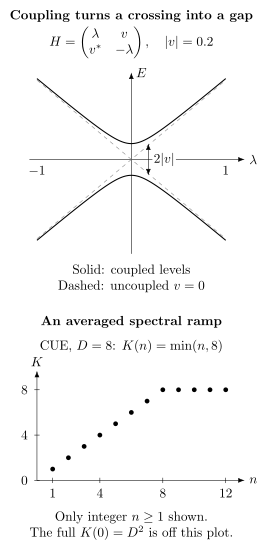
Upper panel: for , compared with the uncoupled crossing. Lower panel: the exact integer-period CUE benchmark for . Local level repulsion and an averaged long-range spectral ramp are different measurements; the two-level calculation alone does not imply the CUE result.
Relation to ETH
Section titled “Relation to ETH”Shared regime, different statements
Section titled “Shared regime, different statements”The ETH ansatz for a few-body observable has the schematic form
with
Here denotes an energy difference, while a Fourier angular frequency would be ; uses the reference-energy convention above. Spectral chaos concerns correlations among the . ETH concerns matrix elements of a declared observable in the energy basis. The two data sets are not the same.
A generic nonintegrable parameter regime often exhibits both:
This is a powerful empirical pattern, not a biconditional theorem.
Random variables retain envelopes and correlations
Section titled “Random variables retain envelopes and correlations”The factor is often modeled as a zero-mean unit-variance random variable over a local energy window. But locality, conservation, Hermiticity, and higher-point consistency impose correlations. The smooth envelope contains dynamical information such as transport and spectral weight.
At low frequency, a conserved mode can produce structure that a featureless random matrix misses. Random-matrix behavior for matrix elements may emerge only below an observable-dependent frequency scale.
Counterexamples to naive equivalence
Section titled “Counterexamples to naive equivalence”- A spectrum can have Wigner–Dyson statistics while a rare set of scarred states violates strong ETH.
- Hilbert-space fragmentation can support ETH-like behavior inside each large component while the union retains memory.
- A chosen local observable can look thermal in a model whose full spectral diagnostics are subtle.
- Mixing exact sectors can make a thermalizing model look Poisson.
- A localized or integrable model can show Poisson statistics for entirely different reasons.
- Spectral statistics alone do not determine a relaxation time or transport law.
Use spectral and ETH tests as mutually constraining evidence, not as synonyms.
OTOC and Scrambling Preview
Section titled “OTOC and Scrambling Preview”For initially separated local operators and , define
and a squared commutator
This probes whether the evolved operator has reached and become noncommuting with the probe at the origin. Spatially resolved can reveal a butterfly front, broadening, and saturation.
It answers a different question from level statistics:
Chaotic systems often show all three, but:
- integrable systems can have ballistic operator fronts;
- free systems can make selected OTOCs decay;
- random-matrix-like spectra do not determine spatial growth;
- a global OTOC can hide front geometry;
- finite-dimensional saturation can mimic a plateau.
Scrambling and OTOCs Preview supplies the regularized thermal correlators, velocity hierarchy, chaos-bound assumptions, and measurement protocols. An OTOC measurement complements the spectral tests without replacing them.
The SYK Model Preview gives a controlled all-to-all example in which an early large- Lyapunov window and much later parity-resolved random-matrix correlations coexist without being the same observable.
Eigenvectors and Basis Dependence
Section titled “Eigenvectors and Basis Dependence”Let
in a chosen basis. The inverse participation ratio is
An extended vector over comparable components has
while a basis vector has .
This diagnostic is explicitly basis dependent. Delocalization in the computational basis can mean something different from delocalization in the eigenbasis of a nearby integrable Hamiltonian. Haar-random vector benchmarks also ignore energy locality and conservation laws unless the comparison ensemble is restricted appropriately.
Entanglement entropy, Porter–Thomas intensity statistics, participation entropies, and eigenstate correlations provide additional evidence. None alone defines chaos. Volume Laws explains the entanglement scaling of states.
What each diagnostic measures
Section titled “What each diagnostic measures”| Diagnostic | Observation | What it does not establish |
|---|---|---|
| adjacent-gap ratios | local repulsion in one block | long-range rigidity or ETH |
| spacing distribution | Dyson small- exponent | mechanism or universal window |
| number variance | rigidity across many levels | dynamics of local observables |
| connected form factor | ramp and plateau after declared averaging | spatial scrambling |
| ETH matrix elements | thermal smoothness and entropy scaling | complete RMT independence |
| participation statistics | basis-relative delocalization | locality or thermalization |
| OTOC front | spatial operator growth | spectral universality |
| local relaxation | loss of memory for chosen observables | absence of scars or hidden sectors |
| size scaling | stability or systematic drift | the infinite-size limit without a model |
The strongest case is overdetermined: several columns agree after their assumptions and scales are made compatible.
Finite-Size and Numerical Failure Modes
Section titled “Finite-Size and Numerical Failure Modes”Exponentially small spacings
Section titled “Exponentially small spacings”In a bulk sector,
up to powers of . Numerical eigenvalue errors must be much smaller than the spacings being analyzed. Loss of orthogonality, insufficient solver tolerance, or accidental duplicate eigenpairs can distort the smallest gaps first.
Too few levels after symmetry resolution
Section titled “Too few levels after symmetry resolution”Correctly resolving symmetries reduces matrix dimension. A very small block may not support a stable histogram. Pooling inequivalent blocks to increase statistics solves the sample-size problem by changing the physical ensemble, which is not acceptable.
Symmetry-related isospectral sectors are duplicate data, not independent samples. Compute statistics within each genuinely distinct block; combining already normalized statistics across comparable blocks is different from pooling their raw levels.
Edge contamination
Section titled “Edge contamination”The low-energy edge can retain quasiparticles, broken-symmetry towers, topology, or critical scaling even when the middle of the spectrum is chaotic. State the energy density and do not generalize a mid-spectrum result to the ground state.
Polynomial unfolding artifacts
Section titled “Polynomial unfolding artifacts”A high-order fit can absorb genuine rigidity, while a low-order fit can leave curvature. Gap ratios, several unfolding schemes, and filtered form factors should be compared.
Disorder and sample averages
Section titled “Disorder and sample averages”Disorder averaging can conceal broad sample-to-sample distributions. Report medians or quantiles when rare samples matter. Do not treat neighboring levels from one realization as fully independent observations.
Dense versus partial eigensolvers
Section titled “Dense versus partial eigensolvers”Shift-invert methods can target a spectral window, but spectral transformation and finite tolerance require validation against dense diagonalization at smaller . Missing or duplicated states invalidate spacing statistics even if individual eigenvalues look accurate.
Experimental Access
Section titled “Experimental Access”Direct many-body spectroscopy becomes exponentially demanding, so experiments often probe adjacent ideas rather than reconstructing a macroscopic spectrum.
Controllable few-qubit systems can map eigenphases, reconstruct states, and compare ergodic and regular parameter regions. Larger quantum processors can measure OTOCs, operator spreading, randomized observables, return probabilities, or spectral form factors through interferometric and randomized protocols.
Interpreting an experiment also requires:
- finite coherence time and gate error;
- imperfect symmetry conservation;
- state-preparation and measurement bias;
- ensemble or random-circuit averaging;
- classical postprocessing assumptions;
- accessible time relative to and ;
- comparison with calibrated integrable and chaotic controls.
Observing rapid entanglement growth or OTOC decay is valuable evidence for information spreading. It is not a direct measurement of Wigner–Dyson energy statistics unless the protocol explicitly reconstructs the relevant spectral correlator.
Boundaries with Neighboring Phenomena
Section titled “Boundaries with Neighboring Phenomena”Integrability
Section titled “Integrability”Integrability is positive structure: an extensive controlled family of charges, factorized scattering, transfer matrices, or equivalent exact machinery. Poisson statistics is supportive evidence after symmetry resolution, not the definition.
Many-body localization
Section titled “Many-body localization”MBL phenomenology combines Poisson-like spectra with local memory, nonthermal eigenstates, suppressed transport, and characteristic entanglement dynamics. Poisson statistics alone cannot distinguish it from a clean integrable model or sector mixing.
Prethermalization
Section titled “Prethermalization”A prethermal system can show chaotic dynamics within an approximately conserved sector while drifting only slowly between sectors. Over that intermediate window one can study exact charge sectors of the effective Hamiltonian. Those approximate charges do not define exact blocks of the full Hamiltonian: exponentially small many-body spacings may resolve leakage on much finer spectral scales.
Quantum scars
Section titled “Quantum scars”A sparse set of atypical eigenstates can coexist with a mostly Wigner–Dyson spectrum and weak ETH. Special initial states can revive even when typical states thermalize. Bulk spectral chaos does not erase every structured eigenstate.
Hydrodynamics
Section titled “Hydrodynamics”Hydrodynamic modes are not failures of chaos. They are universal consequences of conservation and locality that control relaxation before the pure random-matrix regime. Calling every slow mode “nonergodic” confuses a transport timescale with asymptotic memory.
Open systems
Section titled “Open systems”Liouvillian and non-Hermitian spectra have complex eigenvalues and different symmetry classifications. Hermitian spacing ratios and Gaussian ensembles cannot be transferred unchanged.
Worked Microexamples
Section titled “Worked Microexamples”Mixed symmetry sectors
Section titled “Mixed symmetry sectors”Suppose
where each parity block has GOE-like statistics. A level can cross a level because parity forbids coupling:
The merged sequence contains many unconstrained cross-sector spacings. Its small- distribution can have nonzero weight even though each block separately repels. The correct conclusion is not “the model is integrable,” but “the pooled spectrum is not an irreducible ensemble.”
Poisson gap-ratio law
Section titled “Poisson gap-ratio law”For independent exponential gaps and with unit mean, define
The ratio density on is
Its mean is
The derivation appears as an exercise below and illustrates why no unfolding is needed for this local ratio.
Exponential separation of spectral times
Section titled “Exponential separation of spectral times”If a sector contains
states in a bulk band of fixed energy width , then
and
If diffusion sets
then
The universal spectral window can contain exponentially many levels even though it starts only after a polynomially long hydrodynamic time.
Exercises
Section titled “Exercises”1. Derive the Poisson adjacent-gap ratio
Section titled “1. Derive the Poisson adjacent-gap ratio”Let and be independent exponentially distributed gaps with density for . Derive the probability density and mean of
Solution
By symmetry, restrict to and multiply by two. Insert a delta function:
Using
gives
It is normalized because
For the mean,
2. Normalize the GOE Wigner surmise
Section titled “2. Normalize the GOE Wigner surmise”Show that
is normalized and has unit mean spacing.
Solution
For ,
With ,
Also,
Therefore
The result verifies the chosen normalization. It does not make the surmise the exact large-GOE distribution.
3. Resolve a translation and time-reversal subtlety
Section titled “3. Resolve a translation and time-reversal subtlety”A periodic spin chain has time-reversal symmetry and translation symmetry. Explain why a generic momentum block can display GUE statistics while the block displays GOE statistics, assuming and no other antiunitary operation acts within the generic block.
Solution
Time reversal reverses momentum:
For generic , the sectors and are distinct. Thus is a symmetry of their direct sum but is not an antiunitary operator acting inside . The irreducible block therefore has no internal antiunitary constraint and can belong to the unitary class.
At , one has modulo the reciprocal lattice vector. Time reversal acts within the block and squares to , selecting the orthogonal class after any remaining unitary symmetries are resolved.
Pooling and to “restore” time reversal is not a GOE analysis; it combines two correlated but distinct blocks.
4. Avoided crossing criterion
Section titled “4. Avoided crossing criterion”Diagonalize
and find its minimum level spacing. What changes if a symmetry forces ?
Solution
The characteristic equation is
so
The spacing is
with minimum
at .
If symmetry forces , then
and the levels cross exactly at . This is the local reason independent symmetry sectors must not be pooled in a repulsion test.
5. Compare Thouless and Heisenberg times
Section titled “5. Compare Thouless and Heisenberg times”Consider a periodic one-dimensional diffusive chaotic chain with entropy density , diffusion constant independent of , and a bulk spectral window of fixed energy width . Estimate the size dependence of , , and their ratio.
Solution
The slowest diffusive wave number is
Hence
where an order-one geometric factor has been suppressed.
The number of states in the bulk window scales as
so the mean spacing scales as
Therefore
The ratio is
Thus the interval between hydrodynamic relaxation and spectral discreteness grows rapidly with , even though direct numerical access to becomes correspondingly difficult.
6. Why the connected form factor is needed
Section titled “6. Why the connected form factor is needed”Suppose the averaged filtered amplitude is nonzero:
Show how the ordinary form factor decomposes and explain what the disconnected term measures.
Solution
Write
with
Then
The first term is the disconnected piece. It is controlled by the smooth one-level density and the chosen filter. The second term is
which probes connected spectral fluctuations. Failing to subtract the first term can confuse the Fourier transform of the density of states with two-level universality.
7. Distinguish spectral chaos from ETH
Section titled “7. Distinguish spectral chaos from ETH”A model has GOE-like gap ratios in the middle of each symmetry sector, but one specially prepared product state shows long-lived revivals. List three logically different explanations and one diagnostic for each.
Solution
Possible explanations include:
- Quantum scars. A sparse set of atypical eigenstates has large overlap with the product state. Inspect overlap weights, eigenstate entanglement, and diagonal matrix elements of the participating states.
- Approximate conservation or prethermalization. The state lies in an almost-invariant manifold. Track a proposed quasi-conserved quantity and scale the revival or plateau lifetime with the symmetry-breaking parameter.
- Finite-size recurrence. A small set of commensurate gaps produces a revival. Increase , vary boundaries, and test whether the recurrence time and amplitude drift.
One could also test sector contamination, an exact dynamical symmetry, or fragmentation. GOE-like bulk spacings rule out none of these state-selective mechanisms by themselves.
8. Design a converged spin-chain test
Section titled “8. Design a converged spin-chain test”Design a numerical test of the integrability-to-chaos crossover in the mixed-field Ising chain. Your answer must specify sectors, windows, local and long-range diagnostics, and a finite-size check.
Solution
A defensible design is:
- Choose open boundaries and fixed and , then scan from zero into a generic nonintegrable regime.
- Resolve reflection parity for uniform open chains and the additional global spin-flip symmetry at . If edge fields remove these symmetries, check that the desired integrable reference has not also been destroyed; do not assume one unchanged sector decomposition along the whole scan.
- For each , choose one or more fixed central energy-density windows and exclude the spectral edges.
- Compute the full adjacent-gap-ratio distribution and mean with a bootstrap uncertainty.
- Independently unfold with at least two smooth-density procedures and compare the spacing distribution and number variance.
- Compute a filtered connected spectral form factor, varying the filter and smoothing bandwidth.
- Extract crossover couplings separately for each diagnostic rather than assuming one value.
- Repeat over several and shifted windows. Validate partial eigensolver output against dense diagonalization at smaller sizes.
- Compare with ETH diagonal fluctuations for a local observable, while keeping that result conceptually separate from the spectral tests.
The output should report drift and uncertainty, not only the visually best collapse.
Further Connections
Section titled “Further Connections”- Relaxation and Thermalization for dephasing, equilibration, and ensemble selection;
- Exact Solutions Preview for positive criteria of integrability;
- Time-Dependent Correlations for ordinary dynamical correlators and spectral functions;
- Number Operators and Conserved Quantities for symmetry-sector construction;
- Microcanonical Ensemble for energy-window conventions.
- SYK Model Preview for a model-specific mod-8 symmetry cycle, disorder average, and finite- benchmark.
References
Section titled “References”- Y. Y. Atas, E. Bogomolny, O. Giraud, and G. Roux, “Distribution of the ratio of consecutive level spacings in random matrix ensembles,” Physical Review Letters 110, 084101 (2013). doi:10.1103/PhysRevLett.110.084101
- M. V. Berry and M. Tabor, “Level clustering in the regular spectrum,” Proceedings of the Royal Society A 356, 375–394 (1977). doi:10.1098/rspa.1977.0140
- B. Bertini, P. Kos, and T. Prosen, “Exact spectral form factor in a minimal model of many-body quantum chaos,” Physical Review Letters 121, 264101 (2018). doi:10.1103/PhysRevLett.121.264101
- O. Bohigas, M. J. Giannoni, and C. Schmit, “Characterization of chaotic quantum spectra and universality of level fluctuation laws,” Physical Review Letters 52, 1–4 (1984). doi:10.1103/PhysRevLett.52.1
- A. Chan, A. De Luca, and J. T. Chalker, “Spectral statistics in spatially extended chaotic quantum many-body systems,” Physical Review Letters 121, 060601 (2018). doi:10.1103/PhysRevLett.121.060601
- A. Chan, A. De Luca, and J. T. Chalker, “Solution of a minimal model for many-body quantum chaos,” Physical Review X 8, 041019 (2018). doi:10.1103/PhysRevX.8.041019
- A. Chan, A. De Luca, and J. T. Chalker, “Eigenstate correlations, thermalization, and the butterfly effect,” Physical Review Letters 122, 220601 (2019). doi:10.1103/PhysRevLett.122.220601
- A. Dymarsky, “Bound on eigenstate thermalization from transport,” Physical Review Letters 128, 190601 (2022). doi:10.1103/PhysRevLett.128.190601
- F. J. Dyson, “The threefold way: algebraic structure of symmetry groups and ensembles in quantum mechanics,” Journal of Mathematical Physics 3, 1199–1215 (1962). doi:10.1063/1.1703863
- L. D’Alessio, Y. Kafri, A. Polkovnikov, and M. Rigol, “From quantum chaos and eigenstate thermalization to statistical mechanics and thermodynamics,” Advances in Physics 65, 239–362 (2016). doi:10.1080/00018732.2016.1198134
- L. Foini and J. Kurchan, “Eigenstate thermalization hypothesis and out of time order correlators,” Physical Review E 99, 042139 (2019). doi:10.1103/PhysRevE.99.042139
- A. J. Friedman, A. Chan, A. De Luca, and J. T. Chalker, “Spectral statistics and many-body quantum chaos with conserved charge,” Physical Review Letters 123, 210603 (2019). doi:10.1103/PhysRevLett.123.210603
- H. Gharibyan, M. Hanada, S. H. Shenker, and M. Tezuka, “Onset of random matrix behavior in scrambling systems,” Journal of High Energy Physics 2018, 124 (2018). doi:10.1007/JHEP07(2018)124
- F. Haake, Quantum Signatures of Chaos, 3rd ed., Springer (2010).
- P. Kos, M. Ljubotina, and T. Prosen, “Many-body quantum chaos: analytic connection to random matrix theory,” Physical Review X 8, 021062 (2018). doi:10.1103/PhysRevX.8.021062
- M. L. Mehta, Random Matrices, 3rd ed., Elsevier (2004).
- C. Neill, P. Roushan, M. Fang, Y. Chen, M. Kolodrubetz, Z. Chen, A. Megrant, R. Barends, B. Campbell, B. Chiaro, A. Dunsworth, E. Jeffrey, J. Kelly, J. Mutus, P. J. J. O’Malley, C. Quintana, D. Sank, A. Vainsencher, J. Wenner, T. C. White, A. Polkovnikov, and J. M. Martinis, “Ergodic dynamics and thermalization in an isolated quantum system,” Nature Physics 12, 1037–1041 (2016). doi:10.1038/nphys3830
- V. Oganesyan and D. A. Huse, “Localization of interacting fermions at high temperature,” Physical Review B 75, 155111 (2007). doi:10.1103/PhysRevB.75.155111
- D. A. Rabson, B. N. Narozhny, and A. J. Millis, “Crossover from Poisson to Wigner–Dyson level statistics in spin chains with integrability breaking,” Physical Review B 69, 054403 (2004). doi:10.1103/PhysRevB.69.054403
- L. F. Santos and M. Rigol, “Onset of quantum chaos in one-dimensional bosonic and fermionic systems and its relation to thermalization,” Physical Review E 81, 036206 (2010). doi:10.1103/PhysRevE.81.036206
- M. Winer and B. Swingle, “Hydrodynamic theory of the connected spectral form factor,” Physical Review X 12, 021009 (2022). doi:10.1103/PhysRevX.12.021009