

Functions of Operators
A function of an operator is obtained by applying a scalar function to the operator’s spectral values while retaining its spectral subspaces. It is not, in general, obtained by applying the function separately to the entries of one matrix representation.
For a self-adjoint operator with finite spectral decomposition
the defining rule is
This one construction gives precise meanings to , , , , spectral projectors, and many other expressions used throughout quantum mechanics. When is real-valued, it also has a direct physical interpretation: its outcome probabilities equal those obtained by measuring and reporting . The resulting state disturbance need not agree: resolving the finer outcomes can destroy coherence that a direct coarse measurement preserves.
Helpful background. Spectral decomposition supplies eigenspace projectors; spectra explains the continuous-spectrum extension.
Spectral Values and Functions
Section titled “Spectral Values and Functions”We start with a finite-dimensional self-adjoint operator, then extend the construction to spectral integrals. General spectral functions are assumed Borel measurable and finite almost everywhere with respect to the spectral measure.
Three conventions matter:
- denotes the spectrum of .
- A scalar function only needs to be specified on ; changing it away from the spectrum does not change .
- When is unbounded, the domain is part of the definition.
General functions of nonnormal or nondiagonalizable matrices require additional machinery. Their finite-dimensional construction belongs to Matrix Functions and Exponentials.
Finite-Dimensional Spectral Definition
Section titled “Finite-Dimensional Spectral Definition”Let act on a finite-dimensional Hilbert space. Write its spectral decomposition using the distinct eigenvalues :
For any function defined on the finite set , define
If belongs to the eigenspace , then
The degeneracy label is untouched. Functional calculus changes the spectral value attached to an eigenspace, not the vectors inside that eigenspace.
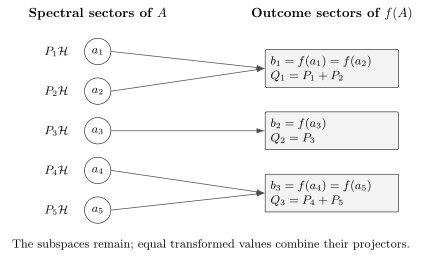
Functional calculus retains each subspace while replacing by . If several values have the same image , the corresponding spectral projector of is their sum, such as .
Basis Independence
Section titled “Basis Independence”Suppose is diagonalized as
Then
where
More generally, under a unitary change of representation,
This covariance is the test that an operator construction is independent of a chosen basis.
Why entrywise substitution fails
Section titled “Why entrywise substitution fails”Consider
Applying to each entry leaves this matrix unchanged. The operator square instead means composition:
Entrywise substitution depends on the displayed basis and usually does not represent any intrinsic function of the operator.
Algebraic Laws
Section titled “Algebraic Laws”For finite-dimensional , the map preserves the ordinary algebra of scalar functions. For scalars ,
For general self-adjoint , the sum, product, and adjoint identities also hold for bounded Borel functions. The identity function can be unbounded, in which case includes its domain. The displayed composition rule uses real-valued to keep self-adjoint; complex-valued requires the normal-operator calculus.
The product law follows immediately from orthogonality of the spectral projectors:
Several useful tests follow:
- If is real-valued on , then is self-adjoint.
- If on , then is positive.
- If on , then is unitary.
- Every commutes with and with every spectral projector .
For unbounded and , these formulas acquire domain qualifications. One must not replace operator inclusions by equalities without checking the domains of the sums and products.
Spectrum, Norm, and Kernel
Section titled “Spectrum, Norm, and Kernel”In finite dimensions, the spectral mapping rule is exact:
Repeated values are listed only once in the set on the right. The operator norm and kernel are
and
For a bounded self-adjoint operator and continuous , the same spectral mapping and norm formulas hold, with the maximum taken over the compact spectrum. For a merely Borel function, the correct general statement uses its essential range relative to the projection-valued spectral measure; the naive set-theoretic image can contain values carried by no spectral weight.
Relabeling and Coarse Graining
Section titled “Relabeling and Coarse Graining”Let be a distinct value of on . The spectral projector of associated with is
There are two qualitatively different cases.
Injective functions preserve all spectral labels
Section titled “Injective functions preserve all spectral labels”If is one-to-one on , every can be recovered from . The observables and have the same spectral projectors, and there is a function on such that
Thus contains exactly the same sharp spectral information as .
Noninjective functions merge outcomes
Section titled “Noninjective functions merge outcomes”If for distinct eigenvalues, cannot distinguish the corresponding eigenspaces. Their projectors add. This is a genuine coarse graining of the sharp observable, even though the operator remains a perfectly well-defined function of .
This distinction is central when deciding whether a derived operator supplies a new label in a complete set of commuting observables. A function of one member automatically commutes with it, but it may be redundant or may erase labels rather than resolve them.
Measurement Distribution of a Function
Section titled “Measurement Distribution of a Function”In this section, let be real-valued and Borel measurable on , so is again a self-adjoint observable. Let be the spectral projector of for a Borel set . The projection-valued measure of obeys
For a state , define the outcome measure
Then
In probability language, the distribution of is the pushforward of the distribution of under . In the finite discrete case,
Whenever the expectation is defined,
Powers give moments, so and the variance are special cases of this rule. Their statistical interpretation is developed in Variance and Standard Deviation.
Which Commuting Operators Are Functions?
Section titled “Which Commuting Operators Are Functions?”Every commutes with , but the converse depends on degeneracy.
If has a nondegenerate finite spectrum, every operator satisfying is diagonal in the eigenbasis of . Assigning the corresponding diagonal value of to each eigenvalue of defines a function such that
If has degenerate eigenspaces, an operator commuting with may act nontrivially inside each eigenspace. A function cannot do that: it is a scalar multiple of the identity on every . Therefore
in a typical degenerate case.
This is the operator-algebra version of the statement that a single degenerate observable does not label a basis completely.
Every Finite Spectral Function Is a Polynomial
Section titled “Every Finite Spectral Function Is a Polynomial”Although may be nonanalytic or even discontinuous away from the spectrum, its values on a finite spectrum can always be interpolated by a polynomial. Define
These polynomials satisfy and
Consequently,
Thus every function of a finite-dimensional self-adjoint operator equals a polynomial in that operator of degree at most . This statement concerns agreement on the finite spectral set; it does not claim that the original scalar function is globally polynomial.
Polynomial and Power-Series Routes
Section titled “Polynomial and Power-Series Routes”For a polynomial
the spectral definition agrees with ordinary operator algebra:
For bounded self-adjoint , if a power series for converges uniformly on the spectrum, then its operator series converges in operator norm:
The spectral rule is more general. It defines discontinuous functions such as characteristic functions and sign functions, for which no globally convergent Taylor series is available. A series is therefore a computational route under appropriate convergence conditions, not the universal definition.
Positive Square Roots and Absolute Values
Section titled “Positive Square Roots and Absolute Values”Let be a positive self-adjoint operator. Since its spectrum is contained in , the nonnegative square-root function defines
In finite dimensions this is
It is the unique positive self-adjoint operator satisfying
The adjective positive removes the branch ambiguity. An operator can have other square roots, and a scalar square-root branch need not be defined on the spectrum of a general operator.
For self-adjoint , its absolute value is
Defining gives the bounded sign operator and the factorization
on . This is the self-adjoint case of polar decomposition.
Inverses, Reciprocals, and Zero
Section titled “Inverses, Reciprocals, and Zero”For a finite-dimensional operator,
exists exactly when no eigenvalue is zero. For a general self-adjoint operator, the bounded everywhere-defined inverse exists exactly when
The distinction between spectrum and point spectrum now matters. It is possible that even though is not an eigenvalue. In that case the reciprocal function may define a densely defined, unbounded inverse:
with a proper domain determined by square integrability near . The scalar function may be assigned any finite value at because the spectral projector of that singleton vanishes in this case.
If zero is an eigenvalue, no two-sided inverse exists on the full Hilbert space. The Moore–Penrose pseudoinverse instead uses
It annihilates the kernel. In infinite dimensions it can still be unbounded if nonzero spectral values accumulate at zero.
Exponentials and Unitary Groups
Section titled “Exponentials and Unitary Groups”For self-adjoint and real , the function has unit modulus. Therefore
is a bounded unitary operator on the whole Hilbert space, even when itself is unbounded. It satisfies
For a time-independent self-adjoint Hamiltonian,
Each energy sector acquires the phase . The dynamical meaning, continuity in , and generator relation belong to Unitary Time Evolution.
By contrast, for real need not be bounded when is unbounded. Its domain must then be determined from the spectral growth of .
A Useful Projector Identity
Section titled “A Useful Projector Identity”An orthogonal projector has spectrum contained in . Hence
For the exponential,
This identity is often faster than expanding the series. It follows equally from for every .
The Resolvent as a Function
Section titled “The Resolvent as a Function”For , the scalar function
is bounded on the spectrum. It defines the resolvent
For self-adjoint ,
The resolvent packages spectral and dynamical information, but its analytic structure and boundary values have their detailed treatment in Resolvent Operator.
Worked Example: Squaring Spin One
Section titled “Worked Example: Squaring Spin One”Let act in the spin-one space, with projectors , , and :
Applying gives
The outcomes of are and . For
their probabilities are
Squaring has merged the and sectors. Measuring cannot recover the sign of the original outcome.
Worked Example: Any Function of a Qubit Observable
Section titled “Worked Example: Any Function of a Qubit Observable”Write a Hermitian two-level operator as
For , define
The two eigenvalues and projectors are
Therefore every function of reduces to
Choosing yields
This is the spectral origin of the familiar Pauli-matrix exponential. If , then and simply .
Continuous Spectra and Spectral Integrals
Section titled “Continuous Spectra and Spectral Integrals”For a self-adjoint operator with projection-valued measure , the general definition is
This includes discrete, continuous, and mixed spectra in one expression. A bounded Borel function gives a bounded normal operator on all of . If is real-valued, is self-adjoint; if , it is positive.
The construction and the projection-valued measure are developed from the mathematical side in Spectral Theorem, Practical Version.
Natural Domain of an Unbounded Function
Section titled “Natural Domain of an Unbounded Function”For , define its scalar spectral measure by
If is unbounded, a vector belongs to exactly when
On this domain,
This formula explains exactly why rapid spectral growth shrinks the domain. It also shows why a bounded phase such as is harmless even when the generator is unbounded.
Position as a Multiplication Operator
Section titled “Position as a Multiplication Operator”On , the position operator acts as
Functional calculus acts pointwise in this particular representation:
with domain
For example,
Thus is strictly smaller than . Writing an extra power of an unbounded operator is not merely an algebraic change; it imposes a stronger condition on the state.
Commutation with Other Operators
Section titled “Commutation with Other Operators”In finite dimensions, implies
for every . For an unbounded self-adjoint , the reliable hypothesis is that bounded commutes with all spectral projectors of . Then also preserves and there. In particular, bounded commutes with everywhere.
For two unbounded self-adjoint operators, vanishing of a formal commutator on a small common domain is not enough. Strong commutation means that their spectral measures commute. Under that condition, bounded functions of the two operators commute as expected.
The familiar identity
is valid for bounded commuting operators. For strongly commuting self-adjoint generators, the corresponding unitary formula is , where the sum has its self-adjoint closure. Real exponentials of unbounded operators require additional domain care. It is generally false for noncommuting operators. The missing corrections are organized by product formulas or the Baker–Campbell–Hausdorff expansion, not by scalar algebra.
Positivity Does Not Make Every Function Operator Monotone
Section titled “Positivity Does Not Make Every Function Operator Monotone”For one fixed self-adjoint , the implication
is valid. A different statement compares two operators. From and an ordinary increasing scalar function , it does not generally follow that . Functions with that stronger property are called operator monotone, and they form a restricted class.
This distinction prevents scalar intuition from being applied to operators that do not share a spectral basis.
Branches and Singularities
Section titled “Branches and Singularities”Before applying a function, inspect it on the actual spectrum.
- The positive square root is canonical for a positive operator, but a square root of a general operator can depend on a branch and need not be unique.
- The logarithm requires a branch choice unless the spectral location supplies a canonical one. Zero is singular for .
- The reciprocal is bounded only when the spectrum stays a positive distance from zero.
- Characteristic functions are discontinuous but still define spectral projectors through the Borel functional calculus.
- Two scalar formulas that agree on define the same operator, even if they differ everywhere else.
Common Pitfalls
Section titled “Common Pitfalls”Apply the function to eigenvalues, not entries. Diagonalize, transform the eigenvalues, and transform back, or use an identity such as the qubit formula. For large sparse matrices, numerical matrix exponentials often avoid full diagonalization.
A reciprocal can be unbounded without a zero eigenvector. The spectrum may approach zero continuously. A bounded inverse needs zero outside the entire spectrum, not merely outside the point spectrum.
A spectral expectation and an operator domain use different moments. A finite expectation of real needs . Applying as a Hilbert-space vector requires .
Commutation does not remove degeneracy. A commuting operator can act differently within one degenerate eigenspace, whereas acts as a scalar there. Functions of existing labels cannot supply a missing degeneracy label.
Exercises
Section titled “Exercises”Exercise 1: Algebra of the spectral calculus
Section titled “Exercise 1: Algebra of the spectral calculus”Let . Prove directly that
Use the second identity to show that real-valued gives a self-adjoint operator.
Solution
Orthogonality gives
Because every spectral projector is self-adjoint,
If is real for every , then on the spectrum, so .
Exercise 2: Exponential of a projector
Section titled “Exercise 2: Exponential of a projector”For a nonzero orthogonal projector , derive and find its inverse. For which complex is the exponential unitary?
Solution
The eigenvalue-zero projector is , while the eigenvalue-one projector is . Therefore
Its inverse is
Since , the operator is unitary exactly when , or . For the excluded case , the exponential is for every .
Exercise 3: Coarse graining spin one
Section titled “Exercise 3: Coarse graining spin one”A normalized spin-one state has amplitudes , , and in the basis. Determine the spectral projectors and probabilities for . What information from a measurement has been lost?
Solution
The square maps and to , while it maps zero to zero. Hence
The probabilities are
The sign of the nonzero magnetic quantum number has been lost. No outcome of distinguishes from .
Exercise 4: Qubit functional formula
Section titled “Exercise 4: Qubit functional formula”Let with . Show that
Use the result to compute .
Solution
The projectors of are
and the eigenvalues of are . Therefore
For , , and , the two spectral values are equal:
Exercise 5: Interpolating an inverse
Section titled “Exercise 5: Interpolating an inverse”Suppose is a finite-dimensional self-adjoint operator with exactly the distinct dimensionless eigenvalues , , and . Find a polynomial of degree at most two that equals when evaluated at .
Solution
Seek satisfying
Solving gives
Thus
The equality is exact because the two scalar functions agree at every point of .
Exercise 6: A strict domain inclusion
Section titled “Exercise 6: A strict domain inclusion”On , let be multiplication by . Show that
can be normalized and belongs to but not to .
Solution
Using dimensionless for this domain example, normalization gives , so one can choose . At large ,
so the normalization integral converges. For the tail of the norm integrand is
which is integrable. For , it is
which is not integrable. Therefore but . Nevertheless the second spectral moment is finite: . It is the norm squared of , not a demand that itself belong to the Hilbert space.
Exercise 7: Reciprocal at continuous spectrum
Section titled “Exercise 7: Reciprocal at continuous spectrum”Let be multiplication by on . Explain why has no zero eigenvector but still has no bounded inverse. State the domain and action of its densely defined reciprocal.
Solution
A vector satisfying almost everywhere must vanish except possibly at the measure-zero point , so it represents the zero vector in . Thus .
Nevertheless, values of approach zero on sets of positive measure, so the reciprocal multiplier is unbounded and . Functional calculus gives
on the dense set of vectors satisfying
This domain is dense but is not the whole Hilbert space.
Exercise 8: Scalar monotonicity is not enough
Section titled “Exercise 8: Scalar monotonicity is not enough”Consider
Show that but . What does this say about the scalar function ?
Solution
Both and are positive. Moreover,
is positive semidefinite, so . But
Its determinant is , so it has one negative eigenvalue and is not positive. Therefore .
Although is increasing on , it is not operator monotone on that interval.
References
Section titled “References”- B. C. Hall, Quantum Theory for Mathematicians, Springer, 2013. Publisher.
- N. J. Higham, Functions of Matrices: Theory and Computation, Society for Industrial and Applied Mathematics, 2008.
- G. Teschl, Mathematical Methods in Quantum Mechanics: With Applications to Schrödinger Operators, 2nd ed., American Mathematical Society, 2014, Chapters 3–5. Author’s book page and online edition.