

From Spin Experiments to Spin Formalism
Spin entered quantum mechanics through evidence that did not fit ordinary orbital motion: discrete Stern–Gerlach splitting, anomalous Zeeman patterns, atomic doublets, and Pauli’s two-valuedness. The modern result is a compact formalism: a spin- system is described by a two-dimensional Hilbert space, spin components are represented by Pauli matrices, and rotations act through .
Begin with Stern–Gerlach Experiment for the apparatus, use What Spin Is and Is Not for its physical meaning, and study Spin-1/2 Hilbert Space.
Spin Projection and Beam Deflection
Section titled “Spin Projection and Beam Deflection”The Stern–Gerlach experiment sends a neutral atomic beam through an inhomogeneous magnetic field. A classical distribution of magnetic-moment orientations suggests a continuous smear of deflections. The original silver beam resolved two components. In the modern electronic ground-state description, a closed shell has zero net angular momentum and the outer electron gives . This is an atomic magnetic-moment measurement, not a beam of free electrons.
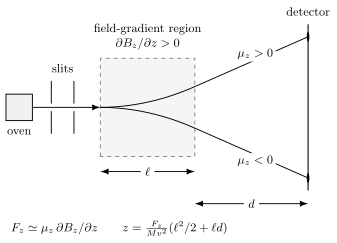
An inhomogeneous magnetic field converts magnetic-moment projection into spatial deflection. In the spin- idealization, a single analyzer has two output beams associated with two eigenvalues of the measured spin component.
In modern notation, an apparatus oriented along a unit vector measures the spin component
For spin-,
so the possible outcomes are
The sign of the spatial deflection also depends on and the field gradient. For an electron , so “upper beam” need not mean positive spin. The key change from a classical picture is not merely that two values appear. It is that each apparatus axis defines a different observable. A state with a sharp projection is generally not sharp along . Sequential Stern–Gerlach experiments therefore reveal both discreteness and noncommuting measurement axes.
Two-Level Systems
Section titled “Two-Level Systems”A spin- Hilbert space is two-dimensional. Choosing the eigenbasis,
A general pure state is
with
The probabilities for a -axis measurement are
The relative phase between and is physically important. It affects measurements along axes other than , even though an overall global phase does not change the physical ray. This is why a two-level system is richer than a classical bit with two possible labels.
Spin is the cleanest historical entrance, but the same two-dimensional mathematics appears in many places: two atomic levels, two localized wells, polarization qubits, superconducting circuit states, and effective avoided crossings. Explore other two-level realizations in Two-Level Systems and Spin-1/2 as a Canonical System.
Spin Projection
Section titled “Spin Projection”For any measurement direction , the spin-up and spin-down projectors can be written
Given a normalized state , the probabilities are
This formula is the formal version of the two-spot experiment. The magnet orientation chooses ; the spin state determines the probabilities; the measurement output is one of the two eigenvalues.
For example, the -axis eigenstates are
Thus a state prepared as gives equal probabilities for and . This is not ignorance about a hidden classical label inside the same formalism. It is the Born rule applied to a different measurement basis.
To calculate the effect of measuring and then selecting an output, use Projective Measurement and Sequential Measurements.
Pauli Matrices
Section titled “Pauli Matrices”The Pauli Matrices obey
With , this gives the angular-momentum commutator . It also lets us expand every Hermitian two-by-two Hamiltonian as
with real and , all with units of energy.
The vector behaves like an effective field in the two-level Hilbert space. That form appears in spin magnetic resonance, avoided crossings, driven atoms, and qubit Hamiltonians. The detailed matrix treatment belongs to Pauli Matrices and Two-State Hamiltonians.
SU(2) Rotations
Section titled “SU(2) Rotations”Spin is not merely a two-outcome measurement label. It is tied to spatial rotations. A spin- rotation by angle about is represented by
The half-angle is a signature of the relation between and . A rotation multiplies a spinor by , while a rotation returns it to itself. For a single isolated ray, the sign is not observable. If a rotation acts on only one arm of a coherent interferometer, however, the minus sign becomes a relative phase between arms and can shift the output fringes.
The angular-momentum algebra is the shared structure behind orbital angular momentum, spin, and rotations. The spinor-specific treatment is Spin Rotations, and the broader algebraic home is Angular Momentum Algebra.
Qubit Language
Section titled “Qubit Language”A qubit is an abstract two-dimensional quantum system. Spin- supplies the prototype, but the word “qubit” does not mean “electron spin” by definition. It means the system has a chosen two-dimensional computational subspace with coherent superpositions, controlled operations, and measurements.
The Bloch-sphere parameterization makes the connection explicit. A pure spinor can be written, up to global phase, as
The corresponding Bloch vector is
For density operators,
This language unifies spin measurements, two-level atoms, driven systems, and quantum-information gates. Its danger is overfamiliarity: the Bloch sphere is a representation of a two-dimensional Hilbert space, not a literal sphere on which a microscopic arrow always points. Use Bloch Sphere for spinors and Bloch Sphere: Wave-Mechanics Perspective for broader two-level systems.
Combining the density operator with the spin projector gives a useful measurement formula:
Thus gives equal outcomes on every axis, whereas a unit Bloch vector gives one certain outcome along that vector. The same formula handles pure and mixed states without introducing a hidden classical spin direction.
Exercises
Section titled “Exercises”- A spin- state is . What are the probabilities for measuring ?
Solution
Use
The amplitudes for and are both , so
- Show that projects onto in the standard basis.
Solution
In the standard basis,
Therefore
which leaves unchanged and annihilates .
- Why is a qubit not the same thing as a classical bit with an unknown value?
Solution
A classical bit has one of two values, even if an observer is ignorant of which one. A qubit state can be a coherent superposition with a relative phase. That phase affects measurements in other bases and enables interference. A mixed state can represent ignorance, but a pure superposition is not merely an unknown classical bit value.
- A state has Bloch vector . Find its and probabilities. Is it pure?
Solution
The probabilities are and . Its Bloch-vector length is less than one, so it is mixed. Its purity is .
References
Section titled “References”- W. Gerlach and O. Stern, “Der experimentelle Nachweis der Richtungsquantelung im Magnetfeld,” Zeitschrift für Physik 9, 349-352, 1922.
- M. A. Nielsen and I. L. Chuang, Quantum Computation and Quantum Information, Cambridge University Press, 2010.
- W. Pauli, “Über den Zusammenhang des Abschlusses der Elektronengruppen im Atom mit der Komplexstruktur der Spektren,” Zeitschrift für Physik 31, 765-783, 1925.
- W. Pauli, “Zur Quantenmechanik des magnetischen Elektrons,” Zeitschrift für Physik 43, 601-623, 1927.
- J. J. Sakurai and J. Napolitano, Modern Quantum Mechanics, 3rd ed., Cambridge University Press, 2020.
- R. Shankar, Principles of Quantum Mechanics, 2nd ed., Springer, 1994.
- G. E. Uhlenbeck and S. Goudsmit, “Spinning Electrons and the Structure of Spectra,” Nature 117, 264-265, 1926.