

From Photons to Quantum Fields
Emission, absorption, and photon-counting experiments raise a common question: how can a quantum theory describe changing amounts of radiation? The modern answer is that radiation is naturally described by quantum states of fields, and photon number can change. Number states, coherent light, and emitted photon pairs fit within that variable-occupation description.
For the development of the photon concept, read Light Quanta and Photon Evidence and From Light Quanta to Photons. The field-theory references are Harmonic Oscillator to Fields, Fock Space, and Second Quantization.
Light Quanta in Early Quantum Mechanics
Section titled “Light Quanta in Early Quantum Mechanics”Einstein’s light quantum hypothesis assigned discrete radiation energy
to light of frequency . The photoelectric effect made this relation experimentally compelling: the electron energy depends on frequency, not just intensity. Millikan’s measurements established the linear energy–frequency law. That law alone does not uniquely demand a quantized field: semiclassical models with quantized matter and a classical drive can also reproduce it. Nonclassical photon-counting correlations provide a sharper test of the field state.
Compton scattering added momentum to the story. In vacuum, a photon mode with wavevector carries
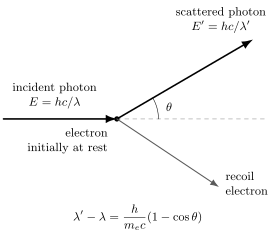
Compton scattering made the energy-momentum aspect of photons difficult to avoid. The modern endpoint is not a classical bullet model of light, but a quantum-field description in which photons are excitations of electromagnetic modes.
These relations are necessary but not sufficient for a full photon theory. Early light quanta explained some exchange processes, but they did not yet provide a complete account of interference, polarization, multiphoton states, emission and absorption dynamics, or gauge-field locality.
Photon States in Quantum Optics
Section titled “Photon States in Quantum Optics”Quantum optics treats light modes as quantum systems. A single field mode behaves like a harmonic oscillator, with number states
Start in a large periodic box, so wavevectors are discrete. Let label one transverse electromagnetic mode; has two polarization values. With ,
A one-photon wavepacket is a superposition of mode excitations,
In the infinite-volume limit the sum becomes an integral and the Kronecker delta becomes a Dirac delta with matching normalization. The finite-box version avoids treating an exact continuum momentum eigenstate as a normalizable vector.
Not all optical states have definite photon number. Coherent states approximate classical laser fields while containing a distribution over number states. Thermal light, squeezed light, entangled photon pairs, and number states are physically distinct quantum states of modes. The phrase “a photon” is therefore context-dependent: it may mean a counted detection event, a one-quantum Fock state, a wavepacket excitation, or a component of a more general optical state.
Photon Number Can Change
Section titled “Photon Number Can Change”Fixed-particle nonrelativistic quantum mechanics is not enough for photons because radiation processes change photon number. An excited atom may emit a photon:
For , an atom may absorb one:
Stimulated emission, absorption, spontaneous emission, Raman scattering, fluorescence, parametric down-conversion, and pair production all require a language in which the radiation field has variable occupation.
Semiclassical models are still useful. Treating the electromagnetic field as a prescribed classical drive can accurately describe many transition rates, Rabi oscillations, and spectroscopy experiments within a domain. But a classical external field cannot by itself describe spontaneous emission as the creation of a field quantum, nor reproduce every photon-counting correlation. Some counting statistics are compatible with classical fluctuating fields plus a photodetection model; antibunching can distinguish them.
The many-particle bridge is From Quantum Statistics to Fock Space, and the mode-operator calculation is developed in Creation and Annihilation Operators.
Relativistic Locality
Section titled “Relativistic Locality”Photons are massless spin-1 excitations. They have no rest frame, carry polarization constrained by gauge structure, and are not naturally described by the same position-space wavefunction framework used for a massive nonrelativistic particle.
Relativistic locality also changes the question. A theory of light and charged matter must describe local interactions between electromagnetic fields and charged fields. It must respect causality, Lorentz symmetry, gauge invariance, and conservation laws. In such a theory, particle number is generally not fundamental in the same way as charge or energy-momentum conservation.
This is one reason quantum field theory is not optional decoration for photons. It supplies:
- local field operators rather than only particle coordinates;
- creation and annihilation operators for field modes;
- a vacuum state with physical structure;
- emission and absorption as interaction processes;
- a natural treatment of processes in which particle number changes;
- a framework for relativistic covariance and gauge symmetry.
Nonrelativistic quantum mechanics remains indispensable as an approximation. Atomic and optical systems often use effective Hamiltonians, rotating-wave approximations, and finite-mode models. The point is not that every photon problem requires full high-energy QED. The point is that the conceptual home of photons is field quantization.
Field Modes and Creation Operators
Section titled “Field Modes and Creation Operators”The mathematical bridge starts from the harmonic oscillator. A single oscillator has
In the finite-box mode convention above, the free-field Hamiltonian is
Each counts occupation of one mode. The ladder rules are
The total vacuum-energy sum diverges if arbitrarily high-frequency modes are included; it requires a consistent regularization and energy-reference prescription. It is not a finite extra photon population. Introducing modes does not by itself solve interacting QED: gauge constraints, coupling to charged matter, and renormalization remain additional parts of that theory.
Continuing to Field Quantization
Section titled “Continuing to Field Quantization”Start with Harmonic Oscillator to Fields to learn why a mode has ladder operators. Then use Fock Space to combine sectors of different occupation, and Field Operators to connect mode amplitudes with spatial fields. These steps explain photon creation at optical energies; full relativistic scattering requires further structure.
Exercises
Section titled “Exercises”- Why does photon emission force a variable-particle-number description?
Solution
If an excited atom emits a photon, the radiation field changes from an -photon state to an -photon state in the relevant mode or wavepacket. A fixed-particle Hilbert space cannot represent this process as a state within one sector. Fock space can, because it contains a direct sum over particle-number sectors.
- What is the difference between a semiclassical drive and a quantized radiation mode?
Solution
A semiclassical drive treats the electromagnetic field as a prescribed classical function of space and time while the atom or material system is quantum. A quantized radiation mode is itself a quantum degree of freedom with states such as , operators and , and photon-number fluctuations. The semiclassical approximation can be excellent for strong coherent fields, but it cannot describe all photon-counting and spontaneous-emission phenomena.
- In the schematic state , what do and label?
Solution
The vector labels the wavevector of the mode, fixing its propagation direction and frequency in vacuum through . The label denotes polarization. The creation operator adds one excitation to that electromagnetic mode. Real photons are often wavepackets, so exact labels are idealizations.
- For one mode define when . Calculate it for . Compare with a classical fluctuating nonnegative intensity, for which in the usual photodetection model.
Solution
A one-photon number state gives , hence . A classical random intensity has , so . This is a sharper nonclassical signature than a single detector click or a photoelectric threshold alone. Actual experiments must account for background, timing resolution, and the conditional preparation used.
References
Section titled “References”- C. Cohen-Tannoudji, J. Dupont-Roc, and G. Grynberg, Photons and Atoms: Introduction to Quantum Electrodynamics, Wiley, 1989.
- A. H. Compton, “A Quantum Theory of the Scattering of X-rays by Light Elements,” Physical Review 21, 483-502, 1923, DOI: 10.1103/PhysRev.21.483.
- P. A. M. Dirac, “The Quantum Theory of the Emission and Absorption of Radiation,” Proceedings of the Royal Society A 114, 243-265, 1927, DOI: 10.1098/rspa.1927.0039.
- A. Einstein, “Über einen die Erzeugung und Verwandlung des Lichtes betreffenden heuristischen Gesichtspunkt,” Annalen der Physik 322, 132-148, 1905, DOI: 10.1002/andp.19053220607.
- R. J. Glauber, “Coherent and Incoherent States of the Radiation Field,” Physical Review 131, 2766-2788, 1963, DOI: 10.1103/PhysRev.131.2766.
- P. Grangier, G. Roger, and A. Aspect, “Experimental Evidence for a Photon Anticorrelation Effect on a Beam Splitter: A New Light on Single-Photon Interferences,” Europhysics Letters 1, 173–179, 1986, DOI: 10.1209/0295-5075/1/4/004.
- G. N. Lewis, “The Conservation of Photons,” Nature 118, 874-875, 1926.
- R. Loudon, The Quantum Theory of Light, 3rd ed., Oxford University Press, 2000.