

Atomic Beams
Atomic beam experiments send atoms or molecules through a low-pressure apparatus so that their internal states can be prepared, deflected, driven, and detected with controlled fields. They made quantum discreteness visible in the Stern–Gerlach Experiment and later made precision magnetic-resonance and clock measurements possible.
Helpful background. Magnetic moments explains why an internal atomic state responds to a magnetic field. The apparatus principles below can be followed without spin matrices.
Why Atomic Beams Matter
Section titled “Why Atomic Beams Matter”An atomic beam turns a hot gas or source into a directed stream of particles. That sounds simple, but it changed what could be measured. A beam experiment can separate preparation, interaction, and detection into different regions of space:
source -> collimation -> state selection -> interaction -> analyzer -> detectorThis separation made several quantum ideas experimentally sharp:
- field gradients could turn magnetic-moment projections into spatial deflections;
- oscillating fields could drive transitions between internal states;
- interaction time could be controlled by beam speed and apparatus length;
- detected intensity could be used as a proxy for state population;
- vacuum reduced random collisions that would otherwise scramble the beam.
Atomic beams therefore sit between spectroscopy and modern quantum control. They keep the particles moving, but they give the experimenter enough control to ask state-resolved questions.
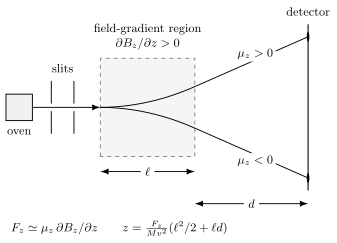
The Stern–Gerlach apparatus is an atomic-beam experiment: an oven produces neutral atoms, collimators define the beam, an inhomogeneous magnetic field separates magnetic-moment projections, and a detector records the output.
Sources and Collimation
Section titled “Sources and Collimation”Early atomic beams often began with a heated oven. Atoms escaped through a small aperture into a low-pressure region. The source was not a laser-cooled point source; it had a thermal velocity distribution and a finite angular spread.
For a thermal source, a characteristic speed scale is
An oven is effusive when the mean free path inside it is much larger than the aperture size, so collisions within the opening are negligible. Faster atoms reach the opening more often: the beam’s speed distribution is proportional to , whereas the equilibrium gas speed distribution is proportional to . A beam therefore has a spread of speeds, biased toward faster atoms, unless velocity selection or cooling narrows it.
Collimating slits reduce angular spread. If a slit of width is separated from a second aperture or interaction region by a distance , a simple angular scale is
Narrower collimation gives better angular definition but lower intensity. That tradeoff appears throughout beam physics: better state resolution usually costs signal rate.
Magnetic and Electric Fields
Section titled “Magnetic and Electric Fields”Neutral atoms are not deflected by the ordinary Lorentz force on net charge, but their internal magnetic and electric moments can couple to field gradients. For a state with an approximately constant magnetic-moment projection in a slowly varying, mainly longitudinal field,
More generally, if the atom follows an internal energy branch adiabatically, then . The simple formula above uses . This is the mechanism behind Stern–Gerlach separation: different energy branches acquire different deflections.
Electric fields play analogous roles when atoms or molecules have electric dipole moments, polarizabilities, or Stark shifts. The relevant force depends on the energy shift:
The field does not need to reveal a little classical arrow. It couples to a quantum level structure. In weak fields one may label states by approximate angular-momentum quantum numbers; in strong or mixed fields those labels can change, and the effective Hamiltonian must be specified.
State Selection and Analysis
Section titled “State Selection and Analysis”Atomic beam experiments often use field gradients twice. The first inhomogeneous field selects a sub-beam associated with particular internal states. A middle region then perturbs the selected atoms. A final analyzer converts internal-state changes back into a spatial or intensity change.
This logic underlies molecular beam resonance:
- Prepare a beam and select a state component.
- Apply an oscillating field in a controlled region.
- Drive transitions when matches an internal energy difference.
- Analyze the outgoing state population by magnetic deflection or intensity.
The detected signal is often a dip, peak, or fringe in beam intensity as a function of drive frequency. The observable is macroscopic, but the interpretation is quantum: the beam intensity depends on transition probabilities between internal states.
Velocity and Transit Time
Section titled “Velocity and Transit Time”The time an atom spends in an interaction region matters. If a beam with speed crosses a field region of length , then
This transit time sets a Fourier-limited frequency scale:
Longer interaction times give narrower resonances, all else equal. But slow beams can be harder to produce, more sensitive to stray fields, and more affected by collisions or gravity. Beam design is therefore a balance among intensity, velocity spread, interaction time, and systematic effects.
Ramsey’s separated-oscillatory-field method improved frequency resolution by using two separated interaction regions. The phase accumulated between them produces fringes whose spacing is set by the free evolution time. This is one of the bridges from atomic beams to atomic clocks.
Precision Measurement
Section titled “Precision Measurement”Atomic beams became precision tools because they turned small energy differences into frequencies. Frequencies can be compared, counted, and stabilized with extraordinary accuracy.
Examples include:
- measuring nuclear magnetic moments with molecular beam resonance;
- measuring hyperfine splittings in atoms;
- testing Zeeman and Stark shifts;
- refining magnetic moments and factors;
- developing beam clocks and frequency standards;
- measuring scattering cross sections and interaction potentials with controlled beams.
The power of the method is also its weakness: the experimenter must understand the apparatus well enough to separate the desired level shift from systematic shifts. Magnetic-field gradients, stray electric fields, blackbody radiation, collisions, finite beam geometry, velocity distributions, and detector response can all matter.
From beams to controlled atoms
Section titled “From beams to controlled atoms”Magnetic resonance develops the state-selection and oscillating-field experiment. Ramsey interferometry explains how two interactions compare an atomic phase with a drive; atom interferometry splits and recombines motional amplitudes. Traps and laser cooling extend the available interaction time, while molecular beams remain useful for collisions and precision spectroscopy.
Common pitfalls
Section titled “Common pitfalls”A count rate needs calibration. Detector efficiency, geometric acceptance, and the initial state distribution affect the number of atoms counted. A fractional change in counts equals a transition probability only under an appropriate apparatus model.
A narrow resonance need not be lifetime limited. Transit time, velocity spread, field variations, collisions, and the drive can dominate its width. Specify the line shape before converting a measured width into a time.
Neutral does not mean insensitive to fields. An atom has no net charge, but its internal energy can depend on electric and magnetic fields. A spatial gradient of that energy produces a force.
Exercises
Section titled “Exercises”- A collimating slit has width and is followed by an interaction region away. Estimate the angular spread scale .
Solution
Use :
- A beam travels at through an interaction region of length . Estimate the transit time and the scale .
Solution
The transit time is
The corresponding frequency scale is
- Why did neutral atoms help the Stern–Gerlach experiment isolate magnetic-moment physics?
Solution
A charged beam in a magnetic field experiences a Lorentz force depending on charge and velocity. Neutral atoms avoid that dominant charge deflection. Their magnetic moments can still couple to a field gradient, so the apparatus can separate components according to magnetic-moment projection rather than ordinary charge motion.
- In a resonance beam experiment with a detector that measures only total beam intensity, why is state-selective analysis needed after the oscillating-field region?
Solution
The oscillating field changes internal-state populations, but the detector usually measures beam intensity or position. A final analyzer converts internal state information into a detectable spatial or intensity difference. Without state-sensitive readout, a transition may occur without changing the total count. Magnetic deflection is one option; state-selective fluorescence can provide another.
References
Section titled “References”- C. J. Foot, Atomic Physics, Oxford University Press, 2005.
- B. Friedrich and D. Herschbach, “Stern and Gerlach: How a Bad Cigar Helped Reorient Atomic Physics,” Physics Today 56, 53-59, 2003, DOI: 10.1063/1.1650229.
- W. Gerlach and O. Stern, “Der experimentelle Nachweis der Richtungsquantelung im Magnetfeld,” Zeitschrift für Physik 9, 349-352, 1922, DOI: 10.1007/BF01326983.
- H. Pauly, Atom, Molecule, and Cluster Beams I: Basic Theory, Production and Detection of Thermal Energy Beams, Springer, 2000.
- I. I. Rabi, S. Millman, P. Kusch, and J. R. Zacharias, “The Molecular Beam Resonance Method for Measuring Nuclear Magnetic Moments,” Physical Review 55, 526-535, 1939, DOI: 10.1103/PhysRev.55.526.
- N. F. Ramsey, Molecular Beams, Oxford University Press, 1956.
- O. Stern, “Ein Weg zur experimentellen Prüfung der Richtungsquantelung im Magnetfeld,” Zeitschrift für Physik 7, 249-253, 1921.