

Periodic Table from Quantum Mechanics
The periodic table is an empirical organization of the chemical elements by atomic number and recurring properties. Quantum mechanics explains why this recurrence is possible: a Coulomb-bound electron has discrete angular-momentum channels, electron spin doubles their one-particle capacity, fermionic antisymmetry limits their occupation, and electron–electron interactions turn those capacities into a nonhydrogenic sequence of valence structures.
That explanation is powerful but not a one-line derivation. Pauli exclusion does not determine which subshell fills next. The Madelung sequence is not an exact spectrum of the many-electron Hamiltonian. A ground-state configuration does not by itself determine chemistry. Periodicity emerges from several ingredients whose relative importance changes with nuclear charge, ionization state, and environment.
Required background. Configurations introduce occupation labels, Pauli antisymmetry supplies state counting, and the central-field approximation explains radial screening. These atomic ingredients identify scales that molecular bonding later reorganizes.
The Atomic Sequence
Section titled “The Atomic Sequence”For a nucleus of charge and electrons, the clamped-nucleus nonrelativistic Hamiltonian in atomic units is
A neutral atom has . Moving one place to the right in the periodic table changes both the nuclear charge and the neutral-electron number:
The Hamiltonians of adjacent elements are therefore different many-body problems. Periodicity means that their low-energy valence sectors recur approximately after compact core structures have formed; it does not mean that the full Hamiltonian or wavefunction repeats.
For quantitative heavy-atom work one adds nuclear recoil, relativistic interactions, finite-nuclear-size effects, and radiative corrections:
Chemical applications then add other nuclei, external fields, or an embedding environment. The boundary between an atomic trend and a chemical trend should always be stated.
Shells, Subshells, and Capacities
Section titled “Shells, Subshells, and Capacities”In a spherical one-electron reference potential, a spin-orbital can be labeled schematically by
with
For a fixed orbital angular momentum , there are magnetic orbitals and two spin projections. The nonrelativistic subshell capacity is therefore
| Subshell | Spatial orbitals | Spin-orbital capacity | |
|---|---|---|---|
These capacities explain the widths of the familiar blocks. They are exact state counts for the chosen central-field labels, even though the corresponding orbitals and their energies are approximate in a real atom.
Why a hydrogenic shell holds 2n²
Section titled “Why a hydrogenic shell holds 2n²”For the Coulomb problem, all values
occur at principal quantum number . Including spin gives
This is a degeneracy count for an ideal hydrogenic shell. It is not the sequence of observed period lengths. Electron–electron interactions remove the accidental hydrogenic degeneracy between different values, and subshells with different then interleave in energy.
Nominal block sequence
Section titled “Nominal block sequence”The conventional long-form table can be summarized by the subshell families that dominate each period:
| Period | Nominal sequence | Length |
|---|---|---|
| 1 | ||
| 2 | ||
| 3 | ||
| 4 | ||
| 5 | ||
| 6 | ||
| 7 |
This table is a structural map, not an assertion that every neutral ground configuration is obtained by rigidly filling orbitals in that printed order. Near-degenerate subshells rearrange, especially in the and regions.
Screening and Penetration
Section titled “Screening and Penetration”A central-field reference replaces the coupled electronic problem by radial equations of the form
The effective potential includes nuclear attraction and an averaged response of the other electrons. It is useful to define a radius-dependent effective charge by
For a regular electronic density, the nuclear singularity dominates near the origin. For a neutral atom or positive ion with charge , one electron far outside the other electrons sees their residual core charge:
This is the physical residual-core asymptote. An arbitrary approximate mean-field potential need not reproduce it: a Hartree field containing all electrons includes self-interaction, and Hartree–Fock exchange is nonlocal. For a neutral atom the correct outer Coulomb tail is . For a singly negative ion the residual core is neutral, so the Coulomb coefficient vanishes and polarization and shorter-range physics determine binding.
A quoted scalar effective charge is an orbital- and model-dependent summary of the radial screening.
Penetration splits equal-n subshells
Section titled “Penetration splits equal-n subshells”The centrifugal term suppresses high- amplitude near the nucleus:
At comparable principal scale, an orbital usually penetrates the core more strongly than a orbital, which penetrates more strongly than a or orbital. Greater penetration samples a less-screened nuclear attraction and tends to increase binding.
This qualitative ordering explains why and are split in multi-electron atoms even though hydrogenic energies depend only on . It also helps explain why an outer family can begin a new period before the nominally lower-principal family has filled.
Penetration is a radial statement, not a claim that one orbital lives entirely “inside” another. Atomic radial densities overlap.
How Periods and Blocks Emerge
Section titled “How Periods and Blocks Emerge”In an interacting atom, an orbital energy carries model and state dependence:
There is no fixed universal ladder that all neutral atoms traverse unchanged. As and increase together:
- compact occupied orbitals screen part of the nuclear charge;
- penetrating valence orbitals respond strongly to the increased ;
- direct, exchange, and correlation energies change with occupation;
- orbital relaxation moves the reference energies;
- relativistic shifts grow and can reorder heavy-atom subshells.
The familiar filling sequence is therefore a successful pattern extracted from self-consistent atomic energetics and data, not an independent postulate of quantum mechanics.
The s and p blocks
Section titled “The s and p blocks”Outside a compact core, the main-group patterns are approximately
After an closure, the next low-energy valence electron often enters a more extended orbital. This resets several observables: the first ionization energy drops, the characteristic radius grows, and a one-electron-outside-a-core structure reappears.
Lithium and sodium are not copies. Their valence orbitals have different radial scales, polarizabilities, excitation energies, and core responses. They nevertheless share a low-energy one-valence-electron architecture, which is why their chemistry has a recognizable family resemblance.
Helium is an instructive exception to any purely outer-configuration rule. Its closed shell places it with the noble gases chemically even though the generic main-group closure is .
The d and f blocks
Section titled “The d and f blocks”Transition regions contain near-degenerate subshells with different radial character:
or
Small changes in direct, exchange, correlation, or relativistic energy can then alter the leading neutral configuration. Ionization can reorder the same orbitals again; for many transition atoms, an electron is removed before a electron even though the neutral Aufbau mnemonic placed first.
The block label identifies the broad valence sector being developed. It does not guarantee a pure configuration, a unique oxidation state, or a simple monotonic property trend.
Ionization Energy as an Observable Test
Section titled “Ionization Energy as an Observable Test”The first ionization energy is a total-energy difference between separately relaxed systems:
More generally, the th ionization energy is
These equations define positive threshold energies when each is the ground-state energy of the indicated charge sector. They make clear why an ionization energy is not, in general, just “the energy of the last electron.”
For canonical spin-orbital Hartree–Fock, Koopmans’ frozen-orbital approximation gives
The difference from experiment includes orbital relaxation and correlation, together with relativistic, recoil, and radiative corrections at the precision where they matter. An approximate orbital eigenvalue and an observed removal threshold are different objects.
The measured sawtooth
Section titled “The measured sawtooth”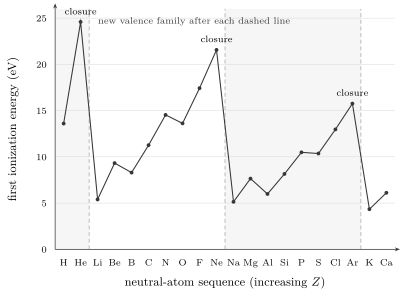
First ionization energies for neutral atoms with , using NIST ASD 5.12 evaluated values. The broad rise across each main-group period and the sharp drops after He, Ne, and Ar reveal periodic shell closure. Local reversals are physical many-electron effects, not measurement noise.
Across the second and third periods, the first ionization energy broadly rises as increasing nuclear charge contracts and binds the valence region. At a noble-gas closure it is relatively large. Adding the next electron begins a more diffuse family, producing the sharp He-to-Li, Ne-to-Na, and Ar-to-K drops.
The pattern is periodic, not monotonic. Four useful local comparisons are shown with energies rounded to four significant figures:
| Pair and first ionization energies | Main qualitative lesson |
|---|---|
| Be, B: | The first electron in B is easier to remove than a electron from Be. |
| N, O: | Interaction and term energies make removal from easier than a smooth trend predicts. |
| Mg, Al: | The -to- change repeats the Be–B mechanism. |
| P, S: | The half-filled and more-than-half-filled sectors differ in exchange and relaxation energy. |
Orbital penetration gives the first and third comparisons a useful starting intuition. The second and fourth require the many-electron terms of both the neutral atom and its ion. “Paired electrons repel” is too compressed to be a derivation: the measured threshold is a difference of two optimized correlated energies.
Successive ionization and core closure
Section titled “Successive ionization and core closure”Neutral sodium has the leading structure . NIST gives
The large jump does not mean that a classical shell wall has been crossed. After the diffuse electron is removed, the next threshold starts from the compact neon-like ion . Successive ionization energies are therefore a direct empirical probe of changing charge sectors and core closure.
Effective Nuclear Charge and Broad Trends
Section titled “Effective Nuclear Charge and Broad Trends”A one-parameter estimate sometimes writes a valence binding scale as
Here may include a quantum defect, and is fitted or defined within a particular model. The expression is useful for trend reasoning but should not be inverted into a unique experimentally measured effective charge.
Across a main-group period
Section titled “Across a main-group period”As increases while electrons enter the same broad valence shell:
- core screening changes less rapidly than the nuclear charge;
- the valence region generally contracts;
- first ionization energies generally rise;
- static polarizabilities generally fall;
- electron-accepting and bond-polarizing tendencies often increase.
Every “generally” matters. Subshell changes, term structure, correlation, and relativistic effects create local reversals.
Down a group
Section titled “Down a group”Moving down a group introduces a valence orbital with a larger principal radial scale:
- the characteristic atomic size generally grows;
- the outer electron is usually more screened and easier to remove;
- excitation energies often decrease;
- the electron cloud is often more polarizable.
Core penetration and relativistic contraction can weaken or reverse a naive extrapolation. The heavy and sectors, for example, cannot be understood quantitatively by scaling a nonrelativistic hydrogen orbital.
From Atomic Trends to Chemical Trends
Section titled “From Atomic Trends to Chemical Trends”Chemistry compares energies of atoms, ions, molecules, solids, and their environments. An isolated neutral-atom configuration is useful input, but it is not the output of a bonding calculation.
| Trend language | Quantum content and boundary |
|---|---|
| atomic size | Radial density and response of a specified state; no single radius operator equals every tabulated atomic radius. |
| ionization energy | A total-energy difference between charge sectors, not exactly one orbital eigenvalue. |
| electron affinity | An energy difference after attachment; some anions are weakly bound, metastable, or environment-stabilized. |
| electronegativity | A tendency inferred from molecular or thermochemical data; several inequivalent scales exist. |
| polarizability | An induced-dipole response through excited states; it is tensorial and frequency-dependent in general. |
| oxidation state | An electron-counting convention tied to bonding, not a direct isolated-atom observable. |
For a nondegenerate isotropic atomic ground state, the static dipole polarizability has the spectral form
The sum includes all dipole-coupled magnetic states and an integral over continuum states; is the total electric dipole operator. Diffuse valence states and low excitation gaps tend to increase . This helps connect the low first ionization energies of alkali atoms with their large response, but the relation is not an identity: transition matrix elements and the full excited spectrum also matter.
Why groups resemble one another
Section titled “Why groups resemble one another”Elements in a group often present the same number and angular type of low-energy valence electrons outside a compact core. Their valence Hilbert spaces and dominant bonding channels then resemble one another.
The resemblance is approximate because the core changes:
- radial nodes and characteristic length scales differ;
- core polarization and core–valence correlation differ;
- accessible or channels can enter;
- spin–orbit coupling grows;
- oxidation and bonding energies need not scale together.
Group membership is therefore a highly successful structural classification, not a symmetry equivalence between different elements.
Transition and inner-transition trends
Section titled “Transition and inner-transition trends”Partially filled and subshells support many Pauli-allowed terms, several oxidation sectors, and dense low-energy spectra. Their chemistry depends on a competition among:
The lanthanide contraction is associated with increasing nuclear charge across the series combined with incomplete screening by the compact electrons; relativistic effects refine the quantitative trend. It is not evidence that screening disappears.
Limits of periodic trends
Section titled “Limits of periodic trends”Near-degenerate configurations can exchange order under small correlation, relaxation, or relativistic corrections. The characteristic relativistic parameter grows with nuclear charge. Penetrating and spinors often contract, while changed screening can expand other orbitals. Heavy-element chemistry therefore requires a coupled relativistic calculation, not a uniform correction to a fixed filling diagram.
In molecules and solids, other nuclei break spherical symmetry and reorganize the valence states. Atomic group membership remains useful, but it does not determine a unique bond energy or oxidation state.
Exercises
Section titled “Exercises”Exercise 1: Why period 3 has eight elements
Section titled “Exercise 1: Why period 3 has eight elements”Hydrogenic counting assigns the shell a capacity of . Explain why the third period nevertheless runs from Na to Ar and has length .
Solution
The hydrogenic shell contains , , and , with capacities
In neutral multi-electron atoms, screening and penetration remove the hydrogenic degeneracy. The valence family becomes relevant before the family is developed across the neutral sequence. Period 3 therefore consists nominally of
with length . The block appears between and in period 4. This is energetic interleaving, not a change in the state capacity of .
Exercise 2: Read the local ionization reversals
Section titled “Exercise 2: Read the local ionization reversals”Use the table above to explain why and do not contradict the broad rise across period 2.
Solution
Boron begins the subshell:
The electron penetrates less strongly and is more weakly bound than a electron in the neighboring system, so the first threshold drops at B.
Nitrogen and oxygen both ionize from , but their many-electron terms differ. Nitrogen’s half-filled ground sector is strongly exchange stabilized. Removing one electron from oxygen’s sector produces the favorable ion. The exact comparison is still a difference of separately relaxed total energies; “pairing” is only shorthand for that term, exchange, and correlation balance.
Exercise 3: The sodium jump
Section titled “Exercise 3: The sodium jump”Using the NIST values on this page, compute the ratio for sodium and explain its physical meaning.
Solution
The ratio is
The first ionization removes the diffuse valence electron. The second starts from the compact neon-like ion and removes a core electron. The large ratio is evidence for a change in electronic sector and shell closure, not a literal discontinuity in a classical radial shell.
Exercise 4: Similarity without identity
Section titled “Exercise 4: Similarity without identity”Lithium and sodium both have one electron outside a closed core. Give three reasons their atomic or chemical properties are not identical.
Solution
Any three of the following suffice:
- Li uses a valence orbital, while Na uses ; their radial nodes and sizes differ.
- The closed cores have different polarizabilities and core-excitation spectra.
- Their ionization and excitation energies differ.
- Core–valence correlation and exchange differ.
- Relativistic corrections, though modest here, are not identical.
- Molecular bond energies depend on partner atoms and geometry, not only the isolated neutral configuration.
The shared one-valence-electron structure explains family resemblance. It does not define a symmetry mapping one element’s Hamiltonian into the other’s.
References
Section titled “References”- B. H. Bransden and C. J. Joachain, Physics of Atoms and Molecules, 2nd ed. (Pearson, 2003), Chapters 6–8.
- R. D. Cowan, The Theory of Atomic Structure and Spectra (University of California Press, 1981), especially Chapters 3–8.
- V. Fock, “Näherungsmethode zur Lösung des quantenmechanischen Mehrkörperproblems,” Zeitschrift für Physik 61, 126–148 (1930), doi:10.1007/BF01340294.
- C. J. Foot, Atomic Physics (Oxford University Press, 2005), Chapters 3–5.
- D. R. Hartree, “The Wave Mechanics of an Atom with a Non-Coulomb Central Field. Part I. Theory and Methods,” Proceedings of the Cambridge Philosophical Society 24, 89–110 (1928), doi:10.1017/S0305004100011919.
- International Union of Pure and Applied Chemistry, “Ionization Energy”, Compendium of Chemical Terminology, 5th ed., online version 5.0.0, 2025.
- International Union of Pure and Applied Chemistry, Periodic Table of Elements, current table release dated 4 May 2022, accessed 2026-07-21.
- W. R. Johnson, Atomic Structure Theory: Lectures on Atomic Physics (Springer, 2007), doi:10.1007/978-3-540-68013-0.
- A. Kramida, Yu. Ralchenko, J. Reader, and the NIST ASD Team, NIST Atomic Spectra Database, version 5.12, National Institute of Standards and Technology, 2024, DOI: 10.18434/T4W30F, accessed 2026-07-21.
- W. C. Martin and W. L. Wiese, “Atomic Spectroscopy: An Introduction”, in G. W. F. Drake, ed., Atomic, Molecular, and Optical Physics Handbook, AIP Press, 1996; NIST online revision.
- NIST Atomic Spectra Database, Ionization Energies Form, critically evaluated ground states and ionization thresholds, accessed 2026-07-21.
- W. Pauli, “Über den Zusammenhang des Abschlusses der Elektronengruppen im Atom mit der Komplexstruktur der Spektren,” Zeitschrift für Physik 31, 765–783 (1925), doi:10.1007/BF02980631.
- P. Pyykkö, “The Physics behind Chemistry and the Periodic Table,” Chemical Reviews 112, 371–384 (2012), doi:10.1021/cr200042e.
- P. Schwerdtfeger, O. R. Smits, and P. Pyykkö, “The Periodic Table and the Physics That Drives It,” Nature Reviews Chemistry 4, 359–380 (2020), doi:10.1038/s41570-020-0195-y.
- J. C. Slater, “Atomic Shielding Constants,” Physical Review 36, 57–64 (1930), doi:10.1103/PhysRev.36.57.