

Helium Atom
Helium is the first atom whose electronic Schrödinger equation contains a genuine interaction between indistinguishable particles. It has only two electrons, yet their Coulomb repulsion prevents exact separation into one-electron problems. Antisymmetry ties spatial exchange to spin, producing distinct singlet and triplet spectra, while high-accuracy energies require correlation beyond a single orbital product. Explicit interelectronic coordinates represent that correlation efficiently; sufficiently large orbital expansions can represent it too.
Required background. The multi-electron introduction sets up interacting atoms; hydrogenic states supply the one-electron basis, spin and spatial symmetry explain the singlet–triplet split, and the variational principle supplies energy bounds.
Physical System and Hamiltonian
Section titled “Physical System and Hamiltonian”Use Hartree atomic units and an infinitely massive point nucleus with charge . Total electronic energy is measured relative to the bare nucleus and two free electrons. The nonrelativistic Hamiltonian is
with
The first four terms are sums of hydrogenic one-electron operators. The final term couples the electron coordinates. A product
can represent independent motion in a chosen field, but it cannot reproduce an arbitrary change in the conditional position of electron 2 when electron 1 moves.
Finite nuclear mass
Section titled “Finite nuclear mass”For an isotope with nuclear mass measured in electron masses, center-of-mass removal produces an internal nonrelativistic Hamiltonian
where
The cross derivative is the mass-polarization term. It correlates the electron momenta through nuclear recoil and cannot be reproduced merely by replacing with a reduced mass in two independent hydrogenic equations.
Relativistic, radiative, finite-nuclear-size, and hyperfine terms enter at still finer resolution. For the nucleus has spin zero, whereas has nuclear spin and therefore hyperfine structure. A precision comparison must identify the isotope and every retained correction.
Why Helium Is Not Separable
Section titled “Why Helium Is Not Separable”The hydrogenic Hamiltonian separates in spherical coordinates because each term depends on one electron–nucleus distance. Helium contains three geometrically independent scalar distances,
The law of cosines gives
so the repulsion depends on the angle between the electron position vectors as well as their radii. Separating a radial equation for each electron discards precisely this angular and radial correlation.
Coordinates adapted to correlation
Section titled “Coordinates adapted to correlation”Hylleraas coordinates make the important distances explicit:
For the symmetric ground-state spatial function, a useful expansion has the schematic form
The powers of describe direct electron–electron correlation. Even powers of enforce symmetry under . This coordinate choice was historically decisive because a modest explicitly correlated expansion could recover effects that require many ordinary orbital products.
Exact and Approximate Quantum Numbers
Section titled “Exact and Approximate Quantum Numbers”The spin-independent Hamiltonian commutes with
Exchange symmetry is also exact. The total electronic state must satisfy
The nonrelativistic ground state has a positive, symmetric spatial factor with
It must therefore be paired with the antisymmetric spin singlet, giving the spectroscopic label
Spin–orbit and other relativistic terms preserve total and parity for an isolated atom but make and approximate. Helium is light enough that LS Coupling remains an excellent organizing limit for much of the low-lying spectrum.
Independent-Particle Baseline
Section titled “Independent-Particle Baseline”First remove electron–electron repulsion and write
Each electron has energy , so the two-electron ground energy of is
For helium,
This is not a variational estimate for the full helium Hamiltonian because the expectation value of has not yet been included. It overbinds the atom severely.
Using the bare hydrogenic state as a trial state for the full Hamiltonian gives
Therefore
and for helium
This is a legitimate variational upper bound. The difference between and is not a small correction: electron repulsion reorganizes the orbital scale.
One-Parameter Variational Screening
Section titled “One-Parameter Variational Screening”Let both electrons occupy normalized exponential orbitals with adjustable exponent ,
Pair the symmetric spatial product with the spin singlet. The energy expectation is
Minimization gives
For ,
and
The exponent is smaller than the true nuclear charge because each electron screens the nucleus for the other on average. This one number captures radial relaxation but not an instantaneous dependence on . The full evaluation of the Coulomb integral and the variational bound is kept at Variational Estimate for the Helium Atom.
What the trial state means
Section titled “What the trial state means”The probability density factorizes:
Knowing electron 1’s position therefore does not change the conditional spatial distribution of electron 2. The optimized exponent accounts for average screening, but it cannot describe the electrons avoiding one another differently on opposite sides of the nucleus.
An Energy Ladder
Section titled “An Energy Ladder”The following values all refer to the fixed-nucleus nonrelativistic Coulomb problem unless noted otherwise.
| Description | Ground energy in | What changes |
|---|---|---|
| noninteracting eigenvalue | omits entirely; not an upper bound for | |
| bare expectation | includes repulsion without orbital relaxation | |
| one-exponent variational state | optimizes average radial screening | |
| Hartree–Fock limit | approximately | optimizes a single determinant |
| correlated Schrödinger value | approximately | converges the two-electron Coulomb eigenproblem |
The conventional nonrelativistic correlation energy is
Its magnitude is about , but that does not mean every helium observable has a one-electron-volt Hartree–Fock error. Energy differences can contain cancellations, and transition amplitudes probe different aspects of the wavefunction.
Total energy versus ionization energy
Section titled “Total energy versus ionization energy”For the same infinite-mass nonrelativistic Hamiltonian, the residual ion has
The theoretical first ionization energy is therefore
The NIST Atomic Spectra Database gives the physical He I ionization energy as
The few-millielectron-volt difference is expected: finite nuclear mass, relativistic dynamics, QED, and nuclear structure change the idealized Hamiltonian. Comparing directly with would also compare quantities with different energy zeros.
Singlet and Triplet States
Section titled “Singlet and Triplet States”For two distinct orthonormal spatial orbitals and , define exchange-symmetrized spatial functions
The plus state is spatially symmetric and must multiply the antisymmetric spin singlet,
The minus state is spatially antisymmetric and must multiply one of the symmetric triplet spin functions,
If , the antisymmetric spatial function vanishes. Two electrons in the same spatial orbital can therefore form the ground configuration only as a spin singlet.
Direct and exchange splitting
Section titled “Direct and exchange splitting”For fixed orthonormal orbitals and a spin-independent Hamiltonian, write the direct and exchange Coulomb integrals as
and
The spatial energies have the schematic form
Thus the fixed-orbital splitting is
This explains why the triplet member of a given helium configuration often lies lower. It does not make exchange a classical attractive force. The result follows from evaluating the same Coulomb Hamiltonian in spatial states with different exchange symmetry. Orbital relaxation and correlation modify the quantitative splitting.
Historically the singlet system was called parahelium and the triplet system orthohelium. Modern notation states and the term symbol directly.
Low-Lying Spectrum
Section titled “Low-Lying Spectrum”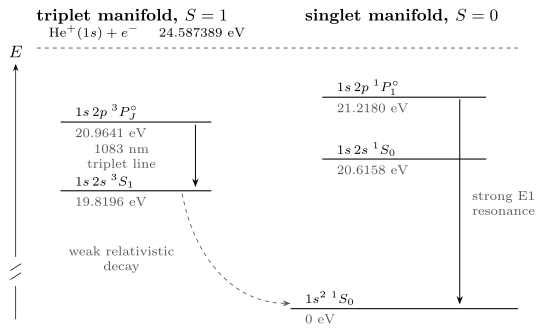
Selected low-lying levels relative to the ground state, using NIST evaluated energies. The vertical scale is schematic and contains a break between the ground and excited manifolds. The strong singlet resonance and the triplet transition are electric-dipole allowed; decay from to the singlet ground state is strongly suppressed.
Representative evaluated excitation energies are:
| Configuration and level | Excitation energy |
|---|---|
| about | |
| limit |
The triplet entry contains the fine-structure levels ; the schematic figure does not resolve their much smaller splitting. The singlet–triplet separation within a configuration is primarily electrostatic exchange at this scale, whereas the splitting within a triplet term is relativistic.
Spectral series
Section titled “Spectral series”Excited levels form singlet and triplet Rydberg series converging to the same threshold. A useful effective description is
where is a reduced-mass Rydberg energy, rather than a wavenumber, and the quantum defect depends on orbital penetration, exchange symmetry, and core polarization. The outer electron becomes hydrogenic at large radius, but the residual core is a polarizable ion rather than an inert point charge.
Selection Rules and Metastability
Section titled “Selection Rules and Metastability”The leading electric-dipole operator is odd under parity and does not act on spin. In the limit, an E1 transition therefore requires
together with the usual angular-momentum rule
Consequences for helium include:
- is a strong resonance transition near .
- produces the important triplet line near .
- is E1-forbidden by parity and the rule, but two-photon decay is allowed.
- changes spin and has no parity change, so its leading E1 amplitude vanishes.
The level is consequently metastable, with a natural lifetime of order . Weak relativistic magnetic and spin-mixing mechanisms eventually permit decay. Its long lifetime and the accessible cycling transition make metastable helium a useful AMO platform, but the metastability is an approximate selection-rule consequence rather than an exact superselection law.
The tensor-operator derivation is given in Atomic Selection Rules.
Correlation Beyond a Single Determinant
Section titled “Correlation Beyond a Single Determinant”For the singlet, a restricted Hartree–Fock wavefunction is one determinant built from a doubly occupied spatial orbital. It enforces total antisymmetry and optimizes the orbital self-consistently. It does not permit the spatial state to respond explicitly to the instantaneous value of .
Hartree–Fock for Atoms derives why this two-electron closed-shell equation coincides with the optimized spatial Hartree equation while still omitting the explicit Coulomb correlation represented below.
An explicitly correlated ansatz may contain a factor such as
When one electron approaches the other, the dependence adjusts the local slope. For opposite-spin electron coalescence, the spherical-average Kato cusp condition is
At electron–nucleus coalescence for an infinitely massive point nucleus,
Ordinary finite orbital expansions converge slowly near these nonanalytic cusps. Hylleraas and expansions can build the cusp directly into the ansatz. Explicitly correlated Gaussians efficiently describe interelectronic correlation but do not satisfy the exact cusp with a finite smooth Gaussian expansion; contact observables therefore require particular care.
Dynamic and angular correlation
Section titled “Dynamic and angular correlation”Two complementary pictures are useful:
- Radial correlation: when one electron lies unusually close to the nucleus, the other tends to occupy a more diffuse radial region.
- Angular correlation: electrons preferentially occupy different directions around the nucleus, increasing their average separation.
These are interpretations of the pair density, not assignments of persistent identities to “inner” and “outer” electrons. The exact state remains exchange symmetric in its spatial coordinates.
Energy and Wavefunction Accuracy
Section titled “Energy and Wavefunction Accuracy”Virial theorem
Section titled “Virial theorem”For an exact stationary state of a Coulomb Hamiltonian,
A variational energy may look converged while violating this relation noticeably. The virial residual is therefore a useful independent check, especially when nonlinear scale parameters have not been fully optimized.
Energy variance and residual
Section titled “Energy variance and residual”For a normalized approximate state,
with . An exact eigenstate has zero variance. Small energy error does not guarantee a uniformly accurate local wavefunction, so cusp checks, expectation values, transition matrix elements, and residual norms add information.
Layered precision theory
Section titled “Layered precision theory”A precision calculation should be organized as
Each term needs a declared isotope, constants adjustment, and uncertainty estimate. Agreement with experiment at one level of this hierarchy does not validate omitted higher-order terms.
The evaluated NIST spectrum provides excitation energies and ionization thresholds for comparison. Keep isotope, energy zero, and Hamiltonian corrections consistent; a precise Coulomb eigenvalue is not the physical transition frequency.
Exercises
Section titled “Exercises”Exercise 1: Bare independent-particle estimate
Section titled “Exercise 1: Bare independent-particle estimate”For two hydrogenic orbitals with nuclear charge , use
to find the expectation of the full two-electron Hamiltonian. Evaluate it for helium and explain why it is an upper bound.
Solution
The two one-electron energies sum to . Adding the repulsion expectation gives
For ,
The normalized spatial product paired with the spin singlet is an admissible trial state for the full fixed-nucleus Hamiltonian. The variational principle therefore makes its expectation an upper bound to the nonrelativistic ground energy.
Exercise 2: Energy convergence and a local cusp
Section titled “Exercise 2: Energy convergence and a local cusp”For the optimized product with , evaluate its electron–nucleus logarithmic derivative and its spherically averaged electron–electron logarithmic derivative at coalescence. Does satisfying the virial theorem guarantee either exact cusp?
Solution
The nuclear derivative is , whereas the exact value is . At fixed electron-pair center away from the nucleus, the smooth product has no term linear in the relative distance after spherical averaging, so its electron–electron derivative is zero instead of . Optimizing a uniform scale enforces within this trial family but leaves both local defects. An accurate energy or virial ratio alone does not establish an accurate contact density.
Exercise 3: Exchange symmetry and the ground state
Section titled “Exercise 3: Exchange symmetry and the ground state”Show that two electrons occupying the same spatial orbital cannot form a triplet. Why does this force the helium ground configuration to be a singlet?
Solution
The antisymmetric spatial combination of one orbital with itself is
A triplet spin function is symmetric, so fermionic antisymmetry would require precisely this antisymmetric spatial factor. No nonzero triplet state exists with both electrons in the same spatial orbital. The ground configuration instead has a symmetric spatial product and must multiply the antisymmetric spin singlet, giving .
Exercise 4: Direct and exchange energies
Section titled “Exercise 4: Direct and exchange energies”For two distinct orthonormal orbitals, suppose . Compare the fixed-orbital singlet and triplet energies and explain why this is not evidence for a new exchange force.
Solution
The energies are
and
Therefore
The triplet lies lower in this fixed-orbital model. Both energies are expectations of the same kinetic, nuclear-attraction, and Coulomb-repulsion Hamiltonian. Their difference arises because antisymmetry changes the spatial interference and pair density; no additional classical force has been introduced.
Exercise 5: Ionization energies and Hamiltonian layers
Section titled “Exercise 5: Ionization energies and Hamiltonian layers”Using and , find the nonrelativistic infinite-mass ionization energy in Hartree. Why does its conversion to electronvolts not exactly equal the NIST physical value?
Solution
The threshold difference is
Using the stated Hartree conversion gives approximately . The NIST value describes physical helium and includes finite nuclear mass, relativistic, radiative, and nuclear effects absent from the idealized Hamiltonian. The discrepancy is therefore not simply numerical error in the correlated Schrödinger calculation.
Exercise 6: Classify helium decays
Section titled “Exercise 6: Classify helium decays”Classify each transition at leading E1 order:
- ;
- ;
- ;
- .
Solution
- Allowed: parity changes, , and .
- Forbidden at E1 order: parity does not change and . Two-photon decay can occur.
- Forbidden at E1 order: parity does not change and . Weak higher-order decay remains possible.
- Allowed: parity changes, , and satisfies the angular-momentum rule.
The classification names the leading multipole approximation. It does not declare the forbidden channels exactly absent in the full Hamiltonian.
References
Section titled “References”- H. A. Bethe and E. E. Salpeter, Quantum Mechanics of One- and Two-Electron Atoms, Springer, 1957.
- G. W. F. Drake, “High Precision Calculations for Helium,” in G. W. F. Drake, ed., Springer Handbook of Atomic, Molecular, and Optical Physics, Springer, 2006.
- E. A. Hylleraas, “Neue Berechnung der Energie des Heliums im Grundzustande, sowie des tiefsten Terms von Ortho-Helium,” Zeitschrift für Physik 54, 347–366 (1929), DOI: 10.1007/BF01375457.
- W. R. Johnson, Atomic Structure Theory: Lectures on Atomic Physics, Springer, 2007.
- T. Kato, “On the Eigenfunctions of Many-Particle Systems in Quantum Mechanics,” Communications on Pure and Applied Mathematics 10, 151–177 (1957), DOI: 10.1002/cpa.3160100201.
- A. Kramida, Yu. Ralchenko, J. Reader, and the NIST ASD Team, NIST Atomic Spectra Database, version 5.12, National Institute of Standards and Technology, 2024, DOI: 10.18434/T4W30F, accessed 2026-10-13.
- W. C. Martin and W. L. Wiese, “Helium and Helium-Like Ions; LS Coupling”, in Atomic Spectroscopy: An Introduction, NIST, 1996 online edition.
- H. Nakashima and H. Nakatsuji, “How Accurately Does the Free Complement Wave Function of a Helium Atom Satisfy the Schrödinger Equation?” Physical Review Letters 101, 240406 (2008), DOI: 10.1103/PhysRevLett.101.240406.
- C. L. Pekeris, “Ground State of Two-Electron Atoms,” Physical Review 112, 1649–1658 (1958), DOI: 10.1103/PhysRev.112.1649.
- J. E. Sansonetti and W. C. Martin, “Energy Levels of Neutral Helium (He I)”, Handbook of Basic Atomic Spectroscopic Data, NIST, accessed 2026-10-13.
- C. Schwartz, “Ground State of the Helium Atom,” Physical Review 128, 1146–1148 (1962), DOI: 10.1103/PhysRev.128.1146.
- A. Szabo and N. S. Ostlund, Modern Quantum Chemistry: Introduction to Advanced Electronic Structure Theory, Dover, 1996.