

Pauli Principle in Atoms
The Pauli principle in an atom is not merely a rule for drawing arrows in orbital boxes. It is the requirement that the total state of the identical electrons be antisymmetric under exchange of any two complete electron coordinates. The familiar statement that no two electrons can have the same four atomic quantum numbers is a basis-dependent consequence of that deeper rule.
Antisymmetry is indispensable for shell capacities, closed subshells, equivalent-electron term restrictions, and the recurring valence patterns behind chemistry. It does not by itself determine orbital energies, the order in which subshells fill, or the energy ordering of allowed terms. Those require the atomic Hamiltonian.
Required background. Configuration notation identifies occupied subshells. Fermionic exclusion and spin–spatial symmetry give the exchange constraint, while angular-momentum coupling supplies the possible terms.
The Exact Atomic Statement
Section titled “The Exact Atomic Statement”Let
denote the spatial and spin coordinates in electron slot . For every transposition , a physical -electron state obeys
More generally,
for every permutation . The physical fixed- Hilbert space is the antisymmetric exterior power
where is the complete one-electron Hilbert space.
Electron labels in identify argument slots, not persistent particles. Exchanging slots changes the amplitude’s sign, while all probabilities and expectation values remain permutation invariant.
Exclusion is not a potential
Section titled “Exclusion is not a potential”The Pauli principle does not add a repulsive term to the Hamiltonian. It restricts the admissible state space before the Coulomb Hamiltonian is diagonalized. Phrases such as “Pauli repulsion” or “exchange force” can summarize an energy cost caused by antisymmetry and orbital overlap, but they should not be mistaken for a new pair potential.
This distinction becomes important when separating exchange from dynamical electron correlation. Both affect spatial avoidance and energies, but they enter the theory in different ways.
Complete One-Electron Spin-Orbitals
Section titled “Complete One-Electron Spin-Orbitals”In a nonrelativistic central field, a one-electron spatial orbital has labels . Combining it with a spin basis gives
The complete one-electron mode includes the spin label. Thus
are distinct spin-orbitals even though they share the same spatial orbital.
For a fixed subshell, there are
spin-orbitals. Pauli exclusion permits at most one electron in each complete spin-orbital, so the subshell capacities are , , , and for , , , and .
Relativistic basis
Section titled “Relativistic basis”In a relativistic central field, a spinor may instead be labeled by or . A fixed- subshell has modes, each with occupation zero or one. The Pauli principle is basis independent; only the labels used to enumerate the one-electron modes have changed.
Exclusion and Mode Occupation
Section titled “Exclusion and Mode Occupation”An antisymmetrized product vanishes when two complete spin-orbitals coincide, or more generally when the occupied spin-orbitals are linearly dependent. Slater determinants derive this algebra and its normalization.
Fermionic creation operator
Section titled “Fermionic creation operator”Fermionic anticommutation gives
Setting yields
The number operator
is a projector:
Its eigenvalues are therefore
These are not three separate principles. They are representations of the same fermionic state-space structure.
Occupation in a Correlated State
Section titled “Occupation in a Correlated State”A determinant has integer occupations in a basis separating its occupied and empty subspaces. In a differently rotated basis even that determinant can have fractional diagonal occupations. A correlated superposition or mixture can also give
The one-body reduced density matrix has natural spin-orbitals and natural occupations satisfying
With spin summed out, a spatial natural orbital can have occupation up to two. Fractional natural spin-orbital occupations rule out a single determinant for a pure state; for a mixed state they can instead arise from statistical averaging. Neither kind of fractional expectation violates exclusion.
Atomic Orbitals Revisited develops natural orbitals and the distinction between basis occupations and observables. Reduced Density Matrices supplies the general operator construction.
Slater Determinants as Atomic Basis States
Section titled “Slater Determinants as Atomic Basis States”Choose orthonormal atomic spin-orbitals . A determinant
records an allowed set of occupied modes. It automatically has the correct fermionic exchange symmetry and a definite particle number. In a nonrelativistic basis it also has definite parity, , and . A relativistic determinant instead has definite parity and , without generally definite separate orbital and spin projections.
A generic determinant is not necessarily an eigenstate of , , or . Atomic calculations therefore combine determinants into configuration-state functions:
where collects the exact or imposed angular-momentum and parity labels. The Pauli principle filters the determinant space first; symmetry adaptation then organizes the surviving states into terms and levels.
Slater Determinants in Atoms develops this determinant-to-CSF step, including ordering phases and a worked singlet–triplet construction.
For a subshell of capacity occupied by equivalent electrons, the determinant count is
This is the number of allowed spin-orbital choices before coupling them into total angular momentum.
Two Electrons in One Spatial Orbital
Section titled “Two Electrons in One Spatial Orbital”Let two electrons use the same normalized spatial orbital but different spin functions. Antisymmetrizing the spin-orbitals and gives
The spatial factor is symmetric and the spin factor is the antisymmetric singlet. No nonzero triplet can be built with both electrons in the same spatial orbital, because the required antisymmetric spatial combination is
This is why the simple helium ground configuration is a singlet. Helium Atom develops the interacting wavefunction and spectrum beyond this occupation argument.
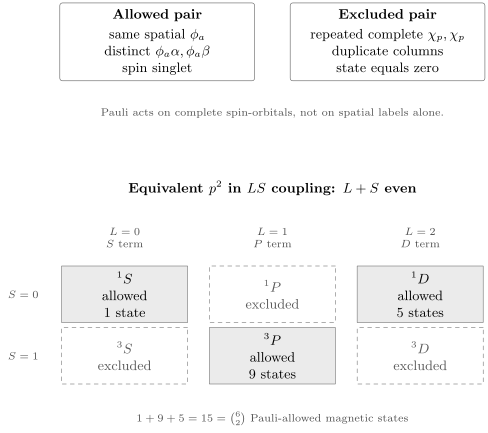
Top: two electrons may share a spatial orbital only through distinct spin-orbitals, while repeating one complete spin-orbital gives a zero determinant. Bottom: for two equivalent electrons, antisymmetry retains , , and and excludes the other naive combinations. Their magnetic states exhaust .
Equivalent Electrons
Section titled “Equivalent Electrons”Electrons are equivalent in atomic spectroscopy when they belong to the same subshell. They share the same radial and orbital angular labels before and spin are resolved. Equivalent electrons face stronger term restrictions than electrons in different subshells because exchanging them cannot be hidden in different radial labels.
Exchange parity of an equivalent pair
Section titled “Exchange parity of an equivalent pair”Couple two equal orbital angular momenta to total . Clebsch–Gordan symmetry gives
Because is even,
For two spin- particles,
The singlet is antisymmetric and the triplet is symmetric. The product exchange parity is
Fermionic antisymmetry requires , so an equivalent pair in pure coupling must satisfy
This compact rule is specific to two equivalent electrons with equal . It should not be applied unchanged to arbitrary configurations.
The p-Squared Example
Section titled “The p-Squared Example”For , each electron has , so ordinary angular-momentum addition gives and . Pauli antisymmetry removes half of the naive combinations:
| Term letter | Singlet | Triplet | |
|---|---|---|---|
| 0 | allowed | excluded | |
| 1 | excluded | allowed | |
| 2 | allowed | excluded |
The allowed term-space dimensions are
Their sum is
exactly the number of two-electron determinants in six spin-orbitals. This closure is a stringent check: no Pauli-allowed magnetic states are missing or counted twice.
Spin–orbit coupling later resolves into levels while preserving the total count . Atomic Term Symbols explains that term-to-level hierarchy.
Why non-equivalent electrons differ
Section titled “Why non-equivalent electrons differ”For a configuration such as , the radial orbitals differ. Symmetric and antisymmetric spatial combinations are both nonzero:
The symmetric spatial combination pairs with a singlet, and the antisymmetric combination pairs with a triplet. Thus helium’s configuration supports both and . Naive use of the equivalent-electron rule even would incorrectly delete the triplet.
Particles and Holes in One Subshell
Section titled “Particles and Holes in One Subshell”A subshell of capacity has the same determinant count for electrons and electrons:
Within an isolated nonrelativistic subshell, particle–hole conjugate configurations have the same allowed term content. For a subshell:
| Occupation | Determinants | Allowed terms |
|---|---|---|
| , | 1 | |
| , | 6 | |
| , | 15 | , , |
| 20 | , , |
The dimensions close:
Particle–hole correspondence does not imply identical energies, radial relaxation, fine-structure order, or spectra for different atoms. It is a state-counting and angular-structure relation within the stated subshell model.
Shell Capacities
Section titled “Shell Capacities”For a nonrelativistic subshell,
In ideal hydrogenic shell counting, , so
The resulting capacities describe the dimension of each ideal shell’s spin-orbital space. They do not say that real neutral atoms fill entire principal shells in that sequence. Multi-electron energies split by , and neighboring principal shells overlap energetically.
Closed subshells
Section titled “Closed subshells”When every mode of an subshell is occupied, there is only one determinant within that subshell. The complete set is invariant under spatial and spin rotations, giving
and even parity. Closed subshells therefore carry no open-shell angular momentum, although their electrons still contribute to charge density, screening, exchange, polarization, and correlation.
From Helium to Sodium
Section titled “From Helium to Sodium”A short sequence separates what Pauli decides from what the Hamiltonian decides.
Helium
Section titled “Helium”The spatial orbital supplies two spin-orbitals. Helium can occupy both as , but only in the singlet coupling required by antisymmetry.
Lithium
Section titled “Lithium”The spin-orbitals are already occupied in a simple core. A third electron cannot enter either complete mode. It must occupy another mode. The atomic Hamiltonian makes the leading ground-state choice; Pauli alone does not prove that lies below .
Neon and sodium
Section titled “Neon and sodium”The subshell closes the valence space in neon’s leading configuration. Sodium has one additional electron, whose leading ground configuration is . The recurrence of a one-electron-outside-a-closed-core pattern connects lithium and sodium chemically, but the actual orbital ordering and ionization energies depend on screening, penetration, and interactions.
The periodic table combines these occupation limits with screened orbital energies. Antisymmetry fixes capacities and removes forbidden terms; electrostatic, relativistic, and correlation effects select the energies of the surviving states. Hund’s rules describe approximate orderings within that allowed space.
Spectroscopic Consequences
Section titled “Spectroscopic Consequences”Pauli restrictions remove entire terms, not merely individual orbital-box arrangements. That has observable consequences:
- only Pauli-allowed levels appear in an atomic spectrum;
- closed subshells contribute and simplify the remaining valence coupling;
- equivalent-electron restrictions control level counts and partition functions;
- holes reproduce characteristic term patterns of complementary fillings;
- configuration mixing occurs only among basis states that already satisfy antisymmetry.
Absence of a line does not by itself prove Pauli exclusion, because transition selection rules, weak matrix elements, population, and detector sensitivity can also suppress lines. The atomic assignment combines state counting with energies, , parity, magnetic response, and transition data.
Historical Perspective
Section titled “Historical Perspective”Pauli formulated his exclusion rule in 1925 while trying to organize atomic shell closure and complex spectral multiplets. His original statement used a fourth two-valued electron degree of freedom before the modern interpretation of electron spin was fully established. The determinant formulation and the broader language of fermionic antisymmetry emerged with many-particle wave mechanics.
In modern relativistic theory, the spin–statistics theorem connects half-integer spin fields with fermionic statistics. That theorem is not proved within nonrelativistic atomic quantum mechanics. Atomic calculations take the electron’s fermionic exchange symmetry as an input and explore its consequences with extraordinary precision.
Spatial Coincidence
Section titled “Spatial Coincidence”Exclusion acts on complete spin-orbitals, not positions alone. Same-spin amplitudes vanish when the spatial coordinates coincide. Opposite-spin components can have nonzero coincidence density, as in a singlet pair. That density may still be reduced by Coulomb correlation.
Exercises
Section titled “Exercises”Exercise 1: Atomic capacities
Section titled “Exercise 1: Atomic capacities”Derive the maximum occupations of , , , and subshells. Then derive the ideal shell capacity . State one reason that this does not determine the ground configuration of every neutral atom.
Solution
For fixed , there are values of and two spin projections, so
For , this gives . In an ideal hydrogenic shell, runs from to :
Real multi-electron subshells are split by screening, penetration, exchange, correlation, and relativistic effects. Pauli fixes capacities but not their energetic order.
Exercise 2: Same spatial orbital
Section titled “Exercise 2: Same spatial orbital”Show that two electrons in the same spatial orbital can form a singlet but not a triplet. Does this imply that their spatial coordinates can never coincide?
Solution
The product is symmetric. Fermionic antisymmetry therefore requires the antisymmetric spin singlet:
A triplet spin function is symmetric and would require the antisymmetric spatial combination
which vanishes identically. The allowed singlet spatial factor need not vanish at , so equal spatial coordinates are not generally forbidden.
Exercise 3: Equivalent d-squared terms
Section titled “Exercise 3: Equivalent d-squared terms”Use even to find all allowed terms of two equivalent electrons. Verify the total dimension against the determinant count.
Solution
Here and . Singlets require even and triplets odd , giving
Their dimensions sum to . The corresponding terms for non-equivalent electrons are less restricted because the antisymmetric radial combination need not vanish.
Exercise 4: Particle–hole counting
Section titled “Exercise 4: Particle–hole counting”Use binomial counting to show that and have equal determinant dimensions. Why does equal term content not imply identical spectra for, say, carbon and oxygen?
Solution
A subshell has six spin-orbitals, so
Particle–hole conjugation within the isolated subshell gives the same , , and term types. Carbon and oxygen nevertheless have different nuclear charges, radial orbitals, screening, direct and exchange integrals, spin–orbit constants, correlation, and coupling to other configurations. State-space correspondence does not make their Hamiltonian matrices equal.
Exercise 5: Non-equivalent electrons
Section titled “Exercise 5: Non-equivalent electrons”For one electron in and one in , construct normalized symmetric and antisymmetric spatial combinations. Pair them with the correct spin states and identify the allowed terms.
Solution
The spatial combinations are
is symmetric and must multiply the antisymmetric singlet. is antisymmetric and must multiply a symmetric triplet. Since both one-electron orbital angular momenta are zero, in either case. The allowed terms are therefore
Both exist because the distinct radial orbitals make the antisymmetric spatial combination nonzero.
Exercise 6: Number-operator bound
Section titled “Exercise 6: Number-operator bound”Using fermionic anticommutation, show that satisfies . What does this imply for an eigenvalue of and for its expectation value in an arbitrary normalized state?
Solution
Use :
because . A projector has eigenvalues and . For an arbitrary normalized state, its expectation lies in the convex interval
The expectation may be fractional when the state is a superposition or mixture of different occupations.
References
Section titled “References”- B. H. Bransden and C. J. Joachain, Physics of Atoms and Molecules, 2nd ed., Pearson, 2003.
- E. U. Condon and G. H. Shortley, The Theory of Atomic Spectra, Cambridge University Press, 1935.
- R. D. Cowan, The Theory of Atomic Structure and Spectra, University of California Press, 1981.
- C. J. Foot, Atomic Physics, Oxford University Press, 2005.
- International Union of Pure and Applied Chemistry, “Pauli Exclusion Principle”, Compendium of Chemical Terminology, 5th ed., online version 5.0.0, 2025.
- W. R. Johnson, Atomic Structure Theory: Lectures on Atomic Physics, Springer, 2007.
- E. H. Lieb and R. Seiringer, The Stability of Matter in Quantum Mechanics, Cambridge University Press, 2010.
- W. C. Martin and W. L. Wiese, “Atomic Spectroscopy: An Introduction”, in G. W. F. Drake, ed., Atomic, Molecular, and Optical Physics Handbook, AIP Press, 1996; NIST online revision.
- W. Pauli, “Über den Zusammenhang des Abschlusses der Elektronengruppen im Atom mit der Komplexstruktur der Spektren”, Zeitschrift für Physik 31, 765–783 (1925).
- W. Pauli, “Exclusion Principle and Quantum Mechanics”, Nobel Lecture, 13 December 1946.
- J. C. Slater, “The Theory of Complex Spectra”, Physical Review 34, 1293–1322 (1929).