

Reading Spin and Geometric-Phase Diagrams
These diagrams show three different objects: a qubit state, angular wavefunction shapes, and interfering physical paths. Read the plotted object first; similar-looking arrows and lobes need not have the same meaning.
Bloch Coordinates, Angular Functions, and Physical Paths
Section titled “Bloch Coordinates, Angular Functions, and Physical Paths”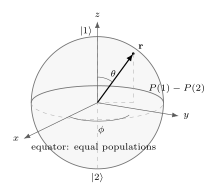
Bloch-sphere coordinates for a normalized two-level state. The pole labels identify the chosen basis, and . For a spin qubit . Pure states lie on the sphere and mixed states inside it; this is state geometry, not a particle trajectory. See Bloch Sphere.
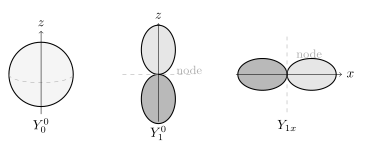
Schematic angular shapes: , , and the real combination . Different gray fills distinguish opposite amplitude signs, not different probabilities. The drawn ellipses are shape mnemonics, not quantitative radial plots. The real is not an eigenfunction. See Spherical Harmonics Quick Reference.
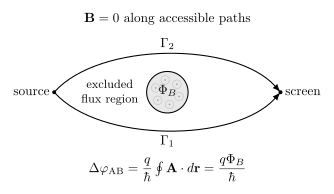
Two paths enclosing excluded magnetic flux acquire a relative Aharonov–Bohm phase. The visual emphasizes holonomy in the accessible region, not a local force along the paths. See Aharonov–Bohm Effect.
Two Checks on the Pictures
Section titled “Two Checks on the Pictures”For the Bloch diagram, an equatorial state has , so . Moving around the equator changes their relative phase and changes measurements in other bases, even though those two populations stay fixed.
For the Aharonov–Bohm diagram, the loop follows one path forward and the other backward. Its orientation fixes the sign of the enclosed flux. The relative phase factor returns to itself when the flux changes by for charge . A nonzero flux can therefore produce a trivial phase factor when it is an integer number of flux quanta. See the worked Berry Phase Problems for this distinction.
References
Section titled “References”- J. J. Sakurai and J. Napolitano, Modern Quantum Mechanics, 3rd ed., Cambridge University Press, 2020.
- A. Shapere and F. Wilczek, eds., Geometric Phases in Physics, World Scientific, 1989.
- E. Tufte, The Visual Display of Quantitative Information, 2nd ed., Graphics Press, 2001.
- R. N. Zare, Angular Momentum: Understanding Spatial Aspects in Chemistry and Physics, Wiley, 1988.