

Bloch Sphere for Quantum Information
The Bloch sphere turns one-qubit calculations into geometry: measurement probabilities become projections, unitary gates become rotations, and noise deforms the set of accessible states. The full ball, including its interior, represents mixed as well as pure states. Its three coordinates describe one qubit exactly; they do not describe correlations in a larger register.
Helpful background. Density operators supplies positivity and the Born rule, while Pauli matrices supplies the operator basis used below.
Bloch coordinates and one-qubit states
Section titled “Bloch coordinates and one-qubit states”The Bloch ball is an exact three-real-parameter representation of every one-qubit density operator:
The vector is the Bloch vector. Pure states lie on the unit sphere , mixed states lie inside it, and the maximally mixed state is the center. Its components are experimentally meaningful Pauli expectation values:
In quantum information, the picture is more than a state visualization. It is an operational dictionary:
- a state corresponds to its vector ;
- a projective measurement corresponds to an axis ;
- a one-qubit unitary corresponds to a proper rotation of ;
- a one-qubit channel corresponds to an affine map .
For the underlying geometry, see Bloch coordinates; for their relation to physical spin directions and spinors, see the spin Bloch sphere.
From a Density Matrix to Three Measurable Numbers
Section titled “From a Density Matrix to Three Measurable Numbers”Pauli expansion
Section titled “Pauli expansion”The identity and Pauli matrices form an orthogonal basis for operators under the Hilbert–Schmidt inner product:
Consequently, every trace-one Hermitian matrix has a unique expansion
The coefficients are recovered by traces:
In the computational basis,
Thus is the computational-basis population imbalance. The transverse coordinates satisfy and ; the minus sign follows from the usual Pauli matrix. A basis label such as is a convention fixed by the chosen encoding and control frame. It need not be a literal spatial direction.
Positivity makes a ball
Section titled “Positivity makes a ball”The eigenvalues of are
The condition is therefore exactly
The purity is
It ranges from at the center to on the surface. The radius measures purity for a one-qubit state; it does not by itself identify a temperature, a noise source, or a preparation procedure.
Pure states on the surface
Section titled “Pure states on the surface”After choosing the computational basis, a pure state can be parameterized as
Its Bloch vector is
The polar angle controls the population imbalance, and the azimuthal angle records relative phase. Global phase is absent because the density operator
is unchanged by . The derivation from normalized rays is given in Bloch Sphere for Spin and Projective Hilbert Space.
Six cardinal states
Section titled “Six cardinal states”The eigenstates of , , and define six useful reference points.
| Direction | State | Pauli eigenvalue |
|---|---|---|
These states are common calibration targets. The names , , and refer to Pauli coordinates in the logical frame. A hardware implementation must establish which pulses and readout settings realize those coordinates.
Mixed States and Convexity
Section titled “Mixed States and Convexity”If preparations occur with classical probabilities , the averaged state is
Bloch vectors average in the same way:
The Bloch ball is therefore convex. Mixing surface points produces an interior point unless all weight lies on the same pure state.
The decomposition is not unique. For example,
and
Both ensembles give . A point in the ball specifies the density operator, not a unique story about which pure state “really occurred.” It can also be the reduced state of a qubit entangled with another system, with no ignorance ensemble preferred by the formalism.
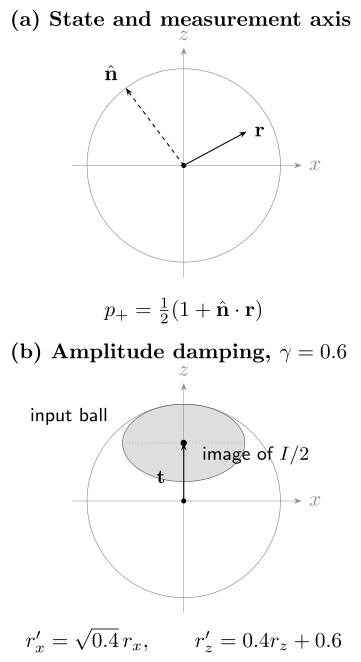
Two – sections of the Bloch ball. In (a), a projective measurement depends on the projection of onto the unit direction . In (b), amplitude damping with maps the ball to the shaded ellipsoid: its center moves to , its transverse radii become , and its vertical radius becomes . The ground-state pole remains fixed. All lengths use the same scale.
Measurement Axes
Section titled “Measurement Axes”Projective measurement along an axis
Section titled “Projective measurement along an axis”For a unit vector , the observable
has eigenvalues . Its projectors are
The Born rule gives
The expectation value is the signed projection
This is the operational meaning of the angle between the state and measurement vectors. Parallel pure-state and measurement axes give a certain outcome; antiparallel axes give a certain outcome; perpendicular axes give equal probabilities.
State axes and measurement axes are different objects
Section titled “State axes and measurement axes are different objects”The same three-dimensional coordinates describe a state vector and a measurement direction, but they play different roles. The state belongs to the preparation model. The axis belongs to the measurement effect. If both are unknown, observed probabilities alone do not determine which one is miscalibrated.
A real detector may be biased or unsharp. A binary effect can be expanded as
where requires and . The other outcome has effect . The resulting probability
need not correspond to an ideal projective axis. Measurement tomography explains how to reconstruct unknown detector effects.
One-Qubit State Tomography
Section titled “One-Qubit State Tomography”If ideal , , and measurements are calibrated, repeated outcomes estimate
For counts and in basis ,
These estimates fluctuate. Independent linear inversion can produce
which corresponds to no positive density operator. Finite sampling and errors in the measurement model can produce such an estimate. Constrained least squares, maximum likelihood, or Bayesian estimation can enforce physicality, but the estimator then has its own bias and uncertainty properties.
For independent shots of a calibrated Pauli measurement, has variance . This sampling uncertainty is separate from systematic error in the measurement axis or readout. If the preparations and measurements are both unknown, a reconstructed vector can absorb errors from either; positivity alone does not validate the calibration. State tomography develops physical estimators and their uncertainty.
Three Pauli settings are informationally complete for one-qubit state tomography, but tomography scales poorly for many qubits. An arbitrary -qubit density matrix has real parameters. The single-qubit sphere does not remove that scaling.
Rotations and Gates
Section titled “Rotations and Gates”Unitary gates rotate the ball
Section titled “Unitary gates rotate the ball”Ignoring an overall phase, every one-qubit unitary can be written
Conjugation by maps
to a rotation in Bloch-coordinate space:
The rotation preserves
so a unitary cannot purify or mix an isolated qubit. It moves pure states along the surface and mixed states on a sphere of fixed radius.
The factor of in the exponential matters. A Bloch-vector rotation by angle is generated by . The underlying spinor changes sign under a rotation, while its density operator and Bloch vector return after . Spin rotations derives the SU(2)-to-SO(3) relation.
Familiar gates as rotations
Section titled “Familiar gates as rotations”Up to global phase:
| Gate family | Bloch action |
|---|---|
| Rotation by about | |
| Rotation by about | |
| Rotation by about | |
| Rotation by about | |
| Rotation by about | |
| Rotation by about | |
| Rotation by about , up to phase |
Single-qubit gates connects these rotations to matrices, decompositions, and physical controls.
Schrödinger and Heisenberg pictures
Section titled “Schrödinger and Heisenberg pictures”One may rotate the state while holding the measurement axis fixed:
or hold the state fixed and rotate the observable oppositely:
The probability is unchanged because
This distinction is practical. A laboratory may implement an measurement by applying a basis-change pulse and then using a fixed readout. Whether the diagram shows a rotated state or rotated measurement axis depends on the chosen description.
Composition order
Section titled “Composition order”Rotations generally do not commute:
On a state column, the rightmost gate acts first. Bloch diagrams can hide this convention when arrows are drawn without an explicit time order. For pulse sequences, state the active rotation convention, axis orientation, and multiplication order.
Noisy Channels as Affine Maps
Section titled “Noisy Channels as Affine Maps”Every trace-preserving, Hermiticity-preserving linear map on one-qubit operators acts affinely on the Bloch vector:
where is a real matrix and . A physical quantum channel must be completely positive as well as trace preserving; this imposes constraints stronger than merely mapping the Bloch ball into itself.
A channel is unital when
In Bloch coordinates this means
Unital channels leave the center fixed, though they may contract or anisotropically distort the ball. Nonunital channels translate the center.
Dephasing
Section titled “Dephasing”Define the dephasing family
Its Bloch action is
At , transverse coherence vanishes and the sphere collapses to the -axis segment. Populations are unchanged. Negative includes an additional phase inversion; in many dynamical dephasing models decays from toward . Dephasing channel relates this map to Kraus operators and coherence times.
Depolarization
Section titled “Depolarization”For the convention
the Bloch vector transforms isotropically:
The ball contracts toward the center. Other sources use different depolarizing parameters, so the channel definition should accompany any quoted error probability.
Amplitude damping
Section titled “Amplitude damping”With chosen as the ground state and damping probability ,
This channel contracts and translates the ball toward . It is not unital because
Amplitude-Damping Channel derives the channel and explains its physical interpretation.
Positivity on one qubit is insufficient
Section titled “Positivity on one qubit is insufficient”A simple counterexample is transposition: reflects and preserves the Bloch ball, but it is not completely positive. Applied to half of an entangled pair it can produce a negative eigenvalue, as the final exercise shows. Ruskai, Szarek, and Werner characterize the allowed qubit-channel contractions and translations. The general tests are developed in quantum channels.
Geometric Diagnostics
Section titled “Geometric Diagnostics”Several one-qubit quantities become elementary functions of Bloch vectors.
Trace distance
Section titled “Trace distance”For qubit states and with vectors and ,
Thus optimal one-shot distinguishability is related to Euclidean separation in the ball. Antipodal pure states have distance and are orthogonal. Trace distance states the general definition and discrimination theorem.
Fidelity
Section titled “Fidelity”Using the squared Uhlmann-fidelity convention,
If is pure, this reduces to
Some sources call the fidelity, so conventions must be stated. Fidelity fixes the site’s formula convention.
Entropy and radius
Section titled “Entropy and radius”Because the eigenvalues are with , the von Neumann entropy is
where is binary entropy. Entropy decreases monotonically from one bit at the center to zero on the surface. This simple radial dependence is special to one qubit.
Worked Operational Examples
Section titled “Worked Operational Examples”Ramsey phase as azimuthal motion
Section titled “Ramsey phase as azimuthal motion”Prepare , apply a pulse about , and obtain the state. A relative phase accumulation
rotates the vector to
An measurement gives
while a measurement gives
The phase is invisible to a direct measurement because throughout. This is why a final analysis pulse is needed to convert phase into a population difference.
Dephasing as loss of contrast
Section titled “Dephasing as loss of contrast”If the same equatorial state undergoes ,
The signed fringe amplitude is multiplied by . Contrast, defined as the nonnegative modulation depth, is multiplied by ; a negative additionally shifts the fringe by . The radial contraction summarizes the loss of coherence for this state family, but it does not by itself identify whether the cause was stochastic detuning, entanglement with an environment, averaging over drift, or another mechanism.
A calibrated measurement
Section titled “A calibrated measurement”Suppose a prepared state has
which is pure because . Measuring along
gives
The near-certain outcome reflects geometric alignment, not simultaneous pre-existing and values.
Limitations of the Picture
Section titled “Limitations of the Picture”It is exact only for one qubit
Section titled “It is exact only for one qubit”An -qubit density matrix requires real parameters. One may draw a reduced Bloch vector for each qubit, but those vectors omit correlations and entanglement. For the Bell state
each qubit has , yet the joint state is pure and maximally entangled. Two centered local balls do not describe the global state.
Generalized Bloch vectors are not ordinary balls
Section titled “Generalized Bloch vectors are not ordinary balls”For a qudit, one can expand a state in traceless generators. Positivity does not fill a simple Euclidean ball when . The elegant equivalence
is special to under the standard normalization.
The coordinates are expectation values measured on separate, similarly prepared specimens, not three simultaneously readable properties of one specimen. Their axes depend on the computational basis and control frame. The same observed trajectory can also have several microscopic explanations; geometry by itself does not identify an environment or a preparation ensemble.
Exercises
Section titled “Exercises”1. Reconstruct a state from Pauli data
Section titled “1. Reconstruct a state from Pauli data”Ideal measurements give
Find the Bloch vector and density matrix. Is the estimate physical?
Solution
For a Pauli measurement,
Therefore
Its length is
so it is physical. The density matrix is
Equivalently,
2. Diagnose an unphysical linear estimate
Section titled “2. Diagnose an unphysical linear estimate”Tomographic linear inversion gives
Why is this not a valid qubit state, and what should an analyst do?
Solution
The squared length is
The smaller eigenvalue
is negative, so the reconstructed matrix is not positive semidefinite.
The analyst should not simply interpret the vector as “more than pure.” They should retain the raw counts, quantify statistical and calibration uncertainty, and use a documented physical estimator such as constrained least squares, maximum likelihood, or a Bayesian method. The choice of estimator and correction procedure must be reported.
3. Measure along a tilted axis
Section titled “3. Measure along a tilted axis”A qubit is in the state, . It is measured along
Find and .
Solution
The dot product is
Hence
Numerically, and .
4. Follow a gate rotation
Section titled “4. Follow a gate rotation”The initial Bloch vector is . Apply
Find the final state and the probabilities of , , and outcomes.
Solution
A positive rotation about sends to :
The final state is
up to global phase. Therefore
5. Dephasing and purity
Section titled “5. Dephasing and purity”The state passes through with . Find its output Bloch vector and purity. Evaluate the result at and .
Solution
The input vector is , so
Its purity is
At , the state remains pure with purity . At , the output is the center of the equatorial chord,
with purity . Complete dephasing of the equal superposition produces an equal incoherent mixture of and .
6. A ball-preserving map that is not a channel
Section titled “6. A ball-preserving map that is not a channel”Show that transposition sends to . Apply transposition to only the second qubit of , where . Why does the result rule out transposition as a physical channel on an arbitrary input?
Solution
Transposing the Pauli expansion leaves unchanged and sends to , so every one-qubit density matrix remains positive. But in the ordered basis , partial transposition gives
The antisymmetric vector has eigenvalue . A channel must remain positive when an untouched reference system is included. Transposition fails this requirement even though its one-qubit picture looks harmless.
For larger systems, continue to density operators for quantum information. BB84 uses the four and cardinal states as a communication alphabet.
References
Section titled “References”- Bengtsson, I., and K. Życzkowski. Geometry of Quantum States, 2nd edition. Cambridge University Press, 2017. doi:10.1017/9781139207010.
- Bloch, F. “Nuclear induction.” Physical Review 70, 460–474 (1946). doi:10.1103/PhysRev.70.460.
- Blume-Kohout, R. “Optimal, reliable estimation of quantum states.” New Journal of Physics 12, 043034 (2010). doi:10.1088/1367-2630/12/4/043034.
- Fano, U. “Description of states in quantum mechanics by density matrix and operator techniques.” Reviews of Modern Physics 29, 74–93 (1957). doi:10.1103/RevModPhys.29.74.
- Nielsen, M. A., and I. L. Chuang. Quantum Computation and Quantum Information, 10th anniversary edition. Cambridge University Press, 2010. doi:10.1017/CBO9780511976667.
- Ruskai, M. B., S. Szarek, and E. Werner. “An analysis of completely-positive trace-preserving maps on .” Linear Algebra and its Applications 347, 159–187 (2002). doi:10.1016/S0024-3795(01)00547-X; author manuscript.
- Watrous, J. The Theory of Quantum Information. Cambridge University Press, 2018. Author’s manuscript and errata.