

Bloch Sphere Geometry
Bloch sphere geometry is the coordinate geometry of a two-dimensional complex Hilbert space after normalization and global phase have been removed. It is special to qubits: the pure-state projective space is a two-sphere, and every one-qubit density matrix is a point in the corresponding three-dimensional ball.
This page gives the linear-algebra formulas. The spinor interpretation is Bloch Sphere, and the density-operator introduction is Bloch Sphere in Core Formalism.
Helpful background. Pauli matrices for the two-by-two operator basis; Hermitian operators for adjoints and real spectra.
Pauli Coordinates
Section titled “Pauli Coordinates”The matrices
form a real basis for Hermitian matrices. Therefore every Hermitian trace-one matrix can be written uniquely as
where
The coordinates are Pauli expectation values:
Thus the Bloch vector is not an additional physical object. It is the density matrix written in the Pauli basis.
Positivity and the Bloch Ball
Section titled “Positivity and the Bloch Ball”Using
the eigenvalues of are
Therefore
The allowed one-qubit density matrices fill the unit ball. Surface points are pure states; interior points are mixed states; the center is the maximally mixed state .
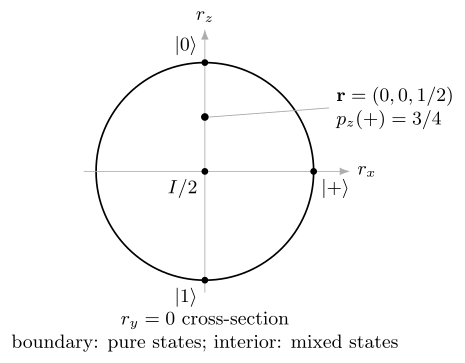
This cross-section shows the distinction between the pure-state sphere and the mixed-state interior. The point has probabilities and ; the center gives equal probabilities along every axis.
Pure States on the Sphere
Section titled “Pure States on the Sphere”A normalized qubit ray can be represented as
where
The associated unit Bloch vector is
The rank-one projector onto the ray is
The global phase of has disappeared. Away from the poles, the relative phase remains as the azimuthal angle. At either pole one coefficient vanishes, so no longer labels distinct rays.
Antipodal Points and Orthogonality
Section titled “Antipodal Points and Orthogonality”Opposite points on the Bloch sphere are orthogonal pure states, not the same state. If is a unit Bloch vector, then the projectors for the two antipodal directions are
They satisfy
Do not confuse with . The first leaves the projector unchanged; the second changes it to the orthogonal projector .
Overlap Geometry
Section titled “Overlap Geometry”Let and be two unit Bloch vectors, with angle between them:
The transition probability between the corresponding pure states is
The angle between rays, defined by , is therefore . Orthogonal states have , while identical rays have .
Rotations
Section titled “Rotations”A unitary generated by a Pauli direction has the form
Acting on a density matrix,
rotates the Bloch vector:
where is the ordinary rotation by angle around .
The map from spinor unitaries to rotations is two-to-one: and rotate the Bloch vector in the same way. The group-theory background is SU(2), and the physical spin version is Spin Rotations.
Measurements as Projections
Section titled “Measurements as Projections”The projective measurement of a Pauli component along a unit direction has effects
For a state ,
Geometrically, measuring along reads the projection of the Bloch vector onto the measurement axis. A pure state at gives the plus outcome with probability one; a state at the center gives equal probabilities in every direction.
Small changes of a pure-state Bloch direction are tangent directions on , not arbitrary independent changes in . The local tangent-space language is summarized in Tangent and Cotangent Spaces.
Why the Geometry Is Special to Qubits
Section titled “Why the Geometry Is Special to Qubits”The Bloch-ball formula depends on the Pauli basis and on the special identity
Higher-dimensional density matrices can be expanded in generalized generator bases, but the allowed set is not simply a Euclidean ball, and pure states do not form an ordinary two-sphere. The qubit case is unusually visual.
Common Mistakes
Section titled “Common Mistakes”- Treating the Bloch vector as a two-component spinor.
- Confusing the surface sphere of pure states with the full Bloch ball of density matrices.
- Calling antipodal points the same state; they represent orthogonal rays.
- Forgetting that global phase is removed but relative phase is visible as azimuth.
- Assuming the Bloch-ball picture generalizes directly to qutrits or larger systems.
- Missing the half-angle relation between spinors and Bloch-sphere directions.
- Treating and as different rotations of the Bloch vector.
References
Section titled “References”- F. Bloch, “Nuclear induction,” Physical Review 70, 460-474, 1946.
- B. C. Hall, Quantum Theory for Mathematicians, Springer, 2013.
- M. A. Nielsen and I. L. Chuang, Quantum Computation and Quantum Information, Cambridge University Press, 2010.
- J. J. Sakurai and J. Napolitano, Modern Quantum Mechanics, 3rd ed., Cambridge University Press, 2020.
Exercises
Section titled “Exercises”- Find the Bloch vector for
Solution
The projector is
Therefore the Bloch vector is
- Show that is pure exactly when .
Solution
The eigenvalues of are
A density matrix is pure exactly when one eigenvalue is and the other is . This happens exactly when .
- Two pure states have Bloch vectors separated by angle . What is their transition probability?
Solution
Use
For ,
- A state has Bloch vector . What are the probabilities for measuring ?
Solution
For measurement direction ,
Therefore
- Why do and give the same Bloch-vector rotation?
Solution
The density matrix transforms by conjugation:
Replacing by gives
Thus the Bloch vector changes in the same way. This is the two-to-one relation between and rotations.