

Mathematical Open-System Models
Tracing out an environment determines a reduced trajectory once a joint initial state is given. A channel family additionally requires a consistent rule for varying the initial system state, and a semigroup requires an exact composition law. The canonical Reduced Dynamics article explains the physical construction. This page organizes its mathematical assumptions and derives an identity that measures the failure of reduced semigroup composition.
Required background. Partial Trace Revisited gives the normal-state reduction map. Hilbert Space Tensor Products supplies the composite space and local operator domains.
Reduced models begin with specified state and preparation spaces
Section titled “Reduced models begin with specified state and preparation spaces”Take separable Hilbert spaces and normal joint states in . A self-adjoint joint Hamiltonian defines the strongly continuous unitary group even if the Hamiltonian is unbounded. Write
For a fixed initial joint state , the reduced trajectory is well defined. It is not yet a map on arbitrary initial system states. To obtain such a map one specifies an assignment from allowed system inputs to joint preparations.
The standard channel construction uses one fixed normal environment state and
Both and are channels between the relevant trace-class spaces. Hence is a channel for every . The fixed environment state and its independence from belong to the model data.
For correlated preparation families, an assignment may instead be defined only on a compatibility domain. Existence, positivity, and extension of such assignments are separate questions, developed in Initial Correlations. A reduced trajectory that is valid for one joint preparation should not be promoted to a universal system-only channel without resolving them.
Strong continuity passes to the reduced family
Section titled “Strong continuity passes to the reduced family”Joint unitary dynamics is strongly continuous on the trace class, by the finite-rank density argument in Strong Continuity. Since is isometric in trace norm and is contractive,
as . Thus normality and trace-norm continuity of the reduced channel family do not require a bounded joint Hamiltonian.
Differentiability is stronger. The joint generator must be defined on , or a separate reduced differentiability argument must apply, before one differentiates under the partial trace. A formal expression involving an unbounded commutator is not valid for every normal state merely because the finite-time channel exists.
The reduced composition defect is an exact projection identity
Section titled “The reduced composition defect is an exact projection identity”Set . This is a bounded CP trace-preserving projection on joint trace-class operators:
It discards the environment, including its correlations with the system, and prepares again. It need not be an orthogonal projection for a Hilbert-space inner product.
Using the joint group law , subtract the two reduced evolutions:
This identity requires no weak-coupling or Markov approximation. The term contains precisely the joint information removed by resetting the environment at time . Subsequent joint evolution can make that information visible again in the reduced system.
A sufficient condition for a reduced semigroup is invariance of the assignment range: for all . Then and the defect vanishes. This condition is not necessary: a nonzero discarded component might remain invisible after every relevant . The exact requirement is vanishing of the displayed composition defect on all inputs.
Worked example: an environment that gives back the input
Section titled “Worked example: an environment that gives back the input”Take a system qubit and environment qubit with . Let be the swap unitary and choose joint dynamics , measuring time in units of its coupling. Since ,
At the first time, swapping gives . The system’s reduced output is therefore , independent of , while the environment holds the input. At time , the actual joint evolution returns the original joint state, so the reduced output is .
Composing two reduced half-period maps instead gives : it implicitly applies between intervals and erases the stored input. The difference between actual reuse and this reset protocol is exactly the projection term above.
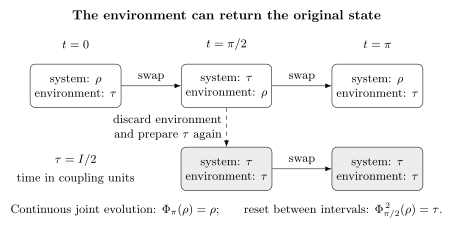
The upper path follows the same system and environment continuously. The lower path resets the environment after the first swap, as composition of the two reduced maps requires. Their different final system states demonstrate the failure of the semigroup law. The environment retains the input at even though the joint state at that instant is uncorrelated.
This same model realizes the reset-family revival considered in The Mathematical Language of Markovianity. A finite-time dilation of each channel therefore does not supply a common memoryless environment realization for their whole family.
A mathematical claim should identify its level
Section titled “A mathematical claim should identify its level”A reduced model can establish a trajectory for one preparation, a channel on a specified input space, a continuous family of such channels, or a semigroup with a defined generator. Each level adds assumptions or identities.
For a proposed differential equation, the practical mathematical questions are which norm defines its solutions, which operators form its generator domain, whether a CP evolution exists, and whether it is conservative. The bounded theorem answers these questions under its hypotheses. The unbounded-generator example shows why the same formal appearance is insufficient beyond them.
Exercises
Section titled “Exercises”An uncoupled environment. Let , where both factors are unitary groups. Is the reduced family a semigroup if ?
Solution
Yes. Partial trace gives , which has the group law. The assignment range need not be invariant because the environment state changes, but the discarded change never influences the system. This demonstrates why assignment-range invariance is sufficient rather than necessary.
Size of a composition defect. Bound the error for a state by the joint information removed at the intermediate time.
Solution
Channel contraction gives . This is an upper bound, not an equality: subsequent dynamics and partial trace can hide some or all of the discarded difference.
References
Section titled “References”- Engel, Klaus-Jochen, and Rainer Nagel. One-Parameter Semigroups for Linear Evolution Equations. Graduate Texts in Mathematics 194, Springer, 2000. doi:10.1007/b97696. Continuity, generators, and evolution on Banach spaces.
- Holevo, Alexander S. Quantum Systems, Channels, Information: A Mathematical Introduction, 2nd ed. De Gruyter, 2019. doi:10.1515/9783110642490. Normal channels, dilation, and reduced dynamics.
- Milz, Simon, M. S. Kim, Felix A. Pollock, and Kavan Modi. “Completely positive divisibility does not mean Markovianity.” Physical Review Letters 123, 040401 (2019). Preprint. Why one-time channel information does not settle multitime memory.