

Measurement in the Formalism
In the standard formalism, a quantum measurement is a rule that connects an input state to:
- a probability distribution over recorded outcomes;
- a conditional output state for each outcome that can occur.
The first item predicts classical data. The second item supplies the state used for later predictions after the record is known. Together they form the operational measurement model.
The scope is deliberately limited:
- measurement formalism means the mathematical probability-and-update rules;
- detector physics means a dynamical model of coupling, amplification, noise, timing, and readout;
- the measurement problem asks how definite macroscopic outcomes and the quantum state should be understood physically.
This page develops the first layer. A detector model can justify or approximate particular operators, and interpretations disagree about the physical status of state update, but neither issue changes how the stated operational model is used to calculate probabilities.
Helpful background. The Born rule assigns outcome probabilities; projectors represent sharp outcome subspaces. Density operators will let us keep both selected and averaged outcomes in one notation.
Measurement as an Input–Output Rule
Section titled “Measurement as an Input–Output Rule”We use finite-dimensional systems and finitely many outcomes for the explicit calculations. Begin with an input density operator
A discrete measurement has an outcome set
For each input state, the model must provide probabilities obeying
If outcome is retained, the model may also provide a normalized conditional state . The pair
is what a later experiment needs: the probability of reaching that branch and the state from which subsequent predictions begin.
For a pure input, one may write
but density operators are the natural language because selective and nonselective measurements can produce mixed ensembles even when the input was pure.
Three Layers That Must Not Be Collapsed
Section titled “Three Layers That Must Not Be Collapsed”A measurement description can contain three mathematically distinct layers.
Outcome labels
Section titled “Outcome labels”The symbols are classical records: numbers, detector clicks, pointer positions, bit strings, or coarse-grained categories. Their numerical labels alone do not determine quantum probabilities.
Probability operators
Section titled “Probability operators”Positive operators assign outcome probabilities through
For a projective measurement, the are orthogonal projectors. More generally, they form a POVM.
State-changing operations
Section titled “State-changing operations”A quantum operation assigns the unnormalized output branch
Its trace is the outcome probability,
and, when , the conditional state is
The family is a quantum instrument. Each branch is linear, completely positive, and trace nonincreasing, and the sum of all branches preserves trace. Linearity makes mixtures behave consistently; complete positivity means the operation remains positive when it acts on one part of an entangled system. The measurement-operator formula below supplies these properties explicitly. The effects determine probabilities, while the instrument contains the additional state-update information. Two instruments can have the same effects and the same outcome statistics but different conditional output states.
The instrument language is the most general of these three. The ideal projective model is the central special case and the right place to begin.
Ideal Sharp Measurements
Section titled “Ideal Sharp Measurements”For a discrete ideal sharp measurement, outcomes are represented by an orthogonal family of projectors:
If the measurement is described by a self-adjoint observable,
then is the recorded value and projects onto the full eigenspace with that eigenvalue.
The projector is the essential probability object. If is degenerate, has rank greater than one. The number does not select a preferred basis inside that eigenspace.
The spectral and joint-measurement structure is developed in Projective Measurement.
Outcome Probabilities
Section titled “Outcome Probabilities”For a pure state,
For a density operator,
Positivity follows because is positive. Normalization follows from the resolution of the identity:
These are instances of the Born Rule. The rule predicts frequencies for repeated preparations and probabilities for individual outcomes according to the adopted probabilistic interpretation. It does not replace the outcome set or the state-update model.
Expectation values are recovered from the same distribution:
Selective State Update
Section titled “Selective State Update”Suppose outcome is actually recorded and . The ideal Lüders branch is
Its trace is
The normalized selective update is therefore
For a pure input, this reduces to
The projected ket has squared norm , so divide the ket by . The unnormalized density operator has trace , so divide it by instead.
If , the conditional state is undefined because that branch never occurs in the stated model. Assigning an arbitrary normalized vector to a zero-probability branch has no operational content.
The update is a conditional rule for future predictions. It should be applied only after specifying which outcome was retained. Its dedicated treatment is State Update Rule.
Nonselective State Update
Section titled “Nonselective State Update”Suppose the measurement interaction occurs but the outcome is not available, is discarded, or is averaged over. The appropriate output is the weighted mixture of conditional branches:
For the ideal projective instrument,
This map is trace preserving:
It removes coherence between different outcome subspaces while preserving coherence within each degenerate subspace.
Forgetting an outcome is not the same physical operation as never performing the measurement. If no measurement occurs, the state remains apart from ordinary dynamics. If a measurement occurs and its record is ignored, the system is generally described by .
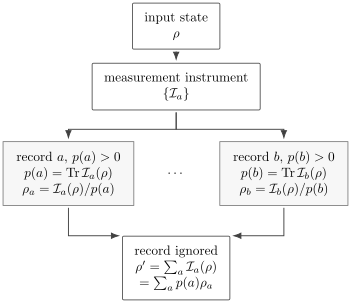
A quantum instrument maps the input to unnormalized branches . Retaining outcome gives the conditional state ; ignoring the record gives the nonselective state .
Repeatability and Its Limits
Section titled “Repeatability and Its Limits”The ideal sharp update is repeatable in a narrow mathematical sense. Since
an immediate repetition of the same projective measurement gives
This statement assumes:
- the same projective measurement is repeated;
- no intervening unitary dynamics, noise, or coupling changes the state;
- the first measurement realizes the ideal Lüders instrument.
Repeatability is not a universal property of measurement. Generalized, continuous, destructive, weak, or noisy measurements can fail it. A detector that absorbs a photon can report its energy accurately without leaving the same photon available for a repeated measurement.
Repeatability also does not mean that every basis vector inside a degenerate eigenspace is preserved by every apparatus measuring the same coarse outcome. The Lüders instrument is a particular minimally refining idealization.
Qubit Example: Measuring Along z
Section titled “Qubit Example: Measuring Along z”Write a qubit state in Bloch form:
where
The sharp -measurement projectors are
The outcome probabilities are
Because the projectors have rank one, the conditional states are
whenever the corresponding probability is nonzero.
If the outcome is ignored,
The and Bloch components vanish. These components encoded coherence between the two -outcome subspaces. The population difference remains.
For the pure state
the same formulas give
Degenerate Outcome Example
Section titled “Degenerate Outcome Example”Consider a three-level system and the two projectors
For a normalized input, with ,
the probability of the degenerate outcome is
If it occurs and , the Lüders state is
The relative phase and coherence between and survive. The measurement distinguishes the subspace from ; it does not secretly measure which basis vector inside was present.
An apparatus that further distinguishes from realizes a finer measurement. Degenerate state update and the difference between Lüders and finer von Neumann refinements belong to Degenerate Measurements and Lüders Rule.
Sequential Measurements Preview
Section titled “Sequential Measurements Preview”State update matters because it changes later probabilities. For a Lüders measurement with projectors followed immediately by one with , with no intervening evolution, the joint ordered probability is
For a pure input,
Reversing the order generally replaces by and changes the probability tree. If all relevant projectors commute, the ideal sequential probabilities reduce to a common joint distribution and the order does not matter.
The complete conditional-probability calculus and order effects belong to Sequential Measurements.
Measurement in a Chosen Basis
Section titled “Measurement in a Chosen Basis”Given an orthonormal basis , the associated rank-one projectors are
If
then
The selective ideal output is the ray represented by . Physically choosing a different measurement basis changes the projectors and can change the probabilities for a fixed input state. Merely rewriting the same apparatus and state in different coordinates leaves the probabilities unchanged. The practical coefficient calculations live in Measurement in a Chosen Basis.
Generalized Measurements Preview
Section titled “Generalized Measurements Preview”Projective measurements are not the full operational language. A discrete generalized instrument can be written using measurement operators :
Normalization of the full measurement requires
The effect for outcome is
so
The effects obey
and therefore form a POVM.
This framework describes noisy discrimination, inefficient detection, coarse-grained records, weak readout, indirect ancilla measurements, and many other procedures. Generalized Measurements Overview develops the operators and update rules; POVMs: First Encounter develops the probability-only effect language.
The Same POVM Can Have Different Updates
Section titled “The Same POVM Can Have Different Updates”Consider the computational-basis effects
The Lüders measurement operators
produce the familiar conditional basis states.
Now let
where
The effects are unchanged:
Thus both instruments give the same outcome probabilities for every input state. But the second instrument resets the system to after either outcome.
A POVM tells us what classical outcome statistics to expect. It does not, by itself, determine the post-measurement state.
Classical Record and Quantum Output
Section titled “Classical Record and Quantum Output”A measurement has both a classical output and, when the system remains available, a quantum output. Introduce orthonormal record states . The joint classical–quantum output can be represented as
The trace of the block is . Reading the classical register and conditioning on gives . Ignoring the register gives the nonselective quantum output
This representation makes selective and nonselective descriptions two views of one instrument rather than competing update rules.
Calibration and Detector Physics
Section titled “Calibration and Detector Physics”The formal operators are not labels attached to an apparatus by declaration. A physical measurement model requires a calibration statement connecting records to effects or instruments. Experimentally, that connection can be tested using known preparations, tomography, control experiments, and uncertainty estimates.
Different devices can realize the same ideal projectors or POVM effects while differing in:
- efficiency and dark counts;
- time resolution and dead time;
- destructive versus nondestructive readout;
- post-measurement disturbance;
- coupling strength and bandwidth;
- unrecorded environmental channels.
Those differences matter whenever later system dynamics or sequential measurements are predicted. The abstract formalism begins after an effective instrument has been specified; deriving it from a system–apparatus Hamiltonian is additional physics.
What the Formalism Does Not Settle
Section titled “What the Formalism Does Not Settle”The probability-and-update calculus does not, by itself, answer:
- why an individual run has one definite macroscopic record;
- whether conditional state update is a physical collapse, an information update, an effective description, or a branch-relative statement;
- how microscopic alternatives become robust macroscopic records;
- which interpretation of quantum mechanics is correct;
- where, if anywhere, a fundamental system–apparatus boundary lies.
Decoherence explains how environmental entanglement suppresses interference between selected reduced-state sectors and stabilizes records under suitable conditions. It does not, without further interpretive assumptions, select one unique outcome from the global state.
These issues are separated carefully in What Measurement Formalism Does Not Settle.
Common Pitfalls
Section titled “Common Pitfalls”The expectation is not an outcome probability. Use for outcome . The number averages all outcomes with their numerical values.
Ignoring a record does not undo a measurement. Sum the unnormalized branches to predict the next experiment. Returning to the original state would predict a different physical procedure.
Outcome effects do not fix the output state. The reset example gives the same probabilities as a sharp basis measurement while producing different states. Sequential predictions need the instrument.
A coarse result does not guarantee preservation of internal coherence. Lüders projection preserves it. An apparatus that resolves finer alternatives and then discards them can destroy it.
Exercises
Section titled “Exercises”Exercise 1: Normalize projective probabilities
Section titled “Exercise 1: Normalize projective probabilities”Let be orthogonal projectors with . Prove that
is a normalized probability distribution for every density operator .
Solution
Since and ,
Summing gives
Exercise 2: Qubit z measurement
Section titled “Exercise 2: Qubit z measurement”A qubit is prepared with and real in
Find the two -measurement probabilities and the selective output states.
Solution
With
the probabilities are
If , the normalized branch is . If , the normalized branch is , which represents the same ray as .
Exercise 3: Unread measurement is not no measurement
Section titled “Exercise 3: Unread measurement is not no measurement”Start with
Compute the state after an ideal computational-basis measurement when the outcome is ignored. Compare it with the state when no measurement occurs.
Solution
The input density operator is
The nonselective update gives
The off-diagonal coherence is removed. If no measurement occurs and no other dynamics acts, the state remains the pure projector .
Exercise 4: Degenerate coherence
Section titled “Exercise 4: Degenerate coherence”For
and
find the probability and conditional state for outcome .
Solution
Projection gives
Its squared norm is
After normalization,
The relative phase survives because the Lüders outcome distinguishes only the two-dimensional subspace from its orthogonal complement.
Exercise 5: Measurement disturbance in sequence
Section titled “Exercise 5: Measurement disturbance in sequence”A qubit begins in , the eigenstate of . Compare the probability of obtaining in an measurement with and without an unread sharp measurement immediately beforehand.
Solution
Without the intervening measurement,
An unread measurement maps
The subsequent probability is therefore
Ignoring the first record does not undo the disturbance of the quantum output.
Exercise 6: Same effects, different instruments
Section titled “Exercise 6: Same effects, different instruments”Let
and
Show that both instruments have the same effects but different conditional outputs.
Solution
For the first instrument,
For the second,
and similarly
Thus the probabilities agree for every input. The instrument outputs the recorded basis state, while either nonzero branch is proportional to and therefore resets the system to that ray.
Exercise 7: Repeatability of the Lüders branch
Section titled “Exercise 7: Repeatability of the Lüders branch”For an outcome with , given
show that an immediate repetition of the same projective measurement returns with probability one.
Solution
Using ,
Therefore
The conclusion assumes no intervening dynamics and the same ideal projective instrument.
Exercise 8: Selective branches average to the channel
Section titled “Exercise 8: Selective branches average to the channel”For an instrument , let
and
for nonzero-probability outcomes. Prove that averaging the conditional states gives the nonselective output.
Solution
For every branch with ,
Zero-probability branches contribute the zero operator and require no conditional state. Hence
The right-hand side is the nonselective output channel. Its trace is one because the total instrument is trace preserving.
References
Section titled “References”- P. Busch, P. Lahti, J.-P. Pellonpää, and K. Ylinen, Quantum Measurement, Springer, 2016. Publisher.
- E. B. Davies and J. T. Lewis, “An Operational Approach to Quantum Probability,” Communications in Mathematical Physics 17, 239–260 (1970). DOI.
- G. Lüders, “Über die Zustandsänderung durch den Meßprozeß,” Annalen der Physik 8, 322–328 (1951). Translation and discussion by K. A. Kirkpatrick.
- M. A. Nielsen and I. L. Chuang, Quantum Computation and Quantum Information, 10th anniversary ed., Cambridge University Press, 2010.