

Effective Hamiltonians in Quantum Matter
Quantum matter is full of Hamiltonians that are not microscopic starting points. A spin model can emerge from itinerant electrons whose charge motion is energetically suppressed. A narrow band can behave like a particle with a mass different from the bare electron mass. A projected band can acquire longer-range hopping, exchange, and geometric terms that were not obvious in the original basis.
An effective Hamiltonian in quantum matter acts on the degrees of freedom that remain active below a chosen energy, momentum, or length scale. The eliminated states still matter through virtual processes, renormalized parameters, induced interactions, and dressed observables.
Required background. Schrieffer–Wolff transformations supplies the reduction; many-particle Hamiltonians and fermionic anticommutators fix the operator algebra. The exact Hubbard dimer below tests the exchange coefficient and dressed double occupancy. Many-body effective Hamiltonians develops the lattice reduction, while effective mass connects band curvature to response.
Low-Energy Subspaces in Many-Body Systems
Section titled “Low-Energy Subspaces in Many-Body Systems”Write
and let project onto a low-energy eigenspace of with energy . The complementary projector
contains high-energy charge configurations, upper orbitals, remote bands, ligand excitations, or other degrees of freedom that will be eliminated.
If
with , then the leading energy-independent effective Hamiltonian is
where
and
The inverse is taken only on . The minus sign says that coupling to higher-energy states lowers an isolated retained level at second order. When the retained manifold has a nonzero bandwidth or several unperturbed energies, one uses the corresponding resolvent or a symmetrized Schrieffer–Wolff expression.
Many-body projection differs from a one-state perturbation problem in three important ways:
- The retained space can be exponentially large and highly degenerate.
- The perturbation can connect many local configurations even when each local matrix element is small.
- Projection generates new many-site operators rather than only shifting a few energy levels.
The useful small parameter is therefore usually local, such as
rather than the naive ratio of an extensive perturbation norm to one local charge gap. The finite-system formula above assumes a genuinely isolated model space and small perturbation norm; extending it uniformly to a lattice requires additional local estimates. A controlled expansion must still account for coordination number, bandwidth, resonances, and the order at which the desired process first appears.
The low-energy sector need not itself be gapped. Near the low-energy states of interest, creating a charge excitation can cost order while spin excitations remain gapless in the thermodynamic limit. This is not a claim that the entire extensive spectrum of a spin sector lies below every state containing a doublon. The projection controls separation between sectors, not the infrared physics within the retained sector.
Superexchange on a Hubbard Dimer
Section titled “Superexchange on a Hubbard Dimer”The two-site Hubbard model is the smallest exact benchmark for interaction-generated spin exchange. With two sites and spin-conserving hopping,
where
and
Choose the hopping phase so that is real, assume repulsive interaction , and retain exactly two electrons. The low-energy sector contains one electron on each site. It has one spin singlet and three spin triplets. The eliminated sector contains a doubly occupied site and an empty site, at unperturbed energy .
Hopping changes the number of doubly occupied sites, so
A singlet can hop virtually into a doublon–hole configuration and return. A triplet cannot place two electrons in the same spatial orbital because the required onsite spin state would violate fermionic antisymmetry.
After choosing the phase of the doublon combination that couples to the singlet, the nontrivial singlet block is
Its exact eigenvalues are
The orthogonal doublon combination is an uncoupled singlet at energy ; it is not part of this two-by-two block. The low-energy singlet therefore has
The triplets remain at zero energy in this convention. The singlet–triplet splitting is
whose leading strong-coupling limit is
Because , the simple repulsive one-band Hubbard dimer produces antiferromagnetic exchange.
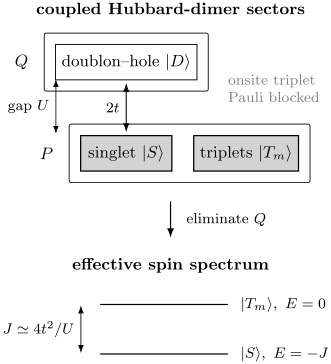
At half filling, the retained sector has one electron per site. Only the spin singlet couples to the doublon–hole sector through spin-conserving hopping. Eliminating the energy cost lowers the singlet by and leaves the triplets higher.
For example, at
second order gives , while the exact splitting is approximately
The comparison is a useful reminder that identifying the right effective operator does not guarantee that its lowest-order coefficient is numerically precise.
From the Dimer Benchmark to Lattice Models
Section titled “From the Dimer Benchmark to Lattice Models”The exact dimer calculation above fixes the sign and leading scale of one virtual bond process:
For dimensionless spin operators, the corresponding bond term is
Extending that result to a lattice requires more than copying the coefficient. One must define the no-doublon projector, decide whether projected hopping survives, sum every virtual path, retain same-order density and correlated-hopping terms, and control locality as the system grows.
Effective Hamiltonians in Many-Body Systems is the canonical derivation of that lattice reduction. It explains why:
- a half-filled no-doublon sector has and reduces to antiferromagnetic spin exchange at second order;
- a doped no-doublon sector has and retains projected hopping at first order;
- the bond density term is constant only at fixed half filling;
- three-site terms arise at the same order as exchange in the doped expansion;
- higher orders and additional microscopic structure generate longer-range, ring, anisotropic, or flux-sensitive interactions.
The Heisenberg model describes the resulting spin problem; the t–J model includes constrained hopping away from half filling.
Effective Mass as Band-Space Reduction
Section titled “Effective Mass as Band-Space Reduction”Scale separation also occurs in momentum space. Let a periodic one-particle Hamiltonian have Bloch energies
Suppose band is isolated from other bands near and has an extremum there. Write
The local band expansion is
where
For a slowly varying external potential and constant mass tensor, the envelope function obeys the effective Hamiltonian
where
The rapidly varying lattice-scale Bloch structure has been encoded into the band edge, effective mass, and envelope basis. The result resembles a free-particle Hamiltonian, but is a property of a chosen band, direction, and expansion point.
For a one-dimensional nearest-neighbor tight-binding band
with , expansion near gives
Matching the quadratic term to yields
Near the band maximum at , the electron curvature and effective mass are negative. Hole variables reorganize that physics into positive-energy carriers with their own charge and mass conventions.
Validity of a single-band mass
Section titled “Validity of a single-band mass”The scalar or tensor effective-mass Hamiltonian requires:
- one smooth isolated band; an isolated group generally requires a matrix-valued envelope equation;
- wave packets localized in momentum near the expansion point;
- external potentials varying slowly on the lattice scale;
- energies small enough that nonparabolic terms are negligible;
- no unresolved degeneracy requiring a multiband Hamiltonian.
The external perturbation must also be weak enough not to mix remote bands appreciably. Near unresolved crossings, a multiband Hamiltonian is needed. Berry-curvature corrections to motion can matter even in an isolated nondegenerate band; the scalar mass Hamiltonian does not capture them. If a curvature eigenvalue vanishes, higher-order dispersion replaces a finite quadratic mass in that direction. Interactions can also renormalize quasiparticle dispersion, producing a many-body effective mass distinct from the bare band-curvature mass.
Bloch Theorem explains the translation-symmetry basis; Effective Mass distinguishes curvature, transport, and other response-dependent definitions.
Projection Changes Operators
Section titled “Projection Changes Operators”An effective Hamiltonian does not make the physical state literally remain in the bare retained sector. If a Schrieffer–Wolff transformation block diagonalizes the Hamiltonian, an observable must be transformed as
For the large- Hubbard model, the bare double-occupancy operator
satisfies
Nevertheless, a physical low-energy eigenstate contains virtual doublon–hole weight of order , so its double occupancy is small rather than exactly zero. Projecting the state while leaving the observable bare would miss that contribution.
The same rule applies to current operators, spin operators, polarization, density, and optical matrix elements. Effective spectra can be correct while effective response functions are wrong if the probes are not dressed consistently.
Symmetry, Locality, and Nonuniqueness
Section titled “Symmetry, Locality, and Nonuniqueness”Three structural checks are especially useful in quantum matter:
Symmetry. If , , and the block-diagonalization procedure respect a symmetry, should inherit it. An unexpected symmetry-breaking term may signal an algebra error or a projector that was not symmetry invariant.
Locality. Eliminating local high-energy processes generally produces quasi-local interactions of increasing range and body order. Truncating those terms requires an order and range estimate. A short effective Hamiltonian is not automatically the most accurate one.
Internal unitary freedom. Two effective Hamiltonians can differ by a unitary transformation acting entirely within . Their coefficients may look different while spectra and consistently transformed observables agree. Comparisons between derivations must first align basis and gauge conventions.
These points become more important with system size. A local expansion in may be meaningful even though the norm of the total hopping Hamiltonian is extensive. Rigorous many-body control then uses locality, linked processes, or quasi-local transformations rather than a volume-independent bound on the full operator norm.
Exercises
Section titled “Exercises”Exact dimer expansion
Section titled “Exact dimer expansion”Expand the exact Hubbard-dimer singlet–triplet splitting
through order . Does second order overestimate or underestimate the exact splitting for finite ?
Solution
For ,
Using
gives
Therefore
The first correction is negative, so the second-order value overestimates the exact splitting at finite .
Singlet projector
Section titled “Singlet projector”For two dimensionless spin- operators, prove that
is the projector onto the singlet.
Solution
Use
For spin ,
The singlet has total spin zero, so
The triplet has total spin one and , so
Thus has eigenvalue on the singlet and on every triplet. It is therefore the singlet projector.
Double occupancy from an energy derivative
Section titled “Double occupancy from an energy derivative”Use the exact dimer singlet energy and the Hellmann–Feynman theorem to calculate its total double occupancy. Express its leading effective operator in the four-dimensional spin space.
Solution
Since ,
Every triplet has zero double occupancy. In the dressed spin representation, the leading operator is therefore
This explicit nonzero observable is consistent with : the latter omits the dressing of the physical state and measurement operator.
Different errors for energy and velocity
Section titled “Different errors for energy and velocity”For , estimate the relative errors of the quadratic band-edge energy above its minimum and the linear group velocity. Are their tolerances identical?
Solution
Put . The exact excitation energy is , so the quadratic approximation has leading relative error . The group velocity is , giving leading relative error for its linear approximation. Thus a one-percent tolerance suggests for energy but for velocity. A small momentum window must be specified relative to the observable being predicted.
References
Section titled “References”- P. W. Anderson, “Antiferromagnetism. Theory of superexchange interaction,” Physical Review 79, 350–356 (1950).
- P. W. Anderson, “New approach to the theory of superexchange interactions,” Physical Review 115, 2–13 (1959).
- A. Auerbach, Interacting Electrons and Quantum Magnetism, Springer (1994).
- S. Bravyi, D. P. DiVincenzo, and D. Loss, “Schrieffer–Wolff transformation for quantum many-body systems,” Annals of Physics 326, 2793–2826 (2011).
- J. Hubbard, “Electron correlations in narrow energy bands,” Proceedings of the Royal Society A 276, 238–257 (1963).
- J. M. Luttinger and W. Kohn, “Motion of electrons and holes in perturbed periodic fields,” Physical Review 97, 869–883 (1955).
- A. H. MacDonald, S. M. Girvin, and D. Yoshioka, “ expansion for the Hubbard model,” Physical Review B 37, 9753–9756 (1988).
- M. Takahashi, “Half-filled Hubbard model at low temperature,” Journal of Physics C: Solid State Physics 10, 1289–1301 (1977).