

Simultaneous Eigenstates and Good Quantum Numbers
A good quantum number is an eigenvalue label that remains meaningful under the dynamics and within the chosen model. In practice, it usually comes from an observable that commutes with the Hamiltonian and with the other observables used to label states.
For example, in a central potential,
Thus stationary states may be chosen as simultaneous eigenstates of , , and , with labels such as
The label is “good” because the corresponding eigenspaces are preserved by the Hamiltonian. It is not good by tradition; it is good because of commutators and symmetry.
Conserved eigenspaces
Section titled “Conserved eigenspaces”Let be an observable with no explicit time dependence. A necessary dynamical test for to be a good label of energy eigenstates is
Then the Hamiltonian preserves the eigenspaces of . If
then time evolution under does not mix that eigenspace with eigenspaces of different .
For several labels , one also needs mutual compatibility:
These conditions allow a common eigenbasis in finite dimensions. In infinite dimensions the observables must strongly commute, meaning that their spectral projections commute; continuous-spectrum labels use generalized eigenstates instead of normalizable vectors.
Simultaneous Eigenstates
Section titled “Simultaneous Eigenstates”In the finite-dimensional textbook setting, mutually commuting self-adjoint operators can be simultaneously diagonalized. A simultaneous eigenstate satisfies
When is included in the commuting family,
This is the algebraic basis of quantum-number notation. For the general formalism, see Compatible Observables and Complete Sets of Commuting Observables.
Good Does Not Mean Complete
Section titled “Good Does Not Mean Complete”A good quantum number can be useful without uniquely identifying a state. If several linearly independent states share the same labels, an additional degeneracy label is still needed:
Completeness is stronger. A complete set of commuting observables distinguishes basis states, up to phase, inside the sector being considered. Good quantum numbers may organize a spectrum while still leaving degeneracy.
This distinction matters in symmetry problems. A Hamiltonian may commute with and , so and are good labels, but there may be several independent copies of the same labels because of radial, spin, flavor, lattice, or internal degrees of freedom.
Central Potentials
Section titled “Central Potentials”For a spinless particle in a central potential,
rotational invariance gives
Since the angular momentum components do not commute with each other, one does not label states by simultaneously. Instead one uses the commuting set
The stationary states can be chosen as
Here denotes whatever additional radial or spectral label is needed. For a generic central potential, depends on both a radial label and . Rotational symmetry guarantees the degeneracy, not degeneracy between different values.
Ideal Hydrogen Labels
Section titled “Ideal Hydrogen Labels”In the ideal spinless Coulomb problem, the bound-state labels are usually written
They are simultaneous labels for , , and :
The label is tied to the Coulomb energy, while and are angular momentum labels. The fact that is independent of is special to the Coulomb problem; it is not implied by central symmetry alone.
If spin is included but spin-dependent terms are ignored, one may also use
where . In that simplified Hamiltonian, and are separately conserved because the spin and orbital sectors are not coupled.
When Spin-Orbit Coupling Changes the Labels
Section titled “When Spin-Orbit Coupling Changes the Labels”Once a central spin-orbit interaction is included,
the separate labels and are no longer generally good. The Hamiltonian remains invariant under simultaneous rotations generated by
so the useful labels become
In the simple central spin-orbit model, , , , and commute with the Hamiltonian. The labels , , , and are good, while and are basis labels for the uncoupled description, not conserved labels of the coupled Hamiltonian.
This is the central lesson: a good quantum number can stop being good when the Hamiltonian changes.
Spin Chain Preview
Section titled “Spin Chain Preview”In a many-spin system with full rotational symmetry, the total spin operators
may satisfy
Then states can be organized by total spin labels
The extra label is often essential: many-body Hilbert spaces can contain repeated copies of the same total-spin representation.
If the Hamiltonian has only axial symmetry, then may remain good while does not. This is the many-body version of the same rule: the good labels are those protected by the actual symmetry of the Hamiltonian, not by the symmetry one wishes it had.
Approximate Good Quantum Numbers
Section titled “Approximate Good Quantum Numbers”In applications, one often uses approximate labels. Suppose
where commutes with but not with :
The relevant small quantity is the mixing ratio between states with different , not alone. If these ratios are small, the eigenstates of remain close to definite- states. Near a degeneracy, even a weak perturbation can strongly mix the labels.
This distinction is especially important in spectroscopy. Labels such as , , , and can change status as spin-orbit coupling, hyperfine coupling, and external fields become more or less important. See Approximate Symmetry for the broader taxonomy.
A near-degenerate counterexample
Section titled “A near-degenerate counterexample”Let and . Then . The energy eigenvectors are rotated from the basis by an angle satisfying . For , the label is approximately good. At , any nonzero selects equal superpositions of the two eigenstates. Calling the coupling “small” without comparing it with the level spacing misses this change.
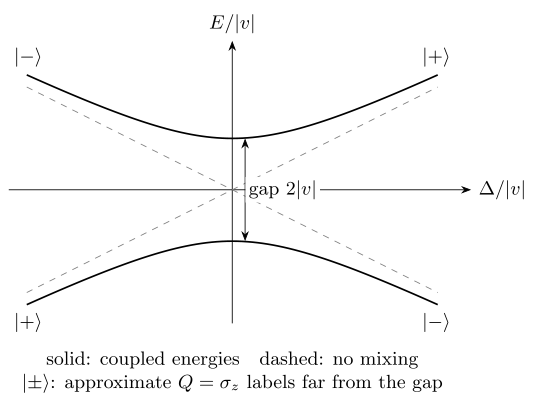
For , the energies are . The plot uses a fixed nonzero as its unit. Far from the avoided crossing, an energy eigenstate is close to a eigenstate. Near , both components have comparable weight, even when is small on other energy scales.
Exercises
Section titled “Exercises”- In a central potential, why are and compatible labels, while and are not?
Solution
The angular momentum algebra gives
so and can be diagonalized together. But
which is generally nonzero. Thus and cannot generally be assigned simultaneous sharp eigenvalue labels.
- For ideal spinless hydrogen, explain why , , and are good quantum numbers but do not all have the same origin.
Solution
The label labels the Coulomb bound-state energy through . The label is the eigenvalue label of , and is the eigenvalue label of . The angular labels come from rotational symmetry and angular momentum algebra. The fact that the energy depends only on , not on , is special to the Coulomb potential and is not a generic consequence of rotational symmetry.
- A Hamiltonian contains a central spin-orbit term . Which labels are natural: or ?
Solution
The spin-orbit term is invariant under simultaneous rotations generated by . It generally does not commute with and separately, so and are not exact labels for the coupled Hamiltonian. The natural labels are those of the coupled basis, including and , together with any remaining good labels such as and in the simple central model.
- Suppose commutes with but not with a perturbation , and . In what sense can still be useful?
Solution
For , is an exact good quantum number. If the mixing matrix elements are small compared with the relevant energy gaps, the exact eigenstates of may remain close to eigenstates of , so can be useful as an approximate label or as the label of a zeroth-order basis. But because , is not exactly conserved by the full Hamiltonian.
- In a spin-1 space, let with real . Are and good labels? Is the Hamiltonian invariant under every rotation? Conversely, if a Hilbert space contains several sectors, does alone guarantee that is good?
Solution
Here , and commutes with its square, so . The states have energies . Nevertheless, connects the state to the two states with , whose energies differ:
Thus good labels do not imply full rotational invariance. The fixed spin-1 assumption matters: for a single spin one half, , so this Hamiltonian would be invariant under every rotation.
Axial symmetry alone also need not conserve when different sectors coexist. For example, in the singlet and triplet space of two distinguishable spins one half, the Hermitian coupling
preserves but mixes states with different eigenvalues. Hence while . Within a single fixed- irreducible space, by contrast, is a scalar and cannot diagnose such mixing.
References
Section titled “References”- C. Cohen-Tannoudji, B. Diu, and F. Laloë, Quantum Mechanics, Vols. I–II, Wiley, 1977.
- P. A. M. Dirac, The Principles of Quantum Mechanics, 4th ed., Oxford University Press, 1958.
- J. J. Sakurai and J. Napolitano, Modern Quantum Mechanics, 3rd ed., Cambridge University Press, 2020, chapters 3–5.
- R. Shankar, Principles of Quantum Mechanics, 2nd ed., Springer, 1994.
- E. P. Wigner, Group Theory and Its Application to the Quantum Mechanics of Atomic Spectra, Academic Press, 1959.