

Dipole Transitions
Electric-dipole transitions are transitions driven by the leading coupling between a charged system and an electric field. In the dipole approximation, the relevant operator is the electric dipole moment
or, for a single particle of charge ,
Rotational rank fixes the allowed angular-momentum changes, and odd parity requires opposite-parity states. Polarization chooses which magnetic components contribute; it is therefore part of specifying a transition, not just its brightness.
Dipole Matrix Element
Section titled “Dipole Matrix Element”In the electric-dipole approximation, the transition amplitude is controlled by a matrix element of the form
For absorption, define the positive-frequency applied field by . The interaction then uses the displayed matrix element. Emission into the same mode uses instead. This conjugation matters for circular polarization. A symmetry zero in the relevant matrix element forbids E1 at this order.
The symmetry content comes from two facts:
- is a vector under rotations;
- is odd under parity.
These two transformation properties are enough to derive the standard angular and parity selection rules.
Spherical Components and Polarization
Section titled “Spherical Components and Polarization”A vector operator can be written in spherical components:
The components form a rank- spherical tensor:
The component selected by the light depends on polarization relative to the chosen quantization axis:
| Component | Common label | Magnetic rule |
|---|---|---|
| linear polarization along , or | ||
| one circular component | ||
| the opposite circular component |
The contraction is
Thus an absorption field with couples through and raises by one in this convention. Linear polarization along contains both components; it is not a drive. A transverse plane wave propagating along cannot have its electric field along , so driving requires a different propagation direction. These explicit vectors avoid ambiguities in the labels .
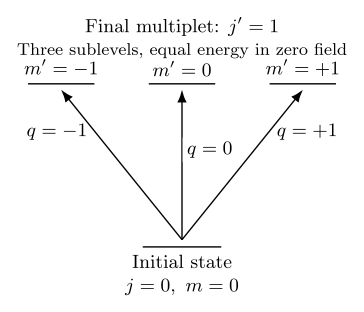
For , the operator component selects . The horizontal positions separate the labels, not the energies: the final multiplet is degenerate in zero field. The two multiplets must have opposite parity for E1, and a nonzero reduced matrix element is still required.
Rotational Selection Rules
Section titled “Rotational Selection Rules”Because is a rank- tensor, the Wigner–Eckart theorem gives
and
Equivalently, the total angular momentum can change by
subject to the triangle condition. In particular, a electric-dipole transition is forbidden by angular momentum because a rank- operator cannot connect two scalar angular-momentum multiplets.
For orbital angular momentum in a central potential, replace by when spin is not included:
This rotation-only rule allows where valid. Parity removes one of these options.
Parity Selection Rule
Section titled “Parity Selection Rule”The electric dipole operator is odd under parity:
If the initial and final states have definite parities and , the parity rule for an odd operator requires
Thus electric-dipole transitions connect states of opposite parity.
For central-potential orbital states,
Opposite parity requires and to differ by an odd integer. Combining this with the vector triangle rule gives
This is why the familiar orbital electric-dipole rule is not merely an angular-momentum triangle rule. It is the combination of rank- rotation behavior and odd parity.
Hydrogenic Orbital Rules
Section titled “Hydrogenic Orbital Rules”For spinless hydrogenic orbital states
the leading electric-dipole rules are
with the value of selected by the polarization component .
There is no symmetry rule requiring a particular . The radial overlap and energy conservation decide which transitions are strong, weak, resonant, or possible for a given photon frequency.
Total Angular Momentum Rules
Section titled “Total Angular Momentum Rules”When spin and spin–orbit structure are included, states are often labeled by total angular momentum rather than by alone. The dipole operator is still a rank- tensor under total rotations, so the angular rules become
and
Parity must still change for an electric-dipole transition. Additional approximate rules can appear in a coupling scheme. For example, in coupling the leading electric dipole operator acts on spatial coordinates and is often described as approximately preserving total spin:
That spin rule is not as fundamental as parity and angular momentum. Spin-dependent mixing and relativistic corrections can make nominally spin-forbidden transitions weakly allowed. Spin-independent electrostatic configuration interaction alone preserves total spin. Neither ordinary configuration interaction nor spin–orbit coupling removes an exact parity rule.
Forbidden Does Not Mean Impossible
Section titled “Forbidden Does Not Mean Impossible”An electric-dipole forbidden transition is forbidden only for the electric-dipole operator under the stated symmetry assumptions. The transition may still occur through:
- magnetic dipole coupling;
- electric quadrupole coupling;
- two-photon processes;
- external-field mixing;
- hyperfine or spin–orbit mixing;
- symmetry breaking by the environment.
These mechanisms are usually weaker, which is exactly why the electric-dipole selection rules remain practically important.
To turn an allowed amplitude into a rate, continue with Transition Rates in Light–Matter Interaction. For the size and wavelength conditions behind the dipole approximation, see Dipole Approximation. Atomic Selection Rules applies the same reasoning to fine and hyperfine structure, while Molecular Rotations applies it to rotor states.
Common Mistakes
Section titled “Common Mistakes”- Deriving from rotations alone. Parity is also needed.
- Forgetting that the polarization component fixes .
- Treating as a symmetry selection rule. It is not.
- Applying spinless orbital rules unchanged after fine structure changes the good angular labels.
- Treating electric-dipole forbidden as absolutely impossible.
- Ignoring the convention dependence of labels while using circular polarization language.
Exercises
Section titled “Exercises”- Use parity to show that an electric-dipole matrix element between two orbitals vanishes.
Solution
An orbital has , so its parity is
The electric dipole operator is odd under parity. A nonzero matrix element requires opposite initial and final parity. Two orbitals both have even parity, so
in a parity-symmetric central potential.
- An atom absorbs light with . Express the interaction in spherical dipole components. Which final magnetic sublevels can it reach from ?
Solution
The definitions give
Hence the absorption amplitude contains and terms, leading to and when the final multiplet contains them. There is no term. The amplitudes are coherent; whether their probabilities can simply be added depends on whether the final sublevels are distinguished or interfere in a later measurement.
- Why is forbidden for electric dipole transitions?
Solution
The electric dipole operator is a rank- tensor. The angular momentum triangle rule is
If , this gives
so . A final state with is not allowed by angular momentum conservation for a rank- operator.
- Explain why is not listed among the basic electric-dipole symmetry rules.
Solution
The principal quantum number is not a simple rotation or parity label. Electric-dipole symmetry rules constrain angular momentum and parity. Whether two radial states with different or equal have a nonzero radial overlap is a dynamical question, not a pure symmetry rule. Energy conservation and the photon frequency also matter.
References
Section titled “References”- C. Cohen-Tannoudji, B. Diu, and F. Laloë, Quantum Mechanics, Wiley, 1977.
- A. R. Edmonds, Angular Momentum in Quantum Mechanics, Princeton University Press, 1957.
- C. J. Foot, Atomic Physics, Oxford University Press, 2005.
- D. J. Griffiths and D. F. Schroeter, Introduction to Quantum Mechanics, 3rd ed., Cambridge University Press, 2018.
- J. J. Sakurai and J. Napolitano, Modern Quantum Mechanics, 3rd ed., Cambridge University Press, 2020.