

Thermal Operations Preview
Thermal operations are a resource-theoretic way to ask which state transformations are possible using a heat bath, energy-conserving dynamics, and no hidden nonequilibrium resource. They are not a replacement for master equations or fluctuation theorems. They are a complementary language for finite systems, one-shot transformations, catalysts, coherence, and work storage.
The central restriction is energy conservation for the system and thermal bath together. We first derive its consequences for equilibrium states, then use a two-level example to see why decreasing average free energy is not always enough. Resource Theories introduces the general language of allowed operations and resources.
Thermal States and Available Resources
Section titled “Thermal States and Available Resources”Fix a system Hamiltonian and a bath temperature , with
The system Gibbs state is
In resource-theoretic thermodynamics, is a free state: it is what can be obtained from a heat bath at the same temperature without spending work or another nonequilibrium resource.
States that differ from contain thermodynamic resources. These resources may include:
- population imbalance relative to the Gibbs distribution;
- coherence between different energy eigenspaces;
- correlations with another system;
- access to a work storage device;
- catalysts that enable transformations while being returned unchanged.
Thermal Operation
Section titled “Thermal Operation”A thermal operation on system has the form
where
is a bath Gibbs state and the joint unitary obeys energy conservation:
The allowed ingredients are therefore:
- add a bath system in a thermal state at temperature ;
- apply a unitary that conserves total energy;
- discard bath degrees of freedom.
No time-dependent external drive is hidden inside . If a drive changes the Hamiltonian or supplies work, that drive is an additional resource and must be modeled explicitly.
Gibbs Preservation
Section titled “Gibbs Preservation”Every thermal operation preserves the Gibbs state:
The reason is simple. The product state is the Gibbs state of :
Because commutes with , it leaves this global Gibbs state invariant. Tracing out the bath gives back .
The converse is not generally true. A map that preserves the Gibbs state is called Gibbs-preserving, but the set of Gibbs-preserving maps is larger than the set of thermal operations. This distinction matters in finite-dimensional and coherence-sensitive settings.
Free-Energy Monotone
Section titled “Free-Energy Monotone”For a fixed Hamiltonian and temperature, the nonequilibrium free energy can be written as
Its excess over the thermal free energy is
where
is quantum relative entropy. Since thermal operations preserve and relative entropy is contractive under quantum channels,
Thus thermal operations cannot increase nonequilibrium free energy. In the many-copy macroscopic limit, this recovers the familiar role of free energy. In one-shot and catalytic settings, additional monotones can appear.
Thermo-Majorization
Section titled “Thermo-Majorization”For energy-diagonal states, a graphical criterion makes the additional restriction precise. Let be the Gibbs probabilities. Sort the levels by decreasing and join the points
This is the thermo-majorization curve of . A transformation is possible under thermal operations in the ideal bath limit precisely when the curve of lies nowhere below that of . For a specified finite bath, additional restrictions on exact implementation can remain. For degenerate energies , this reduces to ordinary majorization.
Consider a qubit with , so . Start in the ground state, , and ask for . At cumulative Gibbs weight , the initial curve reaches only , while the target curve reaches . The transition is forbidden. Yet the excess free energy decreases:
Thus the average free-energy inequality is necessary but not sufficient for this single-copy transformation. Horodecki and Oppenheim develop the general criterion.
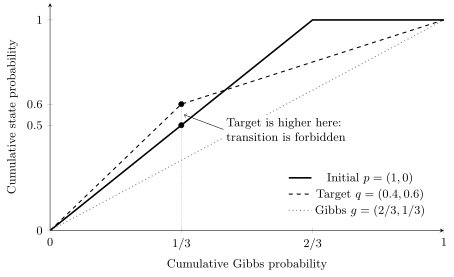
The target has lower average free energy but lies above the initial curve near cumulative Gibbs weight . Thermal operations cannot make this transformation. Each curve sorts levels by its own population-to-Gibbs-weight ratio.
Coherence Constraints
Section titled “Coherence Constraints”Thermal operations are covariant under the system’s free time evolution:
This follows from total-energy conservation and the stationarity of the bath Gibbs state. In particular, implies : no coherence between different energies is created from an energy-block-diagonal state. Coherence within a degenerate energy subspace is not excluded by this argument.
Population thermo-majorization therefore does not fully characterize transformations of coherent states. An external phase reference or explicitly controlled drive changes which transformations are available. Lostaglio, Jennings, and Rudolph explain the additional symmetry constraints.
Relation to Master Equations
Section titled “Relation to Master Equations”A thermal master equation describes continuous-time reduced dynamics under approximations such as weak coupling, Markovianity, and often secularization. A thermal operation describes an allowed state transformation under a resource-theory rule.
The two languages overlap but are not identical:
| Question | Thermal Master Equation | Thermal Operation |
|---|---|---|
| time-resolved dynamics | central | usually absent |
| bath model | correlation functions and rates | Gibbs ancilla at temperature |
| energy conservation | appears through rates and detailed balance | imposed on the joint unitary |
| allowed transformations | generated by the equation | constrained by resource monotones |
| coherence | damped or rotated dynamically | constrained by symmetry and resources |
For continuous-time thermal dynamics, see Thermal Master Equations. For entropy balances, see Entropy Production.
Work Storage and Batteries
Section titled “Work Storage and Batteries”To discuss work extraction, one often adds an explicit work storage system. A schematic energy-conserving unitary then acts on
where is a battery or weight. The battery should not secretly provide entropy, coherence, or correlations beyond the intended work resource.
This is harder than it sounds. A good battery model should specify:
- its Hamiltonian;
- which states count as charged or discharged;
- whether it supplies coherence or only energy;
- whether its entropy changes;
- whether it is returned close to its original form.
Ergotropy and Passive States treats work extraction by arbitrary cyclic unitary control. Thermal operations impose a different control restriction. When a catalyst is added, also specify whether it returns exactly and uncorrelated with the system. Allowing residual correlations or a small error in a very large catalyst changes the transformation criteria.
Simple Consequences
Section titled “Simple Consequences”Thermal operations imply several useful checks:
-
A system already in cannot be turned into a nonequilibrium state for free.
-
A system initially in its Gibbs state cannot acquire population inversion from a bath at the same temperature alone. A nonthermal initial system can already supply a resource.
-
Nonequilibrium free energy cannot increase under a thermal operation.
-
Coherence across energy gaps is not freely available from an ordinary thermal bath.
-
A process that uses a time-dependent Hamiltonian is not a bare thermal operation unless the work source is included as a resource.
These are sanity checks, not a full transformation theorem.
Exercises
Section titled “Exercises”Gibbs State Is Fixed
Section titled “Gibbs State Is Fixed”Show that a thermal operation preserves .
Solution
Start from
The product state is
If , then commutes with every function of , so
Taking the bath trace gives
Free Energy from Relative Entropy
Section titled “Free Energy from Relative Entropy”Show that
Solution
Since
we have
Then
Using ,
The thermal free energy is
Therefore
Why Time-Dependent Driving Is Not Free
Section titled “Why Time-Dependent Driving Is Not Free”Explain why a protocol using an externally controlled is not automatically a thermal operation.
Solution
A thermal operation is built from a fixed system Hamiltonian, a thermal bath state, and a joint unitary satisfying
If an external agent changes , then energy is being exchanged with a work source. That work source is not part of the free thermal bath. To treat the process resource-theoretically, one must include the drive or battery explicitly and track its energy, entropy, and coherence. Otherwise the protocol hides a resource inside the control parameter.
References
Section titled “References”- F. G. S. L. Brandão, M. Horodecki, J. Oppenheim, J. M. Renes, and R. W. Spekkens, “Resource theory of quantum states out of thermal equilibrium,” Physical Review Letters 111, 250404 (2013).
- F. G. S. L. Brandão, M. Horodecki, N. Ng, J. Oppenheim, and S. Wehner, “The second laws of quantum thermodynamics,” Proceedings of the National Academy of Sciences 112, 3275–3280 (2015).
- P. Ćwikliński, M. Studziński, M. Horodecki, and J. Oppenheim, “Limitations on the evolution of quantum coherences: towards fully quantum second laws of thermodynamics,” Physical Review Letters 115, 210403 (2015).
- J. Goold, M. Huber, A. Riera, L. del Rio, and P. Skrzypczyk, “The role of quantum information in thermodynamics: a topical review,” Journal of Physics A: Mathematical and Theoretical 49, 143001 (2016).
- M. Horodecki and J. Oppenheim, “Fundamental limitations for quantum and nanoscale thermodynamics,” Nature Communications 4, 2059, 2013.
- M. Lostaglio, D. Jennings, and T. Rudolph, “Description of quantum coherence in thermodynamic processes requires constraints beyond free energy,” Nature Communications 6, 6383, 2015.