

Optomechanics
Cavity optomechanics studies the coupling between electromagnetic fields and mechanical motion. The mechanical system may be a suspended mirror, membrane, nanobeam, microwave drumhead, levitated particle, phononic mode, or collective elastic coordinate. The common ingredient is that the optical or microwave resonance frequency depends on a mechanical displacement.
Radiation pressure links three tasks: measuring motion, disturbing it through force noise, and cooling it through delayed optical response. We use one cavity mode and one mechanical mode to connect these effects quantitatively.
Basic Radiation-Pressure Model
Section titled “Basic Radiation-Pressure Model”A minimal single-mode optomechanical Hamiltonian is
where annihilates a cavity photon, annihilates a mechanical phonon, is the cavity frequency, is the mechanical frequency, and is the single-photon optomechanical coupling rate.
The mechanical displacement operator is
If the cavity frequency depends on displacement, then
The sign convention is not important by itself; the measurable quantities are frequency shifts, damping rates, spectra, and phases. The essential physics is that photon number exerts a force on the mechanical oscillator, while mechanical displacement shifts the phase and frequency of the outgoing field.
Driven and Linearized Regime
Section titled “Driven and Linearized Regime”Most experiments use a strong coherent drive. In a frame rotating at the drive frequency , write the cavity operator as
where is the coherent intracavity amplitude and represents fluctuations. After also shifting the mechanical equilibrium, retaining terms quadratic in fluctuation operators gives the Hamiltonian for linear fluctuation equations
with detuning
The cavity frequency here includes the static radiation-pressure shift; now describes fluctuations about the displaced mechanical equilibrium. The approximation discards the residual cubic term and requires fluctuations small enough for it to be negligible. The drive changes the problem qualitatively. The single-photon coupling can be small, while the enhanced coupling is large enough to cool, amplify, measure, or hybridize mechanical motion. The price is that drive noise, heating, and classical technical fluctuations may enter the same ports as the quantum field.
Open-System Description
Section titled “Open-System Description”A standard Markovian model includes cavity loss at rate and mechanical damping at rate :
For optical cavities at ordinary temperatures the thermal photon occupation is usually negligible. For microwave cavities it may not be negligible unless the mode is well thermalized and cold. The mechanical bath occupation is
This master equation is not the whole story in every device. Strong colored noise, non-Markovian supports, internal two-level fluctuators, excess laser noise, photothermal forces, gas damping, and nonlinearities may require a more detailed bath model. Still, the Lindblad model is the useful baseline against which those corrections are judged.
Position Measurement and Output Field
Section titled “Position Measurement and Output Field”In the linear regime the outgoing field carries information about mechanical displacement. Schematically,
and an appropriate output quadrature contains a contribution proportional to . Homodyne detection therefore implements a continuous weak measurement of mechanical position or of a filtered mechanical quadrature.
The measurement record may be written abstractly as
where is the detection efficiency, is a convention-dependent measurement rate, , and is measurement noise. The conditional mechanical state follows a stochastic master equation when the record is retained. If the record is discarded, the same interaction produces unconditional diffusion and decoherence.
This is the platform version of Measurement Backaction and Diffusive Trajectories.
Imprecision and Backaction
Section titled “Imprecision and Backaction”An optomechanical position measurement has two quantum noise terms:
- imprecision noise, because the optical phase quadrature has shot noise;
- backaction force noise, because amplitude fluctuations shake the mechanical oscillator through radiation pressure.
For a position-calibrated ideal linear detector with negligible reverse gain, use two-sided symmetrized spectra, . With vanishing imprecision–backaction correlations, the familiar quantum-noise constraint is
The displayed factor belongs to this spectral convention; one-sided spectra have a different numerical factor. More general detectors require the gain and cross-correlation terms in the full quantum noise inequality. See Clerk et al..
Increasing probe power usually lowers while raising . At low power the measurement is too noisy to resolve the motion. At high power the measurement itself drives the motion. The standard quantum limit is the optimum that results when these two contributions are balanced for a specified force, displacement, or quadrature measurement.
The standard quantum limit is not a universal ban on better measurements. It assumes a particular observable, detector model, and absence of helpful correlations. Backaction-evading measurements, squeezed input light, variational readout, two-tone schemes, and quantum nondemolition quadrature measurements can beat the simplest SQL for selected tasks, while still respecting the full quantum noise constraints.
Dynamical Backaction
Section titled “Dynamical Backaction”The mechanical oscillator modifies the intracavity field with a delay set by . That delayed radiation-pressure force changes the mechanical damping and spring constant. In linear response one writes an effective mechanical susceptibility
where is an optical self-energy. Its real part shifts the mechanical frequency; its imaginary part changes the damping.
This is called dynamical backaction. It can cool a mechanical mode, amplify it, drive self-oscillation, or entangle it with the optical field. It is backaction in the literal dynamical sense, not merely a philosophical synonym for measurement disturbance.
Sideband Cooling
Section titled “Sideband Cooling”For a red-detuned drive near
the dominant resonant process converts a mechanical phonon plus a drive photon into a higher-frequency cavity photon. This removes mechanical energy. In the resolved-sideband regime,
the anti-Stokes scattering process can be stronger than the Stokes heating process.
For weak linearized coupling, vacuum optical noise, and a cavity correlation time short compared with the induced mechanical evolution, the detuning convention above gives
Here removes phonons and adds phonons. The optical damping rate is
The approximate final occupation is
With negligible original bath heating and , these rates give . This explains why a narrow cavity suppresses residual Stokes heating. Stability requires ; strong optomechanical hybridization requires the full coupled-mode dynamics instead of these eliminated rates. Ground-state cooling requires more than a large optical damping rate. One also needs sufficiently low classical heating, a sideband-resolved or otherwise optimized spectrum, stable drive power, and a bath that does not add excess noise faster than the cooling removes phonons.
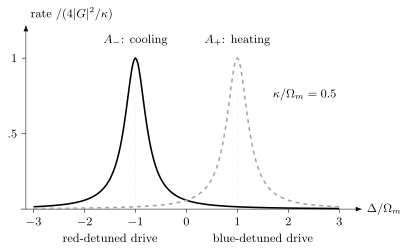
The two weak-coupling scattering rates for . At , phonon removal is resonant and phonon creation is suppressed, but remains nonzero. The separation of these peaks explains the cooling advantage of a spectrally narrow cavity.
Beam-Splitter and Two-Mode-Squeezing Limits
Section titled “Beam-Splitter and Two-Mode-Squeezing Limits”Under a rotating-wave approximation, the red-detuned interaction becomes approximately
which swaps excitations between light and mechanics. This is the interaction behind sideband cooling, state transfer, and optomechanically induced transparency.
For a blue-detuned drive near , the resonant interaction is instead
which creates correlated photon-phonon pairs. It can amplify motion, generate squeezing, or become unstable when gain exceeds damping.
These approximations are powerful only when the rotating terms are well separated from the counter-rotating terms. Outside the resolved-sideband regime, both processes can contribute appreciably.
Mechanical Baths and Heating
Section titled “Mechanical Baths and Heating”The mechanical mode is rarely coupled to only one clean thermal bath. Practical noise sources include:
- substrate phonons and support losses;
- gas collisions or clamping loss;
- absorption-induced heating;
- photothermal forces;
- frequency noise of the optical or microwave drive;
- charge, dielectric, or two-level fluctuators;
- recoil heating in levitated systems.
The open-system task is to identify which noise source contributes at which frequency and through which operator. A force-noise spectrum near drives energy exchange. Low-frequency frequency noise causes phase diffusion of the mechanical oscillator. Nonlinear damping and mode coupling can make the effective bath depend on amplitude.
The relation between damping and thermal noise follows from equilibrium fluctuation–dissipation assumptions. See Fluctuation–Dissipation Relation and Caldeira–Leggett Model for the derivation and its limits.
Experimental Regimes
Section titled “Experimental Regimes”Different optomechanical platforms emphasize different limits:
- optical microcavities often have strong gradients, low optical thermal occupation, and challenging absorption heating;
- microwave drumhead circuits naturally interface with superconducting electronics and microwave input–output measurement;
- membrane-in-the-middle and Fabry–Perot systems provide clean textbook radiation-pressure geometry;
- levitated particles can have extremely weak mechanical contact with a substrate but require careful control of recoil, gas, and trap noise;
- phononic-crystal devices engineer mechanical and optical localization together.
The same symbols , , , , and do not by themselves determine the experiment. Geometry, bath temperature, drive noise, optical absorption, coupling efficiency, and detection efficiency decide which open-system model is trustworthy.
Exercises
Section titled “Exercises”Single-Photon Coupling
Section titled “Single-Photon Coupling”Suppose a cavity resonance changes with displacement as . Express in terms of and using the sign convention in this page.
Solution
The page uses
Since ,
Only the relative sign matters after the phases of and are fixed; rates depend on or .
Cooling and Heating Rates
Section titled “Cooling and Heating Rates”Using the sideband-cooling rates in this page, show which rate is resonantly enhanced when .
Solution
The cooling rate is
At , the second term in the denominator vanishes, so is maximized:
The heating rate is
Thus red detuning favors anti-Stokes scattering when the sidebands are spectrally resolved.
Final Occupation
Section titled “Final Occupation”Assume and . What does the approximate final occupation reduce to?
Solution
Start from
If , the denominator is approximately . If , then . Therefore
The first term is residual heating from the original mechanical bath. The second term is the quantum backaction limit from Stokes scattering.
Imprecision-Backaction Balance
Section titled “Imprecision-Backaction Balance”In a simplified detector model, suppose and , where is probe power and . Find the power-independent product and explain why there is an optimum total noise.
Solution
The product is
Increasing lowers imprecision but raises backaction. For a mechanical displacement or force measurement, the total noise contains an imprecision contribution plus a backaction contribution filtered by the mechanical susceptibility. The minimum occurs at , where the two displacement contributions are equal. Its value is under the stated two-sided noise constraint.
References
Section titled “References”- M. Aspelmeyer, T. J. Kippenberg, and F. Marquardt, “Cavity optomechanics,” Reviews of Modern Physics 86, 1391–1452 (2014). arXiv:1303.0733.
- V. B. Braginsky and F. Y. Khalili, Quantum Measurement, Cambridge University Press, 1992.
- J. Chan et al., “Laser cooling of a nanomechanical oscillator into its quantum ground state,” Nature 478, 89-92 (2011).
- A. A. Clerk, M. H. Devoret, S. M. Girvin, F. Marquardt, and R. J. Schoelkopf, “Introduction to quantum noise, measurement, and amplification,” Reviews of Modern Physics 82, 1155-1208 (2010).
- T. J. Kippenberg and K. J. Vahala, “Cavity optomechanics: back-action at the mesoscale,” Science 321, 1172-1176 (2008).
- J. D. Teufel et al., “Sideband cooling of micromechanical motion to the quantum ground state,” Nature 475, 359-363 (2011).