

Particle-Number Superselection
Fock space allows vectors with components in several particle-number sectors. A particle-number superselection rule is the stronger statement that relative phases between different particle-number sectors are not accessible under the allowed observables, preparations, or reference frames.
The general language of superselection sectors becomes concrete when we distinguish three statements:
- a state is mathematically written as a superposition of different total particle numbers;
- a Hamiltonian conserves total particle number;
- a physical setting permits, forbids, or hides coherent operations between different number sectors.
Those statements are related, but they are not the same.
Helpful background. Fock Space gives the sector decomposition; Number Operators explains number-conserving dynamics.
Number Sectors in Fock Space
Section titled “Number Sectors in Fock Space”For a one-particle Hilbert space , a bosonic or fermionic Fock space is a direct sum of fixed-number sectors:
Here means for bosons and for fermions. The total number operator has eigenvalue on :
where projects onto the -particle sector.
A general Fock-space vector may have the form
with . If more than one coefficient is nonzero, the vector is not an eigenvector of total particle number.
The direct-sum formalism permits such a vector. Whether its relative phases are physically meaningful depends on the available operations and reference frames.
Number Conservation
Section titled “Number Conservation”Particle-number conservation is a statement about dynamics. If a Hamiltonian satisfies
then time evolution generated by does not mix different total-number sectors. If the state begins in , it remains in . For self-adjoint operators on an infinite-dimensional Fock space, the precise requirement is that commute with every number projector . The commutator notation here assumes this sector-preserving realization; a formal calculation on an insufficient domain does not establish it. Conserved Quantities gives the spectral criterion.
This is weaker than a superselection rule. A subsystem Hamiltonian may conserve its particle number while coupling to a suitable reference permits phase-sensitive operations on that subsystem. Merely allowing particle exchange with an incoherent reservoir does not supply such a phase reference. Conversely, a superselection restriction can say that even if a formal vector is written with several sectors, no allowed observable can detect the relative phases.
The practical distinction is:
The second and third rows are common ways of modeling a superselection restriction.
Superselection as Inaccessible Coherence
Section titled “Superselection as Inaccessible Coherence”Use bounded observables (including measurement effects) and require that they preserve each number sector. Equivalently, they commute with every ; in commutator notation:
Then is block diagonal in the particle-number decomposition:
For any density operator , define the number-dephased state
For every such bounded number-conserving observable ,
The dephased-state sum converges in trace norm; boundedness of makes the trace identity valid for every density operator, even one with infinite mean number. For unbounded observables, the corresponding expectations need additional existence conditions. Thus the off-diagonal blocks with cannot be detected by those bounded observables. In that operational setting, a coherent state across number sectors is indistinguishable from its number-dephased mixture.
This is the minimal operational content of a particle-number superselection rule: relative phases between distinct number sectors are not available unless additional structure supplies a way to compare them.
A One-Mode Example
Section titled “A One-Mode Example”Consider the formal state of one bosonic mode
Its density operator contains off-diagonal terms:
Number dephasing removes the coherence:
If the only allowed observables commute with , these two density operators give the same measurement statistics. An observable such as
would distinguish them, but it does not commute with . Whether such an observable is physically available is the superselection question.
Global and Local Number
Section titled “Global and Local Number”Total particle number and local particle number are different. A state can have fixed total number while having indefinite local number.
For two modes and ,
has total particle number . It is not a superposition of different total sectors. But the local number in the left mode is indefinite: a measurement of gives or .
This distinction matters for mode entanglement. The same state is nonfactorizable across the mode split, but if two distant laboratories are restricted to operations that conserve their local particle numbers, they may be unable to access all of the coherence as an ordinary bipartite entanglement resource.
The detailed entanglement cautions belong to Identical-Particle Entanglement Cautions. The lesson here is narrower: always state whether the restriction concerns total number, local number, charge, parity, or some other conserved quantity.
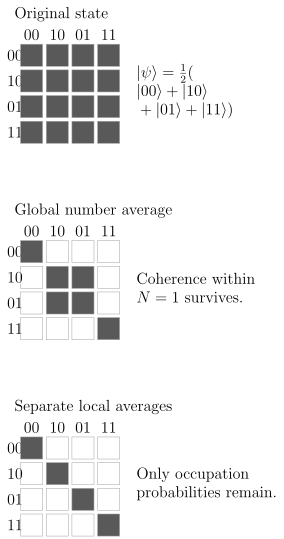
Global and local number averaging remove different matrix elements. The basis is for two bosonic modes, and every shaded entry equals . A global phase average keeps the coherence between and , since both have total number one. Independent phase averages of the two modes remove it. This is a finite occupation subspace used to illustrate the distinction; the modes themselves are bosonic.
Coherent States and Phase References
Section titled “Coherent States and Phase References”Optical coherent states are often written as superpositions of photon-number states:
This formula does not by itself settle the superselection question. In quantum optics, phase is usually meaningful relative to a phase reference, local oscillator, pump, or larger experimental frame. If that reference is not included explicitly, the single-mode state may be effectively averaged over a global phase:
For a coherent state, this phase twirl gives
The photon-number distribution remains Poissonian, but the off-diagonal number coherences are gone. Interference experiments can still be described consistently because the relevant phase information may be stored relationally between system and reference rather than as an absolute phase of one isolated mode.
This is why one should not say “coherent states are impossible” when discussing superselection. A better statement is: the operational meaning of number-sector coherence depends on the reference frames and observables included in the physical description.
Matter Waves and Mean-Field States
Section titled “Matter Waves and Mean-Field States”Similar language appears in many-body physics. A Bose-condensed mean-field state, a BCS superconducting state, or a symmetry-broken variational ansatz is often written with indefinite particle number. These states can be excellent approximations or convenient representations even when the underlying closed system has fixed total particle number.
There are several compatible interpretations:
- the system is effectively open to a large reservoir;
- a reference phase is supplied by the surrounding apparatus or condensate;
- the thermodynamic limit makes number and phase descriptions approximately interchangeable for many local observables;
- a number-conserving state can reproduce the same local predictions as a symmetry-broken ansatz within its regime of validity.
The point is not that particle number is arbitrary. The point is that the correct description depends on the physical question and on which degrees of freedom are included as part of the quantum system.
Number, charge, and fermion parity
Section titled “Number, charge, and fermion parity”Relativistic interactions generally do not conserve particle number; conserved charges and the local observable algebra are the relevant quantities. A phase reference for bosonic number does not automatically remove charge constraints or fermion-parity superselection.
For fermions, parity is . The usual physical observables are even under parity. Pairing terms can violate exact number conservation while preserving parity, because they change by two. Thus a BCS ansatz superposes even-number sectors without requiring an even–odd coherence such as . The distinction is discussed in Wick, Wightman, and Wigner and in Giulini’s review below.
Exercises
Section titled “Exercises”- Number-dephased statistics. Let be bounded and commute with every number projector . Show that , where .
Solution
Since commutes with , it is block diagonal in the number-sector projectors:
Insert the identity on both sides of . For infinitely many sectors, first use finite sums and then take the trace-norm limit:
The off-diagonal terms with vanish because has no matrix elements between different number sectors. Therefore
- Conservation versus superselection. A Hamiltonian satisfies . Does that alone prove that coherent superpositions of different total particle numbers are impossible?
Solution
No. The commutator says that the closed-system time evolution generated by preserves total particle number. It does not by itself classify all possible preparations, measurements, reservoirs, or phase references. A superselection claim requires a statement about allowed observables, states, or operations, not only about this Hamiltonian.
- Local number. The state
has fixed total particle number. Why can local particle-number restrictions still matter?
Solution
The total number is always , but the left and right local occupations are not definite. The state is a coherent superposition of different local-number sectors: left occupied and right empty, or left empty and right occupied. If the local laboratories can only perform operations that commute with their local number operators, some coherence across the split may be operationally inaccessible without a suitable phase reference. An incoherent reservoir that merely exchanges particles does not supply one.
- Pair creation. Let denote either bosonic or fermionic annihilation operators, and suppose
Show that a nonzero changes number by two but preserves number parity. For fermions take .
Solution
Use the product rule for commutators:
A nonzero pair operator changes number by two. It therefore preserves : . For fermions with the operator is identically zero, so that case is not a number-changing process.
References
Section titled “References”- Y. Aharonov and L. Susskind, “Charge Superselection Rule”, Physical Review 155, 1428–1431 (1967).
- S. D. Bartlett, T. Rudolph, and R. W. Spekkens, “Reference Frames, Superselection Rules, and Quantum Information”, Reviews of Modern Physics 79, 555–609 (2007).
- A. L. Fetter and J. D. Walecka, Quantum Theory of Many-Particle Systems, McGraw-Hill, 1971.
- D. Giulini, “Superselection Rules”, arXiv:0710.1516 (2007), revised 2009; expanded account of the contribution to Compendium of Quantum Physics, Springer (2009).
- M. O. Scully and M. S. Zubairy, Quantum Optics, Cambridge University Press, 1997.
- G. Teschl, Mathematical Methods in Quantum Mechanics: With Applications to Schrödinger Operators, 2nd ed., Graduate Studies in Mathematics 157, American Mathematical Society (2014), Section 4.2. Author’s text.
- G. C. Wick, A. S. Wightman, and E. P. Wigner, “The Intrinsic Parity of Elementary Particles”, Physical Review 88, 101–105 (1952).
- H. M. Wiseman and J. A. Vaccaro, “Entanglement of Indistinguishable Particles Shared between Two Parties”, Physical Review Letters 91, 097902 (2003).