

Measurement Problem
The measurement problem is the difficulty of combining a universally linear quantum dynamics with a complete state description and a single definite measurement outcome. Quantum theory predicts outcome statistics with great precision; the foundational question is how its physical description accounts for the individual records to which those probabilities refer. A useful formulation states the assumptions explicitly rather than treating measurement as an unexplained exception.
Helpful background. State Vectors supplies superposition and linear evolution; Entangled States distinguishes joint correlations from product states; Partial Trace explains reduced descriptions of an apparatus.
A calibrated apparatus and linearity
Section titled “A calibrated apparatus and linearity”Let a two-level system have orthonormal states . An apparatus begins in and is calibrated so that a measurement interaction gives
Here and are macroscopically distinguishable pointer records. This ideal repeatable model is sufficient to expose the problem; imperfect instruments do not remove the underlying linearity question.
For normalized , linearity fixes the output:
If both coefficients are nonzero, the result is an entangled vector, not one of the calibrated pointer branches. The interaction creates the right correlations between a system label and an apparatus label. Correlation alone has not selected one label as the unique actual result.
Which assumptions are in tension?
Section titled “Which assumptions are in tension?”A common formulation combines three commitments: the quantum state gives a complete physical description; closed systems always obey linear dynamics; and measurements have one globally definite outcome. In applying this formulation, “complete” includes a rule connecting a pointer state to its physical record. A bare vector space without an account of which records it represents cannot generate the contradiction by itself.
A solution must explain which commitment is modified or how the claimed outcome is represented. Additional-variable theories supplement the state; dynamical-collapse theories alter evolution; Everettian theories retain the global superposition and interpret definite records relative to branches. Operational and relational approaches reassess the role of state assignments and the scope of outcome claims. These families need their own dynamics, probability account and empirical checks; the trilemma is an organizing device, not a proof that every proposal is equally developed.
Reduced mixtures do not identify a unique branch
Section titled “Reduced mixtures do not identify a unique branch”Tracing out the measured system gives the apparatus state
It reproduces statistics of apparatus-only measurements. The same matrix can also describe an ensemble in which one definite pointer state was prepared with classical uncertainty. Equality of reduced matrices does not identify the two global situations. In the ideal unitary model the joint state remains pure and permits interference-sensitive joint observables, whereas the corresponding branch mixture does not.
Environmental decoherence makes such joint interference exceptionally difficult to observe for realistic macroscopic records. It also explains dynamical stability of particular pointer variables. Those achievements are central to the preferred-basis problem, but the suppression of locally accessible interference is not an extra stochastic branch-selection law. The dedicated decoherence boundary discusses that distinction.
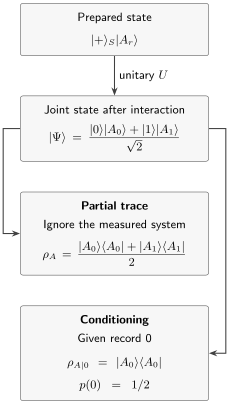
Here . The central arrow shows the unitary measurement interaction. The two side arrows lead independently from its joint output to different descriptions: what can be predicted about the apparatus without using a record, and what can be predicted given record 0. These side arrows describe mathematical operations, not additional physical evolution. Neither taking a partial trace nor writing a conditional state supplies a mechanism that selects one global outcome.
Three questions that should be separated
Section titled “Three questions that should be separated”The outcome problem asks what represents an individual result. The preferred-basis problem asks why certain stable alternatives are the appropriate records. The Born-rule problem asks why their weights have their probabilistic significance. A treatment may make substantial progress on one while relying on additional assumptions for another.
A detector model can therefore be an excellent operational theory without being a complete ontology of measurement. Conversely, an interpretive proposal cannot claim empirical success merely by announcing that records are definite: it must recover the probabilities and transformations used in actual experiments.
Exercise: a global distinction hidden from the pointer
Section titled “Exercise: a global distinction hidden from the pointer”For , abbreviate and . Compare the expectation of in the coherent output and in the equal branch mixture.
Solution
The coherent state is the eigenvector of , so its expectation is one. Each diagonal branch has zero expectation, hence the mixture gives zero. Both have the same reduced apparatus matrix. This is an in-principle distinction of global states, not a claim that a macroscopic apparatus can readily be recohered.
References
Section titled “References”- Maudlin, Tim, “Three Measurement Problems,” Topoi 14, 7–15 (1995), doi:10.1007/BF00763473 — an assumption-based formulation.
- Schlosshauer, Maximilian, “Decoherence, the measurement problem, and interpretations of quantum mechanics,” Reviews of Modern Physics 76, 1267–1305 (2005), doi:10.1103/RevModPhys.76.1267 — the distinction between decoherence and interpretive closure.
- von Neumann, John, Mathematical Foundations of Quantum Mechanics, translated by Robert T. Beyer, Princeton University Press (1955) — the measurement-chain formulation.