

Decoherence Preview
Environment-induced decoherence is the dynamical suppression of locally observable interference as a system becomes correlated with uncontrolled degrees of freedom. For an initially pure system and environment, the model below produces these correlations by entanglement. It is one of the central mechanisms behind the classical appearance of macroscopic records, but it is not the same thing as wavefunction collapse and it is not, by itself, a complete interpretation of measurement.
The basic language is the language of Density Operators and Reduced Density Matrices. A system can be part of a larger pure state while its own reduced state looks mixed because correlations with an environment have become inaccessible to local measurements.
The two-state example below shows how an environmental overlap controls an interference signal. The detailed open-system treatment is Environment-Induced Decoherence.
Helpful background. Reduced Density Matrices explains the partial trace; Superposition and Relative Phase connects phase with interference.
Environment and Loss of Coherence
Section titled “Environment and Loss of Coherence”Take orthonormal system states , normalized environmental states, and . Start from the product state
If the interaction correlates the system alternatives with different environmental states, unitary evolution can produce
The total state is still a coherent quantum state of system plus environment. What changes is where the relative phase information lives. It is no longer stored only in the system. It has been distributed into correlations with many environmental degrees of freedom.
If the environmental states become nearly orthogonal,
then interference between and becomes very hard to observe by measuring the system alone. Recovering it would require coherent control of the relevant environmental degrees of freedom, which is generally impractical for macroscopic environments.
Reduced Density Matrices
Section titled “Reduced Density Matrices”The reduced density matrix of the system is obtained by tracing out the environment:
For
the reduced state is
The off-diagonal terms in the basis are multiplied by overlaps of environmental states. When those overlaps are small, the reduced state is approximately
This looks like an incoherent mixture for measurements on . The word “looks” matters: the global state may still be pure and entangled. The mixture is an improper mixture produced by tracing out the environment, not necessarily ignorance about a secretly prepared pure state. See Classical Mixtures vs Quantum Superpositions for the basic distinction.
Pointer Basis Idea
Section titled “Pointer Basis Idea”Decoherence is basis-sensitive. An environment does not erase all coherences in all bases equally. It usually monitors some system properties more strongly than others.
A simple idealized interaction has the form
where acts on the environment. In this model, each drives a conditional environmental evolution generated by . Its population is unchanged by this interaction. Coherence between two labels is suppressed only if those conditional evolutions make their environmental states distinguishable. If the two responses coincide, or differ only by a phase on the initial environmental state, the overlap has unit magnitude and no dephasing occurs. Noncommuting system dynamics can also compete with this interaction.
The dynamically stable alternatives are called pointer states, and the corresponding approximately stable set is called a pointer basis. The word “basis” should be read with care. In realistic systems the pointer structure may be approximate, overcomplete, coarse-grained, or restricted to a subspace. It is selected by the system-environment interaction, the Hamiltonian time scales, and the observables through which the environment records information.
The pointer-basis idea is why diagonalizing a density matrix is not the whole story. Any Hermitian density matrix can be diagonalized mathematically. Decoherence asks which alternatives are robustly monitored and recorded by the environment.
Why Decoherence Helps Classical Appearance
Section titled “Why Decoherence Helps Classical Appearance”Classical records appear stable, mutually exclusive, and insensitive to microscopic phase control. Decoherence helps explain this because environmental monitoring suppresses interference between macroscopically distinct alternatives in the reduced state accessible to local observers.
For example, a detector pointer coupled to air molecules, photons, phonons, and internal degrees of freedom does not remain an isolated two-state system. Different pointer positions rapidly become entangled with different environmental states. If those environmental records are nearly orthogonal, then local measurements of the pointer are well described by an approximately diagonal density matrix.
This supports a classical probability description for the pointer alternatives:
with negligible interference between macroscopically distinct values. It also explains why reversing a macroscopic measurement interaction is fantastically difficult: the relevant phase information has been dispersed into many uncontrolled correlations.
Decoherence is therefore a bridge between formal density-matrix mechanics and the practical fact that laboratory records can be treated as classical data. It complements, rather than replaces, other classical-limit mechanisms such as wave-packet localization, stationary phase, and coarse graining. The graduate dynamics synthesis is Decoherence as a Classical-Limit Bridge.
Why Decoherence Is Not by Itself an Interpretation
Section titled “Why Decoherence Is Not by Itself an Interpretation”Decoherence does not say that the global state has literally collapsed. In the ideal unitary model,
is still a superposition in the larger Hilbert space. The reduced state of loses local interference because the environment has been ignored, not because a nonunitary projection has necessarily occurred at the global level.
Decoherence also does not, by itself, explain why a single individual outcome is realized. It explains why interference between alternatives becomes locally unobservable and why a diagonal probability calculus becomes effective. To move from that statement to a claim about one actual outcome, many worlds, objective collapse, hidden variables, operational state assignment, or another interpretation requires additional interpretive or dynamical input.
This is the same boundary emphasized in State Update Rule and What the Postulates Do Not Say. Decoherence is an essential physical process in modern measurement theory. It is not a license to hide interpretive assumptions inside a calculation.
For the short correction of the slogan “decoherence solves the measurement problem,” see Common Misstatements About the Classical Limit.
Two-State Dephasing Example
Section titled “Two-State Dephasing Example”Suppose the environment overlap decays as
Then in the basis,
The diagonal entries remain the same in this simple pure-dephasing model, while the off-diagonal coherences are multiplied by . If becomes small, the off-diagonal contribution to each observable’s expectation becomes small; any diagonal contribution remains. This decay need not be monotonic, particularly for a small environment.
For the coherence observable
the trace rule gives
The interference signal is controlled directly by the environmental overlap. For equal weights , vary the relative phase of the measured superposition,
Its probability is
A complex phase of shifts the fringes; its magnitude sets their visibility . Thus loss of local coherence has a direct experimental meaning: reduced fringe contrast.
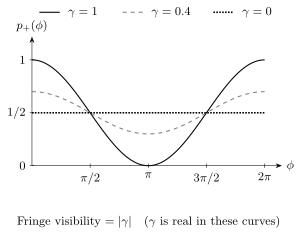
For real nonnegative , . Distinguishable environmental records reduce the modulation while leaving the phase-averaged probability at . The flat curve describes this measurement on the subsystem; it does not assert a collapse of the joint state.
Common Mistakes
Section titled “Common Mistakes”- Saying decoherence is the same as collapse. It is usually modeled as unitary entanglement plus a reduced description.
- Saying the superposition has disappeared absolutely. Locally accessible interference may disappear while global coherence remains in principle.
- Treating a diagonal reduced density matrix as ordinary ignorance about a secretly definite state without checking whether it is a proper or improper mixture.
- Thinking the pointer basis is arbitrary because a density matrix can be diagonalized. The pointer structure is selected dynamically by stability and environmental records.
- Assuming decoherence solves every measurement problem. It explains suppression of interference and effective classical records, but not all interpretive questions.
- Forgetting that decoherence is approximate. Recoherence is possible in small controlled systems, while macroscopic recoherence is usually fantastically impractical.
Exercises
Section titled “Exercises”- Derive the reduced density matrix for .
Solution
Form and trace over the environment. The diagonal terms give
The cross terms contain environmental inner products:
Combining these terms gives the expression in the main text.
- If , does that prove the total state is a classical mixture?
Solution
No. Orthogonality of the environmental states makes the reduced state of the system diagonal in the basis. The total state may still be the pure entangled state
The diagonal reduced state is an improper mixture obtained by ignoring the environment, not necessarily a proper mixture representing ignorance about which pure system state was prepared.
- In the interaction , why are the states natural pointer-state candidates?
Solution
The interaction couples the environment differently to different labels while leaving the projectors singled out. If the conditional environmental states become distinguishable, coherences between those values are suppressed in the reduced system state. The interaction’s diagonal form alone does not guarantee that their overlap decreases. The alternatives are therefore the monitored and relatively stable alternatives in this idealized model.
- Explain in one paragraph why decoherence helps with classical records but does not by itself select a single outcome.
Solution
Decoherence suppresses interference between macroscopically distinct alternatives in the reduced density matrix by entangling those alternatives with nearly orthogonal environmental records. That explains why local observers can use an effectively classical probability distribution over stable records. In a purely unitary model, however, the global system-environment state may remain a superposition, so decoherence alone does not specify why one individual record rather than another is realized.
References
Section titled “References”- H.-P. Breuer and F. Petruccione, The Theory of Open Quantum Systems, Oxford University Press, 2002.
- E. Joos, H. D. Zeh, C. Kiefer, D. Giulini, J. Kupsch, and I.-O. Stamatescu, Decoherence and the Appearance of a Classical World in Quantum Theory, 2nd ed., Springer, 2003.
- M. Schlosshauer, Decoherence and the Quantum-to-Classical Transition, Springer, 2007, doi:10.1007/978-3-540-35775-9.
- H. D. Zeh, “On the interpretation of measurement in quantum theory,” Foundations of Physics 1, 69-76, 1970.
- W. H. Zurek, “Decoherence, einselection, and the quantum origins of the classical,” Reviews of Modern Physics 75, 715–775 (2003), doi:10.1103/RevModPhys.75.715.