

Fermion Doubling
Fermion doubling is the appearance of additional low-energy branches when a Dirac derivative is discretized naively on a periodic lattice. It is visible already in the free dispersion and can survive perfect Hermiticity and norm conservation. The immediate computational task is to identify which modes the chosen discretization actually represents.
Required background. Dirac numerics fixes the spinor Hamiltonian; lattice discretization supplies its derivative symbols.
Two zeros in one spatial dimension
Section titled “Two zeros in one spatial dimension”Set on this page and use . The centered derivative gives
For , the kinetic term vanishes at both and the zone-edge point , with the same periodic boundary point. Expanding near the edge, gives . A second low-energy cone therefore has the opposite slope.
For a massive model, both regions have the same gap . The extra branch is not removed by saying that only the massless case has zeros.
In independently discretized spatial directions, naive derivatives vanish at each combination of zero and zone-edge components, producing free spatial branches. A fully Euclidean spacetime discretization counts its time direction too; do not import its species count into a Hamiltonian calculation without specifying the dimension being discretized.
A direct matrix diagnostic
Section titled “A direct matrix diagnostic”On an even periodic grid, the alternating vector obeys , just like a constant vector. Diagonalize the free spinor matrix and examine both energies and Fourier content. Two nearly identical low energies can belong to physically different momentum regions.
Refining moves the extra region to larger physical momentum, but its lattice energy stays low. A localized potential or rough initial state can couple to it. Restricting the initial packet to low momentum may reduce contamination for a particular smooth finite-time problem; it does not remove the unwanted modes from the operator.
What a Wilson term changes
Section titled “What a Wilson term changes”A one-dimensional Wilson-modified free Hamiltonian is
with dimensionless . Near , its additional mass term is and vanishes in the continuum limit. At the zone edge, it is , pushing that branch to cutoff-scale energy.
For , , the extra branch has energy magnitude at the edge. This is a testable spectral change, not a harmless rewriting of the centered stencil. At finite spacing the momentum-dependent mass changes chiral symmetry and low-energy discretization errors; interacting theories additionally require the relevant parameter tuning.
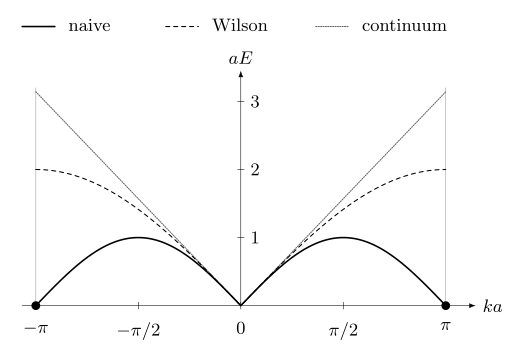
Positive energies across one Brillouin zone for and Wilson parameter . The naive energy returns to zero at the zone edge. The Wilson energy reaches there. Both approach the continuum relation near the origin; the endpoints and represent the same periodic momentum.
No-go assumptions and other discretizations
Section titled “No-go assumptions and other discretizations”The Nielsen–Ninomiya obstruction concerns a set of assumptions including locality, suitable Hermiticity, translation-invariant lattice structure, and the relevant continuum-like chiral properties. It does not say that every numerical representation of a single cone is impossible. A claimed remedy must identify the assumption or symmetry realization it changes.
Staggered formulations redistribute components and reduce species with a different representation. Spectral derivatives alter locality properties. Wilson terms explicitly modify the chiral structure, while overlap/Ginsparg–Wilson formulations realize a modified lattice chiral relation. Their respective costs and observables are not interchangeable.
For an effective condensed-matter Dirac model, additional cones can be physical degrees of freedom of the underlying lattice. Compare with that microscopic model before labeling every second cone an artifact.
Checking the full lattice spectrum
Section titled “Checking the full lattice spectrum”Plot the entire free Brillouin-zone dispersion, check low-momentum continuum convergence, count unwanted low-energy sectors, and test propagation of packets near both momentum regions. Then add potentials and repeat the momentum-content diagnostics. A small eigenpair residual or exactly conserved norm tests the solved lattice model, not its intended continuum particle content.
Exercises
Section titled “Exercises”For and , simplify the Wilson energy magnitude and identify its zeros.
Solution
Using gives . Within one periodic Brillouin zone it vanishes only at , while the edge has magnitude . Its small- slope agrees with the continuum and its remaining finite-spacing errors still require convergence checks.
References
Section titled “References”- Chandrasekharan, Shailesh, and Uwe-Jens Wiese, “An introduction to chiral symmetry on the lattice,” Progress in Particle and Nuclear Physics 53, 373–418 (2004), arXiv:hep-lat/0405024 — lattice chiral symmetry and the scope of doubling remedies.
- Gattringer, Christof, and Christian B. Lang, Quantum Chromodynamics on the Lattice: An Introductory Presentation, Lecture Notes in Physics 788, Springer (2010), doi:10.1007/978-3-642-01850-3 — naive and Wilson lattice operators.
- Nielsen, Holger Bech, and Masao Ninomiya, “A no-go theorem for regularizing chiral fermions,” Physics Letters B 105, 219–223 (1981), doi:10.1016/0370-2693(81)91026-1 — the original no-go result.