

Rényi Entropies
Rényi entropies are a one-parameter family of entropy measures built from powers of a density operator. For a density operator and a parameter with ,
The limit gives the von Neumann entropy,
For a pure bipartite state, applying to a reduced state describes how its Schmidt weights are distributed:
Rényi entropies are especially useful because is determined by the purity , integer orders connect to replica methods, and different values of probe different parts of the eigenvalue spectrum.
Helpful background. Subsystem entropy introduces spectral entropy; Schmidt decomposition turns a pure-state entanglement question into an eigenvalue calculation.
Rényi entropy from a finite spectrum
Section titled “Rényi entropy from a finite spectrum”Unless stated otherwise, the Hilbert space is finite dimensional and logarithms are base two. These assumptions justify differentiating finite sums and make the limits below unambiguous.
Let have spectral decomposition
Then
so
The logarithm base fixes the units. Base gives bits; natural logarithms give nats. This page states finite-dimensional examples in bits when numerical values are given.
Rényi entropy depends only on the eigenvalues of . It is invariant under unitary conjugation:
For a pure state, all Rényi entropies vanish:
For a maximally mixed state ,
for every .
Pure Bipartite Entanglement
Section titled “Pure Bipartite Entanglement”Let a normalized bipartite pure state have Schmidt decomposition
Define Schmidt probabilities
The reduced density operator on has nonzero eigenvalues , so
The same value is obtained from :
for pure bipartite states. They vanish exactly for product pure states and are invariant under local unitaries. All positive orders are nonincreasing under deterministic pure-to-pure LOCC, but the stronger requirement of nonincrease on average over recorded outcomes holds generally for , not for every (Vidal). The last exercise gives an explicit counterexample at order two.
The case is the usual Entanglement Entropy:
The case gives the logarithm of the Schmidt Rank:
provided the support is finite-dimensional.
The von Neumann limit
Section titled “The von Neumann limit”Let . Then and
L’Hôpital’s rule, with the base-two derivative factor retained, gives
Zero eigenvalues contribute zero and are excluded from the differentiated sum. In infinite dimensions, convergence of the power sums and the interchange of limits with infinite sums need additional assumptions; a finite von Neumann entropy alone does not justify every Rényi limit.
Purity and Second Rényi Entropy
Section titled “Purity and Second Rényi Entropy”The second Rényi entropy is
The quantity
is the purity. It equals for pure states and is less than for mixed states.
For a bipartite pure state, is a convenient spectral diagnostic of entanglement; it is not generally an average LOCC monotone. In terms of Schmidt probabilities,
For a Bell state, , so
bit.
For
the second Rényi entropy in bits is
It vanishes at product endpoints and reaches one bit at .
Other Useful Orders
Section titled “Other Useful Orders”The order is the rank entropy:
where the rank is the number of nonzero eigenvalues. It is sensitive to arbitrarily small nonzero eigenvalues, so it is mathematically clean but not robust under small perturbations.
The limit gives the min-entropy:
where is the largest eigenvalue of .
For a fixed density operator, Rényi entropies are nonincreasing as increases:
Small gives more weight to the number of populated eigenvalues. Large emphasizes the largest eigenvalues.
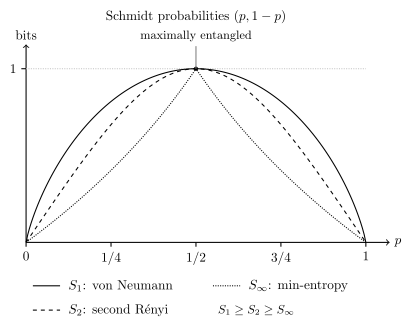
The same two Schmidt probabilities give different spectral entropies. All three vanish for a product state and equal one bit at ; between those limits, larger Rényi order emphasizes the larger probability. The curves describe pure joint states when interpreted as entanglement.
Why purity can be measured with two copies
Section titled “Why purity can be measured with two copies”For the SWAP operator acting on two identical copies of a subsystem,
To see the identity, insert a product basis: the trace is . Thus purity is a two-copy expectation value even though it is nonlinear in one copy of the state. Estimating requires estimating this expectation and then taking ; experimental uncertainty must be propagated through that nonlinear step. If the two copies differ, the same protocol measures instead.
Purity can also be inferred using suitable randomized-measurement protocols, each with its own preparation and sampling assumptions. Numerically, it avoids diagonalization when or an appropriate contraction is already available, but constructing the reduced state can remain expensive. For spatial scaling and tensor-network uses, see many-body entanglement entropy.
Replica Trick Preview
Section titled “Replica Trick Preview”For an integer ,
The quantity can sometimes be computed by considering copies of the system. In statistical mechanics and QFT, this idea leads to replica methods: compute for integer , identify an appropriate continuation, and take the limit to obtain von Neumann entropy. Integer values alone do not specify an arbitrary analytic continuation uniquely; the derivation must control the continuation and its regulator limits.
This is only a preview. In QFT, entanglement entropies of spatial regions can depend on regulators, boundary geometry, and continuum limits. The finite-dimensional Rényi formulas here are the conceptual entry point; Entanglement in QFT Preview explains the wider field-theory setting.
Mixed-State Caution
Section titled “Mixed-State Caution”For a mixed joint state , the Rényi entropy of measures local mixedness, not entanglement by itself. The same warning that applies to von Neumann subsystem entropy applies to every .
For example,
has , so every Rényi entropy of is one bit. The state is separable. Its local entropy reflects classical correlation with , not pure-state entanglement.
By contrast, for a Bell pure state, the same one-qubit reduced state arises from entanglement with the other qubit. The joint-state context determines the interpretation.
Comparing entropy orders
Section titled “Comparing entropy orders”For Schmidt probabilities ,
All values describe the same spectrum. Rank entropy counts both occupied modes equally, while larger orders emphasize the dominant weight. means the second Rényi entropy, not the square of von Neumann entropy.
References
Section titled “References”- P. Calabrese and J. Cardy, “Entanglement entropy and quantum field theory”, Journal of Statistical Mechanics: Theory and Experiment P06002 (2004), DOI: 10.1088/1742-5468/2004/06/P06002.
- A. Rényi, “On measures of entropy and information,” in Proceedings of the Fourth Berkeley Symposium on Mathematical Statistics and Probability, Vol. 1, University of California Press (1961), pp. 547–561.
- G. Vidal, “Entanglement monotones”, Journal of Modern Optics 47, 355–376 (2000).
- J. Watrous, The Theory of Quantum Information, Cambridge University Press (2018).
- A. Wehrl, “General properties of entropy”, Reviews of Modern Physics 50, 221–260 (1978).
Exercises
Section titled “Exercises”- Compute for a pure state.
Solution
A pure state has eigenvalues . Therefore
so
- Compute for the maximally mixed state .
Solution
The eigenvalues are all . Hence
Thus
- Show that SWAP measured on two different diagonal states and yields . When does this equal the purity of ?
Solution
The SWAP expectation is . Subtracting gives , so equality holds for or . Agreement in a special case does not verify identical preparation.
- A pure two-qutrit state has Schmidt probabilities . Alice applies Kraus operators and . Verify completeness and show that the average second Rényi entanglement increases slightly.
Solution
. Both branches have probability . Their normalized Schmidt probabilities are and . Consequently
The increase shows why the order-two entropy is not a general average entanglement monotone. There is no contradiction with von Neumann entropy monotonicity or with deterministic pure-to-pure LOCC restrictions: this protocol has distinct recorded branches.
- For Schmidt probabilities , write in bits.
Solution
The second Rényi entropy is
It is zero at and , and equals one bit at .