

Particle in a Uniform Magnetic Field
A uniform magnetic field is the simplest setting where the difference between canonical momentum and kinetic momentum becomes visible. A charged particle is free along the field direction, but its transverse motion is curved by the Lorentz force. Quantum mechanically, that transverse motion becomes oscillator-like.
This page sets up the Landau-level problem physically. The spectrum, wavefunctions, guiding-center degeneracy, and flux counting are developed in Landau Levels. The goal here is to understand why that later problem is secretly an oscillator problem and why gauge-dependent labels must be handled carefully.
We consider a spinless nonrelativistic particle of mass and charge in the prescribed field
with scalar potential set to zero. Spin magnetic moments, Zeeman splitting, radiation, disorder, interactions, and boundaries are not part of this ideal setup.
Helpful background. Minimal Coupling in Wave Mechanics to distinguish canonical and kinetic momentum.
Classical Picture
Section titled “Classical Picture”Classically, the Lorentz force is
The velocity component parallel to is unchanged, while the transverse velocity rotates. The positive cyclotron frequency is
The sign of determines the direction of rotation in the transverse plane. The magnitude determines the time scale. For transverse speed , the classical cyclotron radius is
This is the classical seed of the quantum problem: magnetic fields do not create a scalar potential well, but they do bind the transverse kinetic motion into circular orbits.
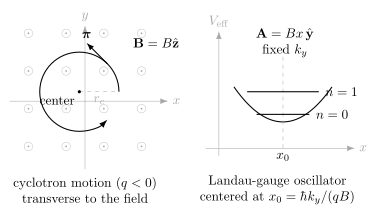
A uniform field separates the physics into cyclotron motion and a guiding-center label. In Landau gauge, fixing turns the transverse Hamiltonian into an oscillator centered at .
Minimal-Coupling Hamiltonian
Section titled “Minimal-Coupling Hamiltonian”Minimal coupling replaces canonical momentum by kinetic momentum:
With , the Hamiltonian is
The vector potential is not unique. Two standard choices for are:
and
Both satisfy
The two gauges make different symmetries convenient. Landau gauge keeps translation invariance along one transverse direction. Symmetric gauge keeps rotation symmetry around the axis. Gauge transformations explain why these different-looking descriptions represent the same physical magnetic field.
Kinetic Momentum Algebra
Section titled “Kinetic Momentum Algebra”The transverse kinetic momenta are
For a uniform field,
This is the algebraic reason a magnetic field changes the spectrum. Free-particle momenta commute; transverse kinetic momenta in a magnetic field do not. Their noncommutativity is proportional to the magnetic field itself.
The transverse Hamiltonian is
Introduce the magnetic length
and the sign
Then the operator
satisfies
Moreover,
This is the central setup result: the transverse kinetic motion has the same algebra as a one-dimensional harmonic oscillator. The magnetic field creates the oscillator algebra without introducing an ordinary position-dependent potential.
Landau-Gauge Reduction
Section titled “Landau-Gauge Reduction”In Landau gauge,
the two-dimensional transverse Hamiltonian becomes
This Hamiltonian has no explicit dependence, so commutes with . If
then acts as multiplication by , and the equation contains
Thus each value of gives a harmonic oscillator in , centered at
The sign of depends on the charge convention, but the oscillator frequency is the positive quantity .
This derivation also hints at degeneracy: changing shifts the oscillator center without changing the oscillator frequency. The full counting of allowed centers is part of Landau Levels.
Symmetric-Gauge View
Section titled “Symmetric-Gauge View”In symmetric gauge,
the Hamiltonian does not single out the or direction. Instead, rotations about are natural. This gauge is useful when angular momentum, circular orbits, or disk geometry matters.
The symmetric-gauge wavefunctions look different from the Landau-gauge wavefunctions. Their labels also look different. This is not a physical disagreement. Gauge-invariant quantities, such as the magnetic field, energy spectrum, local density for each correspondingly transformed state, and physical currents, agree.
Three-Dimensional Motion
Section titled “Three-Dimensional Motion”For a particle in three dimensions, the uniform magnetic field affects the transverse motion but leaves the longitudinal kinetic energy free:
This separation is important. Landau quantization is not ordinary confinement in all directions. In the ideal infinite three-dimensional problem, the transverse energy is quantized while the direction remains continuous. Extra potentials, boundaries, lattice structure, or finite-size conditions can change that statement.
Magnetic Length and Flux Scale
Section titled “Magnetic Length and Flux Scale”The magnetic length
is the natural transverse quantum length scale. Stronger magnetic fields make smaller and the cyclotron spacing larger:
The area scale
is tied to one flux quantum through the plane. This is why the later degeneracy count can be expressed as flux through the sample divided by a flux quantum. For the finite-area count, see Degeneracy of Landau Levels.
Physical Interpretation
Section titled “Physical Interpretation”The useful mental split is:
- kinetic cyclotron motion, which is oscillator-like and carries the energy;
- guiding-center information, which labels where the orbit is centered and accounts for degeneracy in an extended system;
- free longitudinal motion, if the particle is allowed to move along .
In Landau gauge, the guiding-center information appears through and . In symmetric gauge, it appears through angular structure. The canonical labels depend on representation. The guiding-center operators themselves have gauge-covariant definitions in terms of position and kinetic momentum, giving gauge-independent measurement predictions. The physical statements are the magnetic field, the kinetic energy scale, the magnetic length, and gauge-invariant currents or densities.
Common Mistakes
Section titled “Common Mistakes”- Treating as the mechanical momentum after a vector potential is introduced.
- Forgetting that is positive even when is negative.
- Thinking the magnetic field creates an ordinary scalar potential well in the transverse plane.
- Comparing Landau-gauge and symmetric-gauge wavefunctions without applying the appropriate gauge transformation.
- Treating in Landau gauge as a universal physical momentum rather than a convenient gauge-dependent label.
- Forgetting that a three-dimensional uniform-field problem remains free along the field direction.
- Including electron spin effects in the spinless Landau setup without saying so.
Exercises
Section titled “Exercises”- Verify that the Landau and symmetric gauges both produce .
Solution
For Landau gauge,
Thus
and the other components vanish.
For symmetric gauge,
Then
with zero and components.
- Derive the commutator in Landau gauge.
Solution
In Landau gauge,
Therefore
The first commutator vanishes and
Hence
- Show that the transverse kinetic Hamiltonian has oscillator form.
Solution
Let
Using
one finds
Also,
Solving for gives
Since
the transverse Hamiltonian is
- In Landau gauge, explain why changing shifts the oscillator center but not the oscillator frequency.
Solution
With ,
Completing the square gives
The center is
so changing changes the center. The quadratic coefficient is , which corresponds to the same positive frequency for every .
References
Section titled “References”- D. J. Griffiths and D. F. Schroeter, Introduction to Quantum Mechanics, 3rd ed., Cambridge University Press, 2018.
- L. D. Landau and E. M. Lifshitz, Quantum Mechanics: Non-Relativistic Theory, 3rd ed., Pergamon, 1977.
- R. E. Prange and S. M. Girvin, eds., The Quantum Hall Effect, 2nd ed., Springer, 1990.
- J. J. Sakurai and J. Napolitano, Modern Quantum Mechanics, 3rd ed., Cambridge University Press, 2020.
- R. Shankar, Principles of Quantum Mechanics, 2nd ed., Springer, 1994.