

Klein–Gordon Equation
The free Klein–Gordon equation is the direct wave-equation form of the relativistic mass shell for a scalar amplitude:
It is Lorentz covariant, admits both frequency branches of , and is second order in time. These successes also expose a one-particle limitation: its natural conserved density is not positive definite. In quantum field theory the same equation becomes the equation of motion for a scalar field, and the conserved complex-field current is interpreted as charge rather than Born probability.
Required background. Metric and Units, Four-Vectors, and the Energy–Momentum Relation fix the differential signs, scalar contractions, mass shell, and frequency branches used below.
From the mass shell to a scalar wave equation
Section titled “From the mass shell to a scalar wave equation”Start with
For the phase , use
Applying the operator polynomial to a complex scalar amplitude gives
Dividing by yields
Because
the compact covariant form follows. In natural units it is simply
The amplitude is a Lorentz scalar: for . Since is a scalar operator and is invariant, the equation has the same form in every inertial frame.
Plane waves recover both mass-shell branches
Section titled “Plane waves recover both mass-shell branches”Insert
Then
so the equation becomes
A nonzero mode therefore obeys
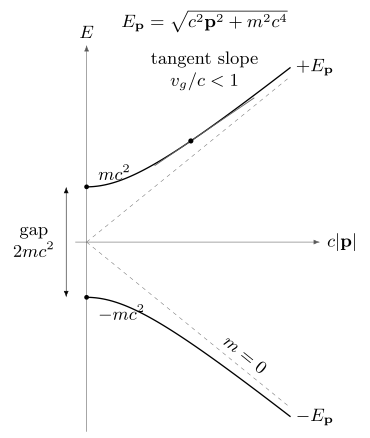
The Klein–Gordon equation retains both sheets of the mass shell because it is quadratic in the time derivative. The branch label is initially a frequency label; antiparticle interpretation requires the field-theory framework.
A general complex solution is a superposition of both frequency sectors. Reality imposes a relation between their coefficients rather than deleting one sector. For a real field, the coefficient of a negative-frequency mode is the complex conjugate of the corresponding positive-frequency coefficient. The precise momentum labels, coefficient reconstruction, and reality condition are worked out in Plane-Wave Solutions.
Second-order initial data
Section titled “Second-order initial data”On an initial constant-time slice , a Klein–Gordon solution is fixed by two functions,
subject to the regularity required by the chosen solution space. The equation then determines and propagates both data forward and backward in time.
This differs from the Schrödinger and Dirac equations, which are first order in time and require only the state amplitude at . Replacing the second- order equation by a positive square root removes one frequency branch but introduces a spatially nonlocal pseudodifferential operator. The local scalar equation and a one-branch Schrödinger evolution are not interchangeable descriptions.
For sufficiently regular compactly supported initial data, disturbances propagate within the Minkowski causal cone. That hyperbolic propagation fact does not by itself supply a positive probability density. For explicit evolution with a source, use Solving Scalar Initial-Value Problems.
Conserved current for a complex scalar
Section titled “Conserved current for a complex scalar”Let solve the Klein–Gordon equation and its complex conjugate. Multiply the equation for by , multiply the conjugate equation by , and subtract. The mass terms cancel:
Using the product rule,
For , one conventional normalization is
The overall nonzero constant is conventional; conservation does not fix it. For , use a fixed nonzero normalization scale instead of dividing by . That change does not repair the sign indefiniteness. For the plane wave above,
The sign of follows the sign of . A superposition can also produce interference contributions with no pointwise positivity. Therefore cannot serve as an ordinary Born probability density over the full solution space.
For a real scalar, and this current vanishes identically. In field theory the same antisymmetric bilinear becomes the Noether current of a complex scalar’s global phase symmetry, but its physical normalization is fixed by the chosen Lagrangian and charge convention rather than by the one-particle normalization displayed above. Its conserved integral represents signed charge, and the sign-indefiniteness argument is unchanged. A real scalar has no such continuous charge.
The gauge-covariant extension and stationary flux applications belong to The Klein–Gordon Conserved Current. Polarization, hypersurface integration, and mode normalization are developed in the Klein–Gordon Inner Product.
Why absolute square is not the answer
Section titled “Why absolute square is not the answer”The candidate is nonnegative, but it does not generally satisfy a local continuity equation under Klein–Gordon evolution. Its time derivative depends on both and the independent datum , so no Schrödinger-style first-order conservation law follows from the equation.
Restricting to free positive-frequency solutions produces a positive integrated inner product, while the local KG density can still be negative. Probability-Density Problems gives an explicit example. The restriction is nonlocal on an equal-time slice, and a chosen sector need not remain isolated in a background that mixes it appreciably with the other sector. Quantization supplies a different framework: the field is expanded in numerical modes with creation and annihilation operators as coefficients. Their algebra and the state determine particle and antiparticle observables.
The free Klein–Gordon equation remains a consistent scalar wave equation. Each component of a free Dirac spinor also satisfies it, although the Dirac equation imposes additional first-order relations among those components.
Controlled nonrelativistic limit
Section titled “Controlled nonrelativistic limit”For prepared positive-frequency, low-momentum data, removing the phase produces a slow envelope whose leading equation is
This limit has selected a positive-frequency sector and removed its rest- energy phase. It is not obtained by simply sending to infinity in an unprepared mixture of both branches. The full derivation, momentum and time error bounds, and norm matching belong to Klein–Gordon to Schrödinger.
Scope and limitations
Section titled “Scope and limitations”This page treats the free scalar amplitude in flat spacetime. External Potentials and the Scalar Coulomb Problem develop prescribed-field applications; Klein–Gordon Propagators constructs the Green functions and boundary prescriptions.
Canonical field quantization and curved-spacetime geometry require additional structure. Interpreting the Klein–Gordon Equation separates classical energy, conserved charge, one-particle norms, and quantized observables.
Common pitfalls
Section titled “Common pitfalls”Calling the relativistic probability density. It is positive but not the density of the conserved Klein–Gordon current. The conserved density is indefinite on the full complex solution space.
Specifying only . A second-order equation also needs . Omitting it leaves the frequency mixture undetermined.
Equating negative frequency with an already-quantized antiparticle. The mode is present before quantization. The antiparticle interpretation arises from how the field modes are quantized.
Forgetting that current normalization is conventional. Multiplying by a fixed real constant preserves conservation. Its sign structure, not the displayed prefactor, causes the one-particle problem.
Exercises
Section titled “Exercises”1. The same initial shape, two different evolutions
Section titled “1. The same initial shape, two different evolutions”In a periodic box, consider a spatially uniform field with , where is real. Find the solution for (a) and (b) , where . Which solution has positive frequency alone, and what is its KG density?
Solution
The equation reduces to . The first preparation gives , with equal positive- and negative-frequency amplitudes and zero KG current because the field is real. The second gives , with positive frequency alone and . The initial spatial shape does not determine either the frequency content or the conserved charge; the time derivative matters.
2. A conserved norm is not always a local probability
Section titled “2. A conserved norm is not always a local probability”For a single negative-frequency mode, the current has . Would discarding all negative-frequency modes suffice to make the local density nonnegative? Use the distinction between an integrated norm and its integrand.
Solution
No. Interference between positive-frequency modes with different energies can make the local density negative. Spatial integration removes cross terms between distinct momenta and leaves a positive energy-weighted norm. Probability-Density Problems calculates a normalized two-mode example explicitly. A positive integrated norm therefore does not turn the local KG current into a Born density.
References
Section titled “References”- W. Gordon, “Der Comptoneffekt nach der Schrödingerschen Theorie,” Zeitschrift für Physik 40, 117–133, 1926, doi:10.1007/BF01390840.
- W. Greiner, Relativistic Quantum Mechanics: Wave Equations, 3rd ed., Springer, 2000, doi:10.1007/978-3-662-04275-5.
- W. Pauli and V. Weisskopf, “Über die Quantisierung der skalaren relativistischen Wellengleichung,” Helvetica Physica Acta 7, 709–731, 1934.
- M. D. Schwartz, Quantum Field Theory and the Standard Model, Cambridge University Press, 2014, doi:10.1017/9781139540940.