

Dense Domains
A dense operator domain contains enough vectors to approximate every Hilbert-space state. That does not mean it contains enough vectors to approximate every operator action. The stronger notion is an operator core, where both the vector and its image can be approximated. Distinguishing these two statements prevents invalid extensions of calculations from smooth test functions.
Helpful background. Unbounded Operators shows why convergence of vectors need not control their images.
Density in the Hilbert norm
Section titled “Density in the Hilbert norm”A linear subspace is dense when . Equivalently, . Every can then be approximated by a sequence in Hilbert norm.
In , both compactly supported smooth functions and Schwartz functions are dense. In , finite sequences are dense. These facts allow differential expressions and infinite matrices to be initially tested on convenient vectors.
Density makes an adjoint action unique. If and both satisfy
then is orthogonal to the dense domain, so it is zero. For a non-dense domain this argument fails: components orthogonal to the domain are invisible to the pairing. This is why the ordinary Hilbert-space adjoint theory assumes densely defined operators.
Density alone says nothing about whether is bounded, closed, symmetric, or self-adjoint. Each property needs its own argument.
Cores use the graph norm
Section titled “Cores use the graph norm”For an operator , define
If units matter, one can replace the second term by using a fixed reference scale . The resulting norm is equivalent and does not alter the core property.
For a closed operator , a linear subspace is a core if it is dense in this graph norm. Explicitly, for every there are with
Equivalently, . A calculation that identifies the closure on a core therefore determines the full closed operator. Hilbert-space density cannot replace graph density.
For the multiplication operator , finite sequences are a core. Truncation after the th coordinate gives
The weighted tail, rather than only the unweighted tail, proves the statement.
A dense set that is not a core
Section titled “A dense set that is not a core”Consider the self-adjoint periodic momentum
The set is dense in and lies inside this domain. It is not a core for .
The graph norm here is exactly the norm. Evaluation at either endpoint is continuous in , so every graph-norm limit of compactly supported smooth functions has zero endpoint traces. Such functions cannot approximate the constant function in the graph norm, even though belongs to the periodic domain. The graph closure of the restriction instead has domain .
This counterexample identifies the missing information: a test domain that suppresses every boundary value cannot determine a chosen periodic boundary condition by closure. A Hilbert-norm approximation can ignore a thin boundary layer, while its derivative can become large there.
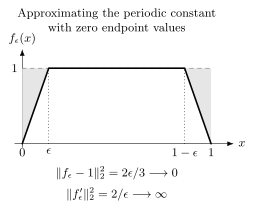
For , take a piecewise linear with slopes and in the endpoint layers and value one between them. It belongs to and approaches the constant in , but its derivative grows in norm. Smoothing the corners does not remove the boundary obstruction: endpoint evaluation is continuous in the graph norm.
Invariant domains and form cores
Section titled “Invariant domains and form cores”An invariant domain for satisfies . Invariance makes repeated products on meaningful. It does not by itself say that is a core, and a core need not be invariant. For several operators, each invariance and core claim must be established separately.
For a nonnegative self-adjoint , the form domain is , with norm
A form core is dense in that norm. Since this norm controls less than the operator graph norm of , a form-core result is generally weaker than an operator-core result. Variational calculations naturally use form cores; strong differential equations require operator-domain control. The distinction is developed in Quadratic Forms.
When reading a proof, check the topology attached to the word “dense.” The phrase “smooth functions are dense” is incomplete until the ambient space and norm are supplied.
Exercises
Section titled “Exercises”Show that the vectors supported in a bounded interval, without a smoothness requirement, form a core for position multiplication on .
Solution
For set . Then . The convergence follows from integrability of the weighted density. Each belongs to and has bounded support.
For the periodic momentum example, identify a core that does retain the boundary condition.
Solution
Finite sums of form a core. A periodic function has Fourier coefficients with . Fourier truncations converge in the norm, so they converge in the graph norm. Unlike compactly supported test functions, these approximants retain periodic boundary data.
References
Section titled “References”- K. Schmüdgen, Unbounded Self-adjoint Operators on Hilbert Space, Graduate Texts in Mathematics 265, Springer, 2012, doi:10.1007/978-94-007-4753-1 — operator graphs, closures, and cores.
- G. Teschl, Mathematical Methods in Quantum Mechanics: With Applications to Schrödinger Operators, 2nd ed., American Mathematical Society, 2014, author’s book page — dense test spaces and self-adjoint realizations.