

Bases and Coordinates
A basis is a linearly independent spanning set, and coordinates are the scalars used to write a vector in that basis. The vector is abstract; its coordinate column is a basis-dependent representation.
Think of describing the same arrow using two different pairs of axes. Its coefficients change, but the arrow does not. State vectors behave the same way when we switch measurement bases.
Helpful background. vector spaces for linear combinations and linear independence; linear maps for linearity and composition.
Let be a vector space over a field , such as or . A finite list
is a basis of if:
- it spans , meaning every can be written as a linear combination of the ;
- it is linearly independent, meaning no basis vector is redundant.
Together these conditions imply that every vector has a unique expansion
The numbers are the coordinates of in the basis .
The index placement convention used here is summarized in Index Notation and Summation Conventions.
Coordinates Are Not the Vector
Section titled “Coordinates Are Not the Vector”Once a basis is chosen, the coordinate column of is written
The map
is a linear isomorphism. It depends on the basis. Changing the basis changes and therefore changes the coordinate column.
The abstract vector does not change when its coordinates are rewritten.
Standard Coordinates
Section titled “Standard Coordinates”For , the standard basis is
With this basis, a vector and its coordinate column look identical. That visual convenience is also the source of a common mistake: in another basis, the same vector can have a different column.
Orthonormal Bases
Section titled “Orthonormal Bases”If has an inner product, a basis is orthonormal when
In an orthonormal basis, coordinates are obtained by inner products. The detailed finite-dimensional treatment is Orthonormal Bases.
Thus
In Dirac notation this becomes the familiar resolution of the identity,
but the coordinate idea is already present in ordinary linear algebra.
Change of Coordinates
Section titled “Change of Coordinates”Let and be two bases of the same vector space. The same vector can be written as
The columns and are different coordinate descriptions of the same vector. A change-of-coordinates matrix translates between them.
For orthonormal bases in a complex inner-product space, the overlap matrix
gives
The detailed coordinate transformation law is treated in Change of Basis. The physics-oriented passive convention is treated in Change of Basis. The invariant idea is simpler: coordinates change, the vector does not.
Worked Example
Section titled “Worked Example”In , take
These vectors form a basis. Write
Then
Solving gives and , so
In the standard basis, the coordinate column is . In the basis , the coordinate column is . Both columns describe the same vector. Notice that are orthogonal but each has squared length . Therefore is not the coefficient : it must be divided by .
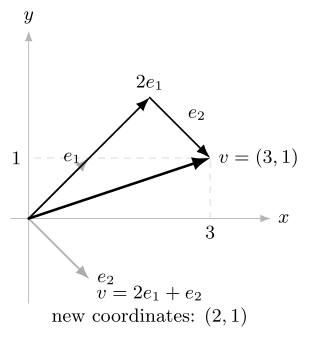
The same vector has standard coordinates and coordinates in the basis . Adding the two arrows and reconstructs it.
Why Quantum Mechanics Needs This
Section titled “Why Quantum Mechanics Needs This”Quantum mechanics constantly changes representations. A spin state can be written in the -basis or the -basis. A wavefunction can be written in position or momentum representation. An operator can be written as a matrix in an energy basis or a differential operator in position representation.
The basis is part of the representation. Probabilities and expectation values are invariant only when states, operators, and measurement projectors are translated consistently.
Common Mistakes
Section titled “Common Mistakes”- Treating a coordinate column as the vector itself.
- Calling a vector a superposition without naming the basis.
- Forgetting that a coordinate map depends on an ordered basis.
- Changing state coordinates without changing operator matrices consistently.
- Assuming formulas from the standard basis remain visually unchanged in every basis.
References
Section titled “References”- S. Axler, Linear Algebra Done Right, 3rd ed., Springer, 2015.
- P. R. Halmos, Finite-Dimensional Vector Spaces, 2nd ed., Springer, 1974.
- R. Shankar, Principles of Quantum Mechanics, 2nd ed., Springer, 1994.
- G. Strang, Linear Algebra and Its Applications, 4th ed., Brooks/Cole, 2006.
Exercises
Section titled “Exercises”- In , let and . Find the coordinates of in the basis .
Solution
Write
Then and , so and . The coordinate column is
- Why is an ordered basis needed for coordinates?
Solution
The coordinate column records coefficients in a specific order. If the basis order is swapped, the same vector has the same coefficients attached to the same basis vectors, but they appear in different positions in the column.
- In an orthonormal basis , what is the coordinate of along ?
Solution
The coordinate is
This formula uses orthonormality.