

Quantum Eraser
A quantum eraser reveals interference in subensembles selected by a measurement that does not distinguish the marked paths. It does not restore fringes in an earlier unconditioned detection record or send information backward in time. The essential distinction is between a physical coherent measurement of the marker and merely forgetting its value.
Path–marker entanglement
Section titled “Path–marker entanglement”Take orthogonal paths and normalized marker states . After marking,
At a screen, let the path amplitudes be and . Ignoring the marker gives
Perfectly distinguishable markers have zero overlap, removing the interference term. Nobody needs to inspect the marker: the joint state already contains the distinguishing correlation. Partial distinguishability leaves partial visibility.
Erasing the distinction by a complementary measurement
Section titled “Erasing the distinction by a complementary measurement”For orthogonal marker states, measure in the basis . Each outcome occurs with probability , and the conditional screen distributions are
The plus ensemble has fringes and the minus ensemble has complementary fringes. Their weighted sum is exactly the original fringe-free distribution. A screen observer needs the marker outcome labels to sort the data. That comparison requires an ordinary communication channel.
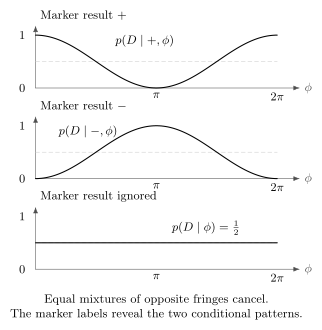
The same cancellation appears with a balanced path recombiner and a variable phase . For one output detector , . Each marker result occurs half the time, so the unsorted detection probability is for every phase.
A unitary acting only on the marker preserves ; it cannot map two orthogonal states to the same state. Thus “erase the marker” cannot mean a reversible marker-only operation that makes the unconditional paths coherent. A joint inverse interaction, or a conditional operation using a measurement result, is a different physical protocol.
Delaying the marker measurement
Section titled “Delaying the marker measurement”If the screen and marker measurements act on separate subsystems, their operators commute. Their joint probabilities are independent of which is performed first, absent additional interactions. Choosing the marker basis after a screen detection changes the correlations used to partition records, not the record itself. The review by Ma, Kofler, and Zeilinger distinguishes such protocols from the related delayed-choice interferometer.
The experiment constrains naive stories in which a particle first selects an intrinsic “wave behavior” or “particle behavior” independent of the whole measurement procedure. Its predictions do not require retrocausal influence. A retrocausal interpretation, if proposed, must reproduce these same operational constraints; see Retrocausality.
Exercise
Section titled “Exercise”Assume equal path intensities at a screen point, , and . Calculate the joint densities and and their sum.
Solution
The conditional values are and . Multiplying by gives and . Their sum is , equal to the unconditioned density there. At a point with relative path phase , the roles reverse.
References
Section titled “References”- Ma, X.-S., Kofler, J., and Zeilinger, A., “Delayed-choice gedanken experiments and their realizations,” Reviews of Modern Physics 88, 015005 (2016), doi:10.1103/RevModPhys.88.015005 — experimental protocols and their interpretation.
- Scully, M. O., and Drühl, K., “Quantum eraser: A proposed photon correlation experiment concerning observation and ‘delayed choice’ in quantum mechanics,” Physical Review A 25, 2208–2213 (1982), doi:10.1103/PhysRevA.25.2208 — original proposal.