

Quantum Darwinism
Quantum Darwinism studies how information about selected system observables is copied into many environmental fragments. Its proposed account of objectivity is operational: different observers can learn the same stable record by examining different fragments. This adds a record-distribution question to ordinary decoherence, without by itself selecting one global outcome.
Required background. Density operators: Distinguish a density operator, its coherences, and its outcome probabilities.
Redundancy is more than decoherence
Section titled “Redundancy is more than decoherence”The open-systems treatment develops the information framework. Decoherence can occur when information is stored in a hard-to-access collective degree of freedom. Redundancy requires many separately accessible fragments carrying useful information about the same selected variable.
For a system and fragment , quantum mutual information is
A plateau near over many fragment sizes suggests that a small part of the environment contains much of the system’s classical record information. Mutual information includes quantum correlations, however, so a plateau alone is not a universally sufficient test of independently accessible objectivity.
A perfect copying example
Section titled “A perfect copying example”Consider
with and . Any nonempty proper fragment of the environment, after tracing the remaining environment, is perfectly classically correlated with the system’s label. Its mutual information with is the binary entropy , measured in bits.
Each observer can measure one environment qubit in the basis and obtain the same record label. Accessing the entire environment instead gives mutual information because the global state is pure. This distinction prevents confusing the classical plateau with the full quantum correlation.
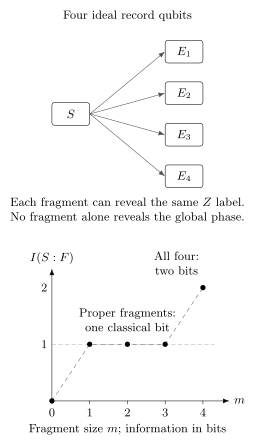
For the ideal copying state with and , every nonempty proper fragment carries the same classical bit. The full environment has two bits of quantum mutual information with the system. This is not two independently readable copies of an arbitrary system state. The arrows represent correlations with the selected record label; dashed plot segments only connect the integer fragment sizes.
What can be copied
Section titled “What can be copied”The process copies information about orthogonal pointer alternatives, not an arbitrary unknown pure state. It therefore does not violate no-cloning or no-broadcasting. A superposition becomes entangled with records rather than producing independent copies of its complete quantum state.
In realistic models the records are noisy, partially overlapping, and sometimes correlated among fragments. Defining a redundancy count requires an information deficit tolerance, a fragment-selection prescription, and a criterion for what observers can actually extract.
Stronger conditions for objectivity
Section titled “Stronger conditions for objectivity”Spectrum-broadcast descriptions use distinguishable conditional fragment states that carry the same classical label. Such conditions make nondisturbing local readout more explicit than total mutual information alone. Relations among different objectivity criteria depend on their precise assumptions about independence and accessible information.
The important lesson is methodological: verify the structure of records, not only a plotted plateau. This page does not equate all definitions of quantum Darwinism or claim that every environment generically produces redundancy.
Interpretation and limits
Section titled “Interpretation and limits”Redundant records help explain agreement and practical irreversibility. In the example, the global state still contains both terms. The mechanism is compatible with several interpretations and is not by itself a proof of Everett, collapse, or a unique solution to the measurement problem.
Exercises
Section titled “Exercises”Why can two observers read the label in different fragments without obtaining the relative phase between the two global terms?
Solution
Their reduced fragment states are diagonal in the record basis after unobserved fragments are traced out. The phase resides in joint coherence linking the full alternatives. Local record readout accesses the classical label but cannot reconstruct that global coherence.
References
Section titled “References”- T. P. Le and A. Olaya-Castro, “Objectivity (or lack thereof): Comparison between predictions of quantum Darwinism and spectrum broadcast structure,” Physical Review A 98, 032103 (2018), author manuscript.
- W. H. Zurek, “Quantum Darwinism,” Nature Physics 5, 181–188 (2009), author manuscript.