

Generalized Probabilistic Theories
A generalized probabilistic theory (GPT) describes states by the probabilities they assign to measurement events, without assuming Hilbert space in advance. It separates three questions: what single systems can do, how systems combine, and which transformations are physically possible. Classical and quantum theories occupy particular places in this larger framework.
Helpful background. Operational theories explains equivalence of procedures and classical randomization.
Convex state spaces and effects
Section titled “Convex state spaces and effects”For a finite-dimensional system, let be a real vector space, a cone of unnormalized states, and a normalization functional. Normalized states form
An effect is linear on and satisfies on . A measurement is a finite collection with . Extreme points of are pure states: they cannot be decomposed into a nontrivial convex mixture of other states.
The full mathematical dual interval need not be physically available. Assuming that every such effect is allowed is the no-restriction hypothesis, an extra choice rather than a consequence of convexity.
A classical -level system has a simplex of probability vectors. Each state has a unique decomposition into its deterministic vertices. A qubit has the Bloch ball,
whose center admits infinitely many decompositions into opposite pure states. Nonunique decompositions distinguish this geometry from a simplex, but do not uniquely characterize quantum theory.
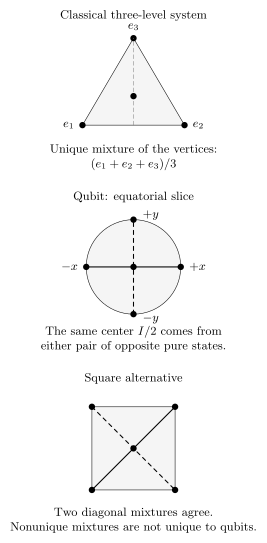
A mixture is a weighted average of points. The classical triangle’s center fixes all three vertex weights to . Both the qubit center and the square’s center admit different equal-weight pairs of pure states. The qubit picture is an equatorial slice of the three-dimensional Bloch ball; the square is an alternative state space, not another picture of a qubit.
Composites require another rule
Section titled “Composites require another rule”Product preparations and product effects must reproduce
Convex mixtures of product states define the minimal state tensor cone. A maximal cone consists of bilinear objects positive on every product of positive local effects, with appropriate normalization. Quantum composite states lie between these extremes. This comparison presumes a locally tomographic vector-space description; theories without that property need additional composite degrees of freedom.
A useful alternative is a binary-input, binary-output no-signaling box. The Popescu–Rohrlich box assigns probability to outcomes satisfying and zero otherwise. Each marginal is uniform, yet the corresponding CHSH value is . Quantum theory instead allows at most . Thus no-signaling alone does not select quantum correlations.
A box is a correlation specification, not automatically a realizable laboratory device or a full GPT with arbitrary coherent dynamics.
What comparison can establish
Section titled “What comparison can establish”GPTs turn claims such as “this feature is uniquely quantum” into questions about counterexamples. No-cloning, uncertainty, and nonunique decompositions can occur in nonquantum models. A reconstruction must identify a sufficient collection of assumptions, including composition and dynamics, rather than select a familiar feature and declare it decisive.
Barrett supplies concrete comparison theories. Purification and local tomography illustrate stronger structural demands.
Exercises
Section titled “Exercises”A square state space has four pure vertices . Show that its center has distinct pure-state decompositions.
Solution
It is both the equal mixture of and and the equal mixture of and . This proves nonsimpliciality. It does not make the square a qubit: the qubit’s pure states form a sphere and its reversible transformations have different geometry.