

Kochen–Specker Contextuality Experiments
Kochen–Specker contextuality experiments test whether measurement outcomes can be explained by pre-existing values that are independent of the compatible measurement context in which an observable is measured. They are experimentally testable cousins of the Kochen–Specker theorem.
The theorem itself is a mathematical no-go result about noncontextual value assignments in Hilbert spaces of dimension at least three. Experiments cannot directly test an infinite-precision value assignment to all projectors. Instead, they test finite sets of compatible measurements and inequalities obeyed by noncontextual hidden-variable models.
For the theorem statement, see Kochen–Specker Theorem. This page focuses on the experimental logic.
Contextuality Idea
Section titled “Contextuality Idea”A measurement context is a set of compatible measurements that can be performed together. In projective quantum mechanics, a context may be a complete orthogonal resolution of the identity. The same projector or observable can appear in more than one context.
In the deterministic Kochen–Specker model, noncontextuality says that the value assigned to a measurement should not depend on which compatible measurements are performed alongside it. If observable can be measured with or with , then a noncontextual hidden-variable model assigns one value to , not one value for the -with- apparatus and another value for the -with- apparatus.
This is not the same as saying measurement devices never disturb systems. Contextuality is a constraint on hidden-variable explanations of measurement statistics. Experiments must therefore distinguish ordinary disturbance, imperfect compatibility, and genuine failure of noncontextual models.
Kochen–Specker Theorem as Background
Section titled “Kochen–Specker Theorem as Background”The Kochen–Specker theorem shows that in dimension at least three, one cannot assign definite values to all projectors while preserving the functional relations among compatible projectors. In a projector formulation, a complete orthogonal context
would require values with exactly one yes outcome:
The contradiction comes from overlapping contexts. A single projector may appear in several contexts, and noncontextuality requires its value to remain fixed. For certain finite arrangements of projectors, no global assignment satisfies all context constraints.
Experiments usually use inequalities rather than exact logical contradictions. Inequalities tolerate noise and finite statistics while still separating quantum predictions from noncontextual hidden-variable bounds.
Contextuality Inequalities
Section titled “Contextuality Inequalities”A useful example is the KCBS inequality for a qutrit. Consider five rank-one yes-no projectors on a three-dimensional Hilbert space, with and cyclic indexing . Adjacent tests are exclusive and compatible. A deterministic noncontextual model can assign value to at most two of the five tests, so
Quantum mechanics reaches for suitable qutrit states and projectors. One realization uses a real unit vector for each projector :
Adjacent vectors have zero inner product. For , every yes probability is , giving the sum . These are probabilities from different compatible pairs, not five outcomes jointly measured in one context.
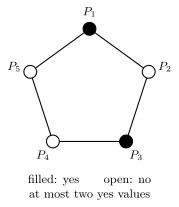
An edge means two yes outcomes are mutually exclusive. A context-independent assignment can mark at most two vertices yes. Mixtures of such assignments retain the bound .
The violation is not a Bell nonlocality violation: it can be tested on a single system with compatible sequential or jointly implemented measurements.
State-independent contextuality tests use a different strategy. They build a finite set of measurements for which every quantum state in the relevant Hilbert space violates a noncontextuality inequality or satisfies a parity contradiction. Mermin–Peres square experiments with two qubits are a common route.
Experimental Implementations
Section titled “Experimental Implementations”Contextuality experiments have used several platforms:
- single photons with path and polarization degrees of freedom;
- trapped ions implementing qutrits or two-qubit observables;
- neutron interferometry, where path and spin serve as degrees of freedom;
- photonic qutrits testing KCBS-type inequalities;
- atomic and solid-state systems used for sharper compatibility and detection control.
The details differ, but the experimental pattern is similar:
- Define a finite set of measurements and contexts.
- Calibrate which measurements are compatible or jointly measurable.
- Estimate the relevant single-observable and joint-context statistics.
- Compute a contextuality inequality.
- Compare the result with the noncontextual bound.
The hard part is not only collecting statistics. It is justifying that the same measurement is implemented across different contexts and that imperfections do not mimic contextuality.
Compatibility and Sharpness Loopholes
Section titled “Compatibility and Sharpness Loopholes”Contextuality tests have loopholes analogous in spirit to Bell-test loopholes, but the details differ.
The compatibility loophole appears if measurements claimed to be compatible actually disturb each other in a context-dependent way. Then a noncontextual model may fail for a mundane reason: the experiment did not implement the intended compatible measurements.
The sharpness loophole appears when a test is meant to concern ideal projective measurements, but the implemented measurements are unsharp, noisy, or context-dependent. For noisy measurements, noncontextuality is formulated through operational equivalence: procedures with the same observable statistics must have the same representation in the model. It need not assign every unsharp measurement a deterministic value. Spekkens (2005) develops this broader formulation, so the ideal projective bound cannot simply be carried over without checking its assumptions.
The detection loophole can also appear if only a biased subset of trials is retained. Modern experiments therefore pay attention to detection efficiency, sequential-measurement disturbance, operational equivalence, and statistical analysis.
Relation to Bell Experiments
Section titled “Relation to Bell Experiments”Bell scenarios can be treated as contextuality scenarios in which spatial separation motivates independence from the distant compatible measurement. The assumptions of the Bell and Kochen–Specker theorems are nevertheless different. The Kochen–Specker theorem tests context-independent value assignments to sharp observables without requiring spatially separated parties.
The distinction matters:
- Bell tests use separated systems and locality constraints.
- Kochen–Specker tests can use a single system of dimension at least three.
- Bell violation rules out local hidden-variable models under Bell assumptions.
- Contextuality experiments rule out noncontextual hidden-variable models under contextuality-test assumptions.
Neither result says that every hidden-variable theory is impossible. A contextual hidden-variable theory may assign outcomes in a way that depends on the full measurement arrangement.
Relation to Quantum Information
Section titled “Relation to Quantum Information”Contextuality is not only a foundations topic. It has become a resource concept in quantum information. In several models, contextuality is linked to computational advantage, magic-state quantum computation, and restrictions on classically simulable subtheories.
The resource statement must be made model by model. Contextuality is not a single scalar that automatically measures all quantum advantage. But the connection is important: contextuality experiments probe the same structural feature that helps separate quantum information processing from noncontextual classical descriptions.
This is one reason modern contextuality research uses operational language. Instead of asking only whether hidden variables exist, it asks which observed input-output statistics can be explained by noncontextual ontological models.
An experimental excess above a noncontextual bound must remain significant after accounting for imperfect compatibility, equivalences, detection, and finite statistics. A raw excess caused by context-dependent disturbance would not test the model stated above. Contextual hidden-variable theories remain outside the class excluded by these tests.
Exercises
Section titled “Exercises”- In the deterministic projective model used for the Kochen–Specker theorem, what does noncontextuality require?
Solution
The assigned outcome value must be independent of which compatible measurements are performed alongside it. The broader operational definition also covers probabilistic responses and unsharp measurements; it does not assume that every measurement has a predetermined outcome.
- In the KCBS projector picture, why can a deterministic noncontextual model assign value to at most two of five cyclic yes-no tests?
Solution
Adjacent tests are exclusive, so two adjacent projectors cannot both be assigned value . On a five-cycle, the largest set of vertices with no adjacent pair has size . Therefore at most two of the five tests can be assigned value , giving the noncontextual bound .
- Why is contextuality not just ordinary measurement disturbance?
Solution
Ordinary disturbance means that performing one measurement physically changes the system before another measurement. Contextuality concerns whether a hidden-variable explanation can assign the same value to a measurement across all compatible contexts. Experiments must control disturbance, but the conceptual target is context-independent value assignment.
- Give one difference between a Bell test and a Kochen–Specker contextuality test.
Solution
A Bell test uses separated parties and locality assumptions to rule out local hidden-variable models. A Kochen–Specker contextuality test can use a single system of dimension at least three and targets noncontextual value assignments across compatible measurement contexts.
References
Section titled “References”- H. Bartosik et al., “Experimental Test of Quantum Contextuality in Neutron Interferometry,” Physical Review Letters 103, 040403, 2009, DOI: 10.1103/PhysRevLett.103.040403.
- A. Cabello, “Experimentally Testable State-Independent Quantum Contextuality,” Physical Review Letters 101, 210401, 2008, DOI: 10.1103/PhysRevLett.101.210401.
- M. Howard, J. Wallman, V. Veitch, and J. Emerson, “Contextuality supplies the magic for quantum computation,” Nature 510, 351-355, 2014, DOI: 10.1038/nature13460.
- G. Kirchmair et al., “State-independent experimental test of quantum contextuality,” Nature 460, 494-497, 2009, DOI: 10.1038/nature08172.
- A. A. Klyachko, M. A. Can, S. Binicioglu, and A. S. Shumovsky, “Simple Test for Hidden Variables in Spin-1 Systems,” Physical Review Letters 101, 020403, 2008, DOI: 10.1103/PhysRevLett.101.020403.
- S. Kochen and E. P. Specker, “The problem of hidden variables in quantum mechanics,” Journal of Mathematics and Mechanics 17, 59-87, 1967.
- R. Lapkiewicz et al., “Experimental non-classicality of an indivisible quantum system,” Nature 474, 490-493, 2011, DOI: 10.1038/nature10119.
- N. D. Mermin, “Hidden variables and the two theorems of John Bell,” Reviews of Modern Physics 65, 803-815, 1993, DOI: 10.1103/RevModPhys.65.803.
- M. Michler, H. Weinfurter, and M. Zukowski, “Experiments towards Falsification of Noncontextual Hidden Variable Theories,” Physical Review Letters 84, 5457-5461, 2000, DOI: 10.1103/PhysRevLett.84.5457.
- A. Peres, Quantum Theory: Concepts and Methods, Kluwer, 1995.
- R. W. Spekkens, “Contextuality for preparations, transformations, and unsharp measurements,” Physical Review A 71, 052108, 2005, DOI: 10.1103/PhysRevA.71.052108.
- P. Wang et al., “Significant-loophole-free test of Kochen-Specker contextuality using two species of atomic ions,” Science Advances 8, eabk1660, 2022, DOI: 10.1126/sciadv.abk1660.