

Exterior Complex Scaling
Exterior complex scaling (ECS) leaves the interaction region on the real coordinate axis and rotates the exterior into the complex plane. Outgoing waves can then decay along the contour, allowing resonance states to appear as discrete eigenvectors. The transformed differential operator and interface conditions must be derived from the coordinate map; substituting a complex grid into an unchanged real-grid stencil is insufficient.
Required background. Coordinate transformations supplies derivative rules, and complex resonance energies defines the pole convention.
The exterior contour and kinetic operator
Section titled “The exterior contour and kinetic operator”For a radial coordinate, choose outside the difficult interaction region and define
For the unrescaled pulled-back function and Jacobian ,
In the uniform exterior segment this multiplies the kinetic energy by . A smooth contour has nonconstant and therefore additional derivative structure.
At a sharp interface, continuity of and its physical derivative becomes continuity of and . If a square-root-Jacobian rescaling is used instead, the interface conditions change accordingly. State which representation the basis implements.
Why outgoing waves become square integrable
Section titled “Why outgoing waves become square integrable”A free outgoing wave becomes
For real , its magnitude decays as . An incoming wave grows along the same contour, so the contour selects the outgoing branch.
For a resonance momentum with , damping requires . Equivalently, the rotation must expose the pole below the real energy axis. Merely choosing a nonzero angle may be inadequate for a broad resonance.
Continuum rotation and eigenvalue tracking
Section titled “Continuum rotation and eigenvalue tracking”In the ideal dilation-analytic setting, the free continuum ray rotates by in the energy plane while an exposed resonance pole is independent of angle. ECS extends the usable setting by keeping the inner region unrotated, but analytic continuation of the exterior potential and the relevant operator domain still matter.
A finite discretization turns the rotated continuum into discrete strings of eigenvalues. Vary , the exterior length, , and basis resolution. Physical candidates should stabilize under these changes, while continuum approximants generally track the rotation or box length.
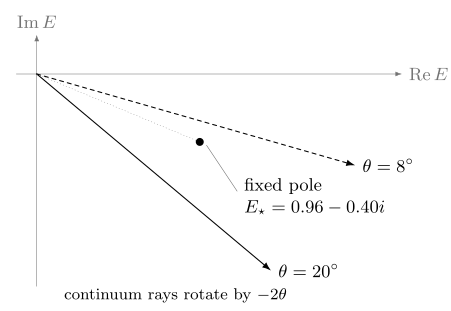
For and units , the resonance energy is . An rotation leaves the pole below the continuum ray and the outgoing wave still grows. At , the ray has rotated past the pole, so the outgoing wave decays along the contour. Rotation exposes the pole; it does not change its physical width.
For a free exterior segment of complex length, discrete kinetic eigenvalues scale with the inverse squared complex length. This gives a direct continuum-rotation test and prevents misidentifying every lower-half-plane eigenvalue as a resonance.
Implementation boundaries
Section titled “Implementation boundaries”Use an interface-aware finite element, spectral element, or correctly transformed finite-difference scheme. Preserve the contour Jacobian in integration measures and matrix elements. Non-Hermitian matrices may be complex symmetric under particular bilinear forms but are not ordinarily Hermitian under the usual conjugate inner product.
Long-range potentials need a valid exterior continuation. Nonanalytic tabulated potentials cannot be evaluated at complex arguments without specifying an interpolation or analytic model that justifies that continuation. Time-dependent gauges and absorptive observables can introduce further restrictions.
Compare a candidate pole with a real-axis scattering feature or an independently converged CAP trajectory. Agreement between independently refined outgoing formulations is more informative than an angle plateau on one mesh.
Exercises
Section titled “Exercises”For in inverse-length units, what minimum rotation angle makes the outgoing wave decay?
Solution
The condition is , so radians, or . At the limiting angle the wave has no exponential damping; a finite computational contour needs an angle and length that provide adequate attenuation beyond that threshold.
References
Section titled “References”- Moiseyev, Nimrod, “Quantum theory of resonances: calculating energies, widths and cross-sections by complex scaling,” Physics Reports 302, 212–293 (1998), doi:10.1016/S0370-1573(98)00002-7 — non-Hermitian resonance calculations.
- Simon, Barry, “The definition of molecular resonance curves by the method of exterior complex scaling,” Physics Letters A 71, 211–214 (1979), doi:10.1016/0375-9601(79)90165-8 — the exterior-scaling construction.