

Classical Correlation versus Entanglement
Classical correlation and entanglement can give identical statistics for one chosen measurement. They are nevertheless different properties of a quantum state. Entanglement means that no mixture of product states describes the joint density operator across the chosen subsystem split. Off-diagonal coherence in one basis, by itself, is not an entanglement criterion.
The standard comparison is between the classically correlated separable state
and the Bell state
Both predict perfectly matching outcomes when both qubits are measured in the computational basis. Only the Bell state is entangled.
Helpful background. Separable mixed states explains mixtures of products; Bell states introduces the two-qubit state compared here.
Identical correlations in one basis
Section titled “Identical correlations in one basis”For the separable state , computational-basis measurement gives
Squaring the two Bell-state amplitudes gives exactly the same probabilities.
Therefore perfect correlation in one basis is not enough to identify entanglement. It may be caused by a shared classical random variable.
The reduced states also agree: both have . This is why the distinction cannot be resolved by one-subsystem measurements alone; it requires joint statistics or a state-level entanglement criterion.
In , the preparation can be described as:
That is a separable preparation. There is correlation, but no entanglement.
Coherence Terms
Section titled “Coherence Terms”The Bell-state density operator is
Expanding,
The separable state is only the diagonal part:
The off-diagonal terms
are coherence terms between the two product alternatives. They are the terms that let the Bell state show correlations in complementary measurement bases.
One way to say this compactly is:
where denotes dephasing in the computational product basis. Dephasing removes the coherence and leaves only the classical record of which matched outcome occurred.
Different Behavior Under Basis Changes
Section titled “Different Behavior Under Basis Changes”Let
The Bell state can be rewritten as
Thus if both qubits are measured in the basis, the Bell state again gives perfect agreement:
The classically correlated state does not. For either product state or , measuring both qubits in the basis gives four equally likely outcomes. Hence
for .
Equivalently,
but
The two states therefore respond differently to the new measurement basis. This is not a claim that the classical mixture has no off-diagonal entries in every basis: coherence is basis dependent, whereas entanglement is invariant under local basis changes.
Two correlations give an entanglement test
Section titled “Two correlations give an entanglement test”Knowing that two candidate states differ is weaker than excluding every separable state. For two qubits there is a useful bound:
For a product state, let the local Bloch components be and . Cauchy–Schwarz gives
A convex mixture obeys the same bound by the triangle inequality. The Bell state gives , while gives . Thus sufficiently strong correlations in these two complementary settings certify entanglement without reconstructing the entire density matrix. Values at or below are inconclusive.
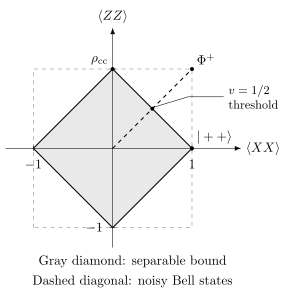
The axes abbreviate and . Every separable state lies in the gray diamond; points outside certify entanglement, while points inside are inconclusive. Along , the correlations are and this test detects entanglement only for .
This test assumes that the measured observables are the calibrated qubit Pauli operators. A Bell test makes a different claim under a different set of assumptions.
A fidelity witness
Section titled “A fidelity witness”An entanglement witness is an observable whose expectation value is nonnegative on all separable states but negative on at least one entangled state.
For detecting , a standard witness is
For normalized product factors, Cauchy–Schwarz gives . Therefore
By convexity, the same nonnegative bound holds for separable mixed states. For the Bell state,
For the classically correlated state,
The threshold is fidelity . An expectation of zero or greater does not establish separability. See entanglement witnesses for how the observable is chosen.
Comparison with Bell inequalities
Section titled “Comparison with Bell inequalities”Bell-inequality violations are another way to distinguish some entangled states from classical explanations of correlations. The singlet state and the Bell state can violate a CHSH inequality with suitable measurement settings.
The state cannot do so. It can be modeled by a shared classical bit that tells both parties whether the preparation was or in the computational basis.
The logical relations are subtle:
but the converse is not true for every mixed state and every measurement scenario. Some entangled mixed states even admit local hidden-variable models for all projective measurements. Bell violation is therefore a stronger requirement than entanglement in that measurement scenario; it is not the definition. The Bell theorem states the locality and measurement assumptions.
Common pitfalls
Section titled “Common pitfalls”An correlation alone is not enough. The product state has . The separable bound above combines information from incompatible local observables.
Local mixedness is inconclusive for a mixed joint state. The Bell state, the correlated mixture, and all have marginals .
Separable is broader than fully classical. A separable preparation may use nonorthogonal local states and have nonzero quantum discord. The nonorthogonal preparation example illustrates why absence of entanglement does not remove every quantum feature.
References
Section titled “References”- Ryszard Horodecki, Paweł Horodecki, Michał Horodecki, and Karol Horodecki, “Quantum entanglement,” Reviews of Modern Physics 81, 865–942 (2009). DOI.
- Michael A. Nielsen and Isaac L. Chuang, Quantum Computation and Quantum Information, 10th anniversary ed., Cambridge University Press, 2010, section 2.5.
- Reinhard F. Werner, “Quantum states with Einstein–Podolsky–Rosen correlations admitting a hidden-variable model,” Physical Review A 40, 4277–4281 (1989). DOI.
Exercises
Section titled “Exercises”- Compute and in the product state . Does it saturate the separable bound?
Solution
The local expectations are and , so the joint expectations are and . Their absolute values sum to , exactly the separable bound. Strong correlation in the setting alone does not certify entanglement.
- Consider partial dephasing with a possible phase shift,
Check positivity and compute the , , and correlations. When can the fixed test miss entanglement? Show how replacing Bob’s axis by detects every entangled member of this family.
Solution
The nonzero block has eigenvalues and , both nonnegative. Directly taking the Pauli traces gives
The fixed test violates its separable bound when , but misses a purely imaginary nonzero coherence. Rotating Bob’s calibrated measurement axis recovers it:
Because and are perpendicular Bloch axes, the same Cauchy–Schwarz argument gives for every separable state. For , choose ; the score is . At , the state is explicitly the separable mixture .
Thus every nonzero coherence in this particular family implies entanglement, even when its phase hides it from the original settings. This does not make an arbitrary off-diagonal entry an entanglement criterion, nor does failure of a fixed witness establish separability.
- Show that for any two-qubit density matrix in the ordered computational basis,
Solution
exchanges and . Taking the trace selects the four corresponding entries of . Hermiticity pairs each entry with its complex conjugate, giving the stated real parts. This also shows why is not a measurement of just one coherence for an arbitrary state.
- Let , with . Compare the noise thresholds of the two-correlation bound and the fidelity witness.
Solution
Both and expectations equal , so their sum exceeds when . The Bell fidelity is , hence
The fidelity witness detects more of this noisy family. The weaker test misses entanglement for , illustrating that a failed witness test is inconclusive.